


Last updated: November 13, 2026
Reviewed by a certified public accountant (CPA) on November 13, 2026.
A Trump account employer contribution lets a company put up to $2,500 a year into the Trump accounts of an employee or the employee’s children, and the employee owes no income tax on it. That’s the headline. The fine print is that the money is still wages for Social Security, Medicare and FUTA, the rules are only proposed, and the AICPA has told the IRS that most employers can’t run these programs well in 2026.
Short answer: Under Section 128, an employer can contribute up to $2,500 per employee each year to Trump accounts for the employee or their dependents. The amount is excluded from income tax but not from FICA or FUTA. You need a separate written plan, employee notices, nondiscrimination testing and W-2 reporting with code TA. The rules are proposed, and you can rely on them now.
Key takeaways
- The $2,500 limit applies per employee, not per child, and across all of an employee’s employers; it’s $2,500 for 2026 and 2027, with inflation adjustments after 2027.
- Section 128 contributions skip income tax and withholding, but the proposed regulations keep them subject to FICA, RRTA and FUTA.
- Trump account employer contributions count toward the $5,000 annual account limit, and none could be made before July 4, 2026.
- Matching the government’s $1,000 pilot deposit gets a nondiscrimination safe harbor; other designs must pass eligibility and average benefits tests.
- In an October 16, 2026 letter, the AICPA asked Treasury to let 2026 contributions be made through 2027 and to give transition relief.
Table of Contents
Trump account employer contribution rules at a glance
Every rule below comes from the Treasury and IRS proposed regulations (REG-101355-26), Notice 2025-68 and the Department of Labor, checked November 13, 2026.
| Rule | What it says | Source |
|---|---|---|
| Annual limit | $2,500 per employee for 2026 and 2027, adjusted for inflation after 2027 | IRC 128(b); proposed regs |
| Who the limit covers | The employee, not each child; one $2,500 cap across all employers | Notice 2025-68, Q&A I-1 |
| Income tax | Excluded from gross income; no federal income tax withholding | IRC 128; proposed regs |
| Payroll taxes | Still wages for FICA, RRTA and FUTA | Proposed regs, Part III.A.6 |
| Account limit | Counts toward the $5,000 annual Section 530A limit | Notice 2025-68 |
| Start date | No contributions before July 4, 2026 | IRC 530A; Notice 2025-68 |
| Plan document | A stand-alone written plan that benefits employees only | Proposed 1.128-2 |
| Reporting | Annual statement to each employee; W-2 box 12, code TA works | Proposed 1.128-2(g) |
| ERISA | Contributions to dependents’ accounts don’t create an ERISA plan | DOL Technical Release 2026-02 |
The status matters. These are proposed regulations, not final ones. The preamble says they’d apply to plan years beginning on or after final publication, and that employers may rely on them for earlier plan years.
What a Trump account is, in one paragraph
A Trump account is a type of IRA for a child under 18, created by the One Big Beautiful Bill Act under Internal Revenue Code Section 530A. Until January 1 of the year the child turns 18, the money can’t come out, and it can only sit in low-cost funds that track an index of mostly U.S. companies, with annual fees capped at 0.1%, according to Notice 2025-68. Children born from 2025 through 2028 can also get a one-time $1,000 deposit from Treasury under Section 6434. Think of it as a kid’s account that turns into a traditional IRA at 18.
Accounts launched on July 4, 2026. By late July, the Treasury Department said more than 6.5 million families had signed up, as reported by HR Brew.
How the $2,500 Trump account employer contribution limit works
The limit follows the worker, not the family. The IRS wrote in Notice 2025-68 that total employer contributions for an employee’s dependents can’t exceed $2,500 in a year, and the proposed regulations repeat that the cap applies to the employee rather than child by child.
- Several children, one cap. An employee with two kids can split $2,500 between them, for example $1,250 each, but can’t get $2,500 per child.
- Two jobs, one cap. An employee who works for two employers can exclude only $2,500 in total from all of them.
- Over the limit becomes taxable. Anything above $2,500 isn’t excludable and is treated as wages, so the written plan has to stop payments above the cap.
- The account limit still applies. Employer dollars count toward the $5,000 annual limit on the child’s account, together with what parents and relatives put in.
Who can receive a Trump account employer contribution is narrower than many owners expect. Partners, sole proprietors, directors serving only as directors and 2% S corporation shareholders aren’t treated as employees for this benefit. A business owner can run a program for staff but can’t use it for their own children. Our LLC vs. S corp guide explains why that 2% shareholder line shows up again here.
Tax treatment: income-tax free, not payroll-tax free
This is the part most announcements skip. Section 128 removes the contribution from the employee’s taxable income, and there’s no federal income tax withholding on it. But the proposed regulations point out that the Code has no matching exclusion from wages for FICA purposes, so the contribution stays subject to Social Security and Medicare tax, railroad retirement tax and FUTA unless some other exclusion applies.
Here’s what that means for a $2,500 Trump account employer contribution to an employee who is below the Social Security wage base and in the 22% federal bracket. The 22% bracket is an example; state income tax is left out.
| Item | $2,500 Trump account employer contribution | $2,500 cash bonus |
|---|---|---|
| Federal income tax on the employee (22% example) | $0 | $550.00 |
| Employee Social Security and Medicare (7.65%) | $191.25 | $191.25 |
| Employer Social Security and Medicare (7.65%) | $191.25 | $191.25 |
| What the employee keeps or saves | $2,500 in the child’s account | $1,758.75 in cash |
Two details change the math. FUTA usually adds nothing extra, because it only applies to the first $7,000 of an employee’s wages each year. And the comparison to a 401(k) match isn’t flattering: an employer contribution to a qualified retirement trust is generally excluded from FICA wages under 26 U.S.C. 3121(a)(5), so it costs the company less in payroll tax than the same dollars sent to a Trump account. If you’re choosing where the next dollar of benefits goes, check your 2027 retirement numbers first in our 401(k) contribution limits 2027 guide.
Because a Trump account employer contribution counts as FICA wages, it flows through your quarterly Form 941 like any other taxable pay.
What your Trump account contribution program must include
Under proposed section 1.128-2, the program has to be a separate written plan, and the employer has to follow its terms. The plan must spell out:
- Which classes of employees are eligible.
- The contribution rules, including amounts and whether salary reduction is allowed.
- How an employee designates the Trump account that receives the money.
- The certification, notice and reporting procedures.
- The plan year.
- How the employer will correct failures and notify employees and trustees.
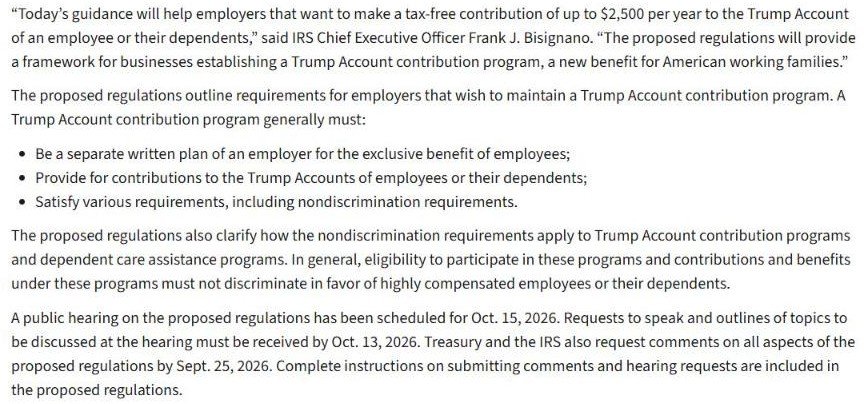
The paperwork doesn’t stop at the plan document:
- Notice. Eligible employees must get reasonable notice of the program and its terms. The rules don’t prescribe a form.
- Annual statement. Each employee gets a statement of the prior year’s Section 128 contributions; reporting them on Form W-2 in box 12 with code TA satisfies this.
- Trustee notice. When you send money, you tell the trustee it’s a Section 128 contribution. If you later find it wasn’t, you send a corrective notice; 21 calendar days is the safe harbor.
- Account verification. You can rely on an employee’s certification for some facts, but not as the only check that the account is a valid Trump account.
- No favorite trustees. The plan can’t limit contributions to accounts held by particular trustees.
That last rule is the one payroll teams worry about. If employees open accounts with many different trustees, the employer has to be able to send money to all of them.
Nondiscrimination tests, in plain English
A Trump account contribution program can’t favor highly compensated employees (HCEs). The proposed regulations in section 1.128-3 use three tests:
| Test | What passes | Common trap |
|---|---|---|
| Contributions and benefits | The same terms are offered to every eligible employee, even if amounts differ by election | A richer formula for managers |
| Eligibility | A reasonable classification based on objective business criteria that passes a facts-and-circumstances test or the numerical safe harbor | Limiting eligibility to one office full of HCEs |
| Average benefits | Average benefits for non-HCEs are at least 55% of the HCE average, counting only employees who received something | Low take-up among hourly staff |
The numerical safe harbor starts at 90% and drops by three-quarters of a percentage point for each whole point by which non-HCEs exceed 60% of the workforce. Employees under 21 without a year of service, and certain union employees, can be left out of the eligibility and average benefits tests.
Two features make the tests less scary than they look:
- The pilot match safe harbor. A Trump account employer match of Treasury’s $1,000 deposit for children born from 2025 through 2028 is ignored for the contributions and average benefits tests, as long as every non-excluded employee gets the same offer. It still counts for eligibility.
- Failures hit HCEs only. If the program fails, it generally loses tax-free status only for HCEs. If the average benefits test fails, you can keep the program qualified by adding the excess to the affected HCEs’ income by the W-2 deadline.
Salary reduction through a cafeteria plan
A Trump account contribution program can also let employees fund a child’s account with pre-tax pay through a Section 125 cafeteria plan, inside the same $2,500 cap. The rules are specific:
- Salary reduction can go only to a dependent’s Trump account. Money into the employee’s own account would be deferred compensation, which a cafeteria plan can’t offer.
- Elections are prospective, and the plan must let employees change or revoke them at least monthly.
- The cafeteria plan document must describe the Trump account benefit specifically, and Treasury plans to amend the election-change rules in section 1.125-4 to fit.
Is a Trump account program an ERISA plan?
Mostly no, which is one area where Trump accounts for employers are lighter than retirement plans. The Department of Labor’s Technical Release 2026-02, issued June 17, 2026, says employer involvement in accounts for an employee’s dependents doesn’t create an ERISA pension plan. For an employee’s own account, the Trump account contribution program stays outside ERISA if participation is voluntary, the employer adds no conditions beyond the tax rules, doesn’t steer investments, doesn’t present it as its own benefit plan and isn’t paid in connection with the accounts, according to a summary by the law firm Groom Law Group.
Trump accounts for employers: what companies are actually doing
Interest is split between a visible group of large companies and a much quieter majority.
| Employer | Announced approach | Source |
|---|---|---|
| Visa | Matches the government’s one-time $1,000 deposit | Treasury, Aug. 11, 2026 |
| State Street | Matches Treasury’s contribution for eligible children of active employees | Treasury, Aug. 11, 2026 |
| Franklin Templeton | Matches the government’s contribution for eligible children of U.S. employees | Treasury, Aug. 11, 2026 |
| Vanguard | From 2027, crew members can direct a $1,500 employer contribution to an eligible Trump account | Treasury, Aug. 11, 2026 |
| ADP | Payroll and HR tools to process contributions and reporting | Treasury, Aug. 11, 2026 |
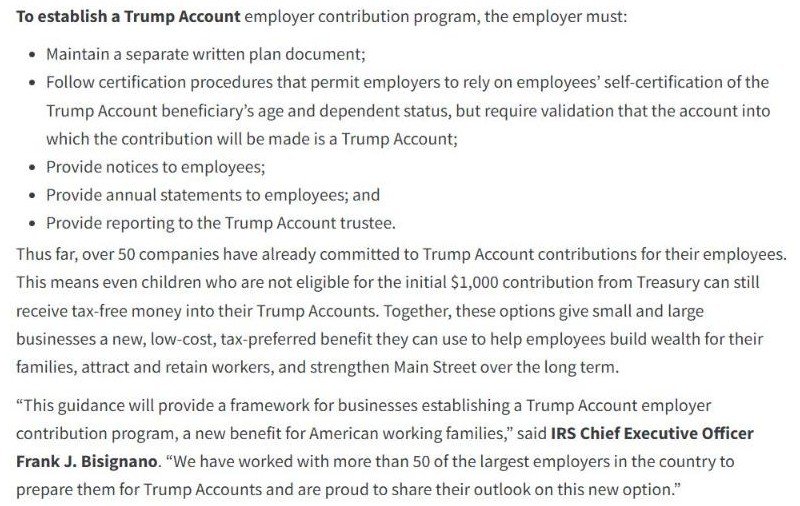
Treasury said more than 50 companies had committed. The broader market is slower: in a Mercer survey of employers as of April, two-thirds of employers said they didn’t plan to offer employer or employee contributions and 4% said they did, as reported by HR Brew.
Notice the pattern. Most named employers chose the $1,000 pilot match, which is the one design with a built-in nondiscrimination safe harbor.
Why the AICPA says 2026 is too soon
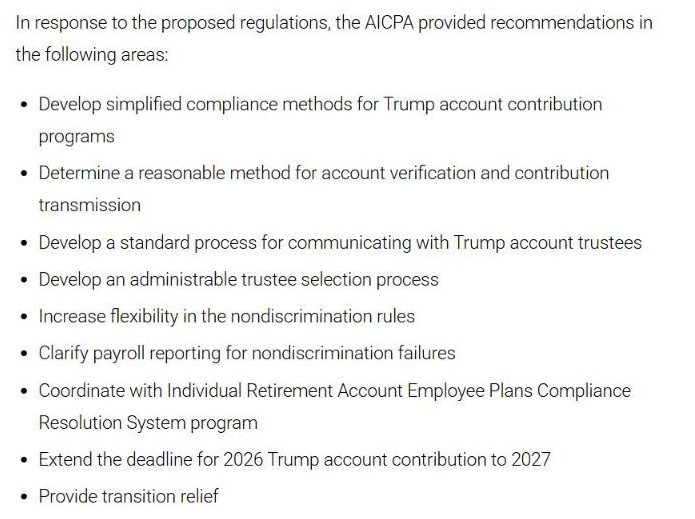
On October 16, 2026, the AICPA sent Treasury and the IRS a comment letter calling the proposed rules administratively burdensome. As summarized by the Journal of Accountancy, its main points were:
- Employers, payroll providers, trustees and benefits administrators would need heavy coordination to verify accounts, send money, report and test.
- Without a way to limit trustees, a large employer could end up dealing with 50 or more of them.
- Many employers waited for guidance and are still pricing vendors.
Its nine recommendations included simpler compliance methods, a standard process for verifying accounts and talking to trustees, more flexible nondiscrimination rules, clearer payroll reporting for test failures, coordination with the IRS correction program for IRAs, letting 2026 contributions be made through 2027, and transition relief.
We found no Treasury response to those requests, and no final regulations, as of November 13, 2026.
Should you offer a Trump account employer contribution now? A 3-question test
Use these three questions before you budget for a Trump account employer contribution. If you can’t answer yes to the first two, plan for 2027 instead of rushing in December.
- Can your payroll provider do it? You need code TA on Form W-2, trustee notices, FICA on the amounts and a way to stop at $2,500. If the vendor can’t confirm all four in writing, wait.
- Can you keep the design simple? A flat $1,000 Trump account employer match of the pilot deposit, offered on the same terms to everyone, uses the safe harbor. Tiered or manager-only designs bring the full tests into play.
- Is this the best use of the dollars? Compare the payroll tax cost with a 401(k) match, a dependent care benefit or a cash bonus, using the table above.
If the answers are yes, write the plan, update the cafeteria plan if you’ll allow salary reduction, set up the notice and pick a plan year. If not, write down what’s missing and revisit when final rules arrive.
Our Take / Expert Perspective
Our take: the real question isn’t whether Trump accounts are popular with families. They plainly are. It’s whether Trump accounts for employers, a $2,500 benefit that still carries payroll tax, can justify a new plan document, a trustee network and a nondiscrimination test for most employers. For a 40-person company in 2026, the honest answer is usually no.
The winners are large employers with payroll vendors already built for it, and parents of children born from 2025 through 2028, because a $1,000 Trump account employer match on top of Treasury’s $1,000 is a simple, visible perk. The losers are small employers that announce something in December and then discover their payroll system can’t send money to dozens of trustees.
Forecast, not fact: we expect final rules to keep the $2,500 per-employee cap and the FICA treatment, because both come from the statute, and to give more room on trustees and timing, because that’s where the AICPA, payroll providers and the IRS’s own burden estimate of about 3 million affected employers all point.
What to do now: if you want to offer the benefit, start with a $1,000 Trump account employer match of the pilot deposit only, get your payroll provider to confirm W-2 code TA support in writing, and put everything else on the calendar for the 2027 plan year.
Frequently Asked Questions
How much can an employer contribute to a Trump account?
A Trump account employer contribution can be up to $2,500 per employee per year, excluded from the employee’s income. The cap covers all of the employee’s dependents together and all of their employers, and it’s $2,500 for 2026 and 2027 before inflation adjustments begin.
Is a Trump account employer contribution taxable?
Not for federal income tax, and there’s no income tax withholding on them. Under the proposed regulations they’re still wages for Social Security, Medicare and FUTA, so both the employer and the employee pay FICA on them.
Does a Trump account employer contribution count toward the $5,000 limit?
Yes. Section 128 contributions count toward the $5,000 annual limit on the account. The $1,000 Treasury pilot deposit and qualified general contributions from charities or governments don’t.
Can employees contribute to Trump accounts pre-tax through payroll?
Yes, for a dependent’s account, through a cafeteria plan and within the $2,500 cap. Pre-tax salary reduction to the employee’s own Trump account isn’t allowed.
Can a business owner make a tax-free Trump account contribution for their own children?
Generally no. Partners, sole proprietors, directors acting only as directors and 2% S corporation shareholders aren’t employees for Section 128, so they can sponsor a program for staff but can’t benefit from it themselves.
When can employers start contributing?
Contributions couldn’t be made before July 4, 2026. You can rely on the proposed rules now, but the AICPA has asked Treasury to let 2026 contributions be made through 2027, and we found no final regulations as of November 13, 2026.
This article is for general information only and is not tax, accounting or financial advice. Consult a licensed CPA or financial professional for your situation.
Sources
- Internal Revenue Service: IR-2026-90, Treasury, IRS issue proposed regulations on employer contributions to Trump Accounts, checked November 13, 2026
- Treasury and IRS: REG-101355-26, Employer Contributions to Trump Accounts and Nondiscrimination Rules for Dependent Care Assistance Programs (Federal Register document 2026-16314), checked November 13, 2026
- Internal Revenue Service: Notice 2025-68, checked November 13, 2026
- U.S. Department of the Treasury: Treasury Announces Employer Contributions to Trump Accounts, Drawing Corporate Support, checked November 13, 2026
- U.S. Department of Labor: Guidance clarifying Trump Accounts are not generally employee pension benefit plans, checked November 13, 2026
- AICPA & CIMA: AICPA makes recommendations on proposed regulations detailing employer contributions to Trump accounts, checked November 13, 2026
- Journal of Accountancy: AICPA: Trump account regulations make 2026 rollout difficult and Trump account prop. regs. clarify $2,500 limit for workers, checked November 13, 2026
- Cornell Law School LII: 26 U.S.C. 3121, checked November 13, 2026
- HR Brew: Trump accounts launched; employer contributions, checked November 13, 2026
- Groom Law Group: DOL says that most Trump accounts are not subject to ERISA, checked November 13, 2026
- aiandblog: more Tax articles and our Editorial Policy









Leave a Reply