


Last updated: November 12, 2026
Reviewed by a certified public accountant (CPA) on November 10, 2026.
Section 174 no longer makes US businesses stretch domestic research costs across five years. Since the 2025 tax law, domestic research and experimental expenditures can be deducted in the year you pay them under the new section 174A, while research performed outside the United States still has to be amortized over 15 years under section 174.
Short answer: For tax years beginning after December 31, 2024, domestic research and experimental expenditures, software development included, can be deducted right away under section 174A, or you can elect to amortize them over 60 months or more. Section 174 now applies only to foreign research, amortized over 15 years. Domestic costs capitalized from 2022 through 2024 can be deducted in 2025 or split across 2025 and 2026.
Key takeaways
- Public Law 119-21, signed July 4, 2025, created section 174A for domestic research and limited section 174 to foreign research.
- Unamortized domestic costs from 2022 to 2024 can be deducted in full in the first tax year beginning after 2024, spread over two years or left on the original five-year schedule.
- The retroactive small business election covering 2022 to 2024 closed on July 6, 2026.
- All software development costs are treated as research or experimental expenditures.
- Claiming the research credit lowers the 174A amount unless you elect the reduced credit under section 280C(c).
Table of Contents
What section 174 covers now
Where there used to be one section, there are now two:
- Section 174A governs domestic research or experimental expenditures. For tax years beginning after December 31, 2024, you can deduct them in the year paid or incurred, or elect to capitalize them and amortize over 60 months or longer.
- Section 174 governs foreign research or experimental expenditures. These have to be capitalized and amortized evenly over 15 years, beginning at the midpoint of the tax year in which they’re paid or incurred.
The split came from Public Law 119-21, widely known as the One Big Beautiful Bill Act, signed July 4, 2025. Cornell’s Legal Information Institute hosts the statutory text for both section 174 and section 174A.

How we got here: three regimes in five years
If the rules seem unstable, that’s because they have been. Here’s how domestic and foreign research costs have been handled:
| Tax years | Domestic research | Foreign research |
|---|---|---|
| Before 2022 | Deduct currently, or elect to amortize | Deduct currently, or elect to amortize |
| 2022 through 2024 | Capitalize; amortize over 5 years from the midpoint of the year | Capitalize; amortize over 15 years from the midpoint of the year |
| 2025 and later | Deduct currently under section 174A, or elect to amortize over 60+ months | Capitalize; amortize over 15 years from the midpoint of the year |
The 2022 change came from the Tax Cuts and Jobs Act. It didn’t cut total deductions; it pushed them later. Because of the midpoint convention, only 10% of a year’s domestic costs could be deducted in the first year, which drove up taxable income for companies spending heavily on engineering, particularly software businesses that had never considered themselves research companies.
What counts as a research or experimental expenditure
Research or experimental expenditures reach further than the costs that qualify for the research credit. The credit uses a four-part test, while the R&E expenditure rules ask whether costs arise in developing or improving a product amid uncertainty about capability, method or design.
Common R&E expenditures include:
- Wages of employees doing development work, along with related benefits.
- Supplies and materials consumed in development.
- Contractor and consultant fees for development work.
- Depreciation and amortization on property used in research. The property itself isn’t an R&E expenditure, but its depreciation is.
- Allocable overhead, like rent and utilities for research space.
- Costs of getting a patent, like attorneys’ fees for preparing a patent application, under the Treasury regulations.
Section 174A(d) leaves out the cost of buying or improving land, the cost of depreciable property itself and expenses for locating mineral deposits, oil and gas included.
Software development is always included
Section 174A(d)(3) treats any amount paid or incurred in connection with developing any software as a research or experimental expenditure. That reaches software you sell and software you build for your own use. Buying or licensing someone else’s software isn’t development, so those costs fall under other rules.
For software companies, that puts most engineering payroll inside section 174A, whether or not the work would qualify for the research credit.
Domestic vs. foreign: location decides the treatment
What separates section 174A from section 174 is where the research happens. Foreign research takes its meaning from the research credit rules: research carried out outside the United States, Puerto Rico and US possessions.
That has real consequences:
- Offshore development teams. Payments to a contractor or affiliate doing development abroad fall under the 15-year rule.
- Mixed teams. If a project draws on engineers in the United States and another country, you need a sensible way to divide costs by location.
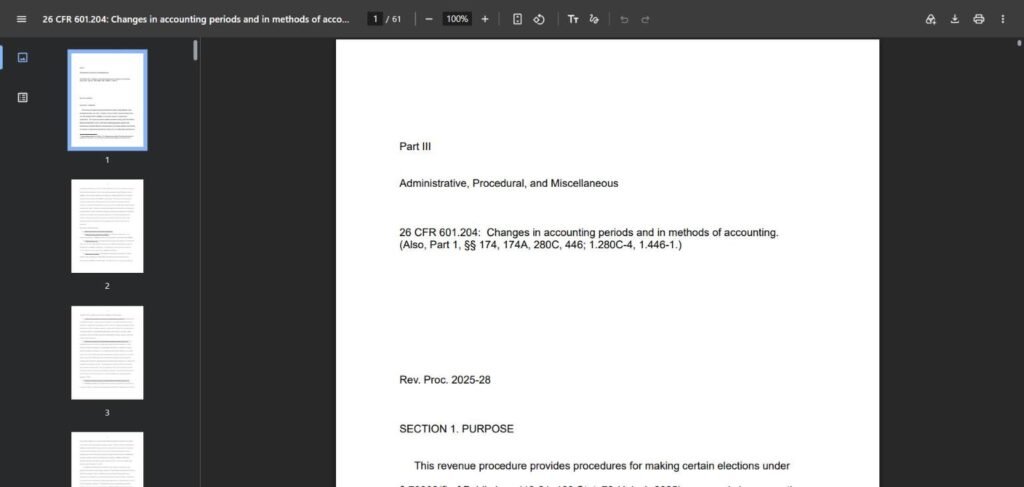
- No early recovery. Under amended section 174(d), as explained in IRS Rev. Proc. 2025-28, you can’t deduct leftover foreign R&E costs when the related property is disposed of, retired or abandoned after May 12, 2025; amortization just carries on.
The 15-year rule now opens a genuine tax gap between US and offshore development, and companies considering an offshore engineering hub should model it.

Your options for domestic costs in 2025 and later
You have two methods for current-year domestic costs.
Deduct currently under section 174A(a). This is the new law’s default. For the first tax year beginning after December 31, 2024, Rev. Proc. 2025-28 treats the switch as an automatic accounting method change on a cut-off basis, so no section 481(a) adjustment is needed. Rather than Form 3115, you attach a brief statement in lieu of it listing your name, taxpayer identification number, the designated change number and a declaration that you’re changing on a cut-off basis.
Elect to capitalize and amortize under section 174A(c). You pick a period of 60 months or more, starting with the month you first realize benefits from the expenditures. Under section 6.02 of Rev. Proc. 2025-28, you make the election by attaching a statement to your original, timely filed return (extensions included) for the first year it applies. The statement lists the number of months chosen, and you have to stick with that method and period unless the IRS agrees to a change.
Why would anyone pick capitalization? A company might weigh it for a few reasons, depending on its circumstances:
- It’s running losses and would prefer to push deductions into years when it expects taxable income.
- It wants to manage taxable income for limits that depend on it, like the business interest limitation.
- A state where it files hasn’t adopted the federal change, and it wants federal and state treatment to stay aligned.
For most profitable companies, deducting currently is simpler and worth more. Model both before deciding, since the capitalization election is hard to undo.
Catching up on 2022 to 2024 costs
Domestic costs you capitalized from 2022 through 2024 don’t vanish. You have three ways to recover the remainder:
- Stay on the original schedule. Without an election, you keep amortizing those amounts over the original five years. BDO notes that continuing requires no action.
- Deduct it all in one year. Elect to deduct the entire remaining unamortized amount in the first tax year beginning after December 31, 2024.
- Split it across two years. Elect to deduct it evenly over that first year and the following one.
Rev. Proc. 2025-28 treats the acceleration election as an automatic change on a cut-off basis, again with a statement in lieu of Form 3115 indicating which option you picked. Taxpayers who had already filed a return by September 15, 2025, using either option are treated as compliant.
The retroactive small business election has closed
Small business taxpayers, meaning those passing the section 448(c) gross receipts test for their first tax year beginning after 2024 ($31 million for 2025), could elect to apply section 174A retroactively to tax years beginning after December 31, 2021, through amended returns. Rev. Proc. 2025-28 set the deadline at Monday, July 6, 2026, or an earlier refund statute deadline for some 2022 years. That window has since closed.
If you were an eligible small business and filed an original return by November 15, 2025, deducting domestic costs for an affected year, the revenue procedure treats you as having made the election.
Worked example: recovering unamortized costs
Consider a hypothetical software company that spent $1.2 million a year on domestic research and experimental expenditures from 2022 through 2024 and capitalized them under the old five-year rule with the midpoint convention.
Amounts deducted through 2024:
- 2022 costs: 10% in 2022 and 20% in both 2023 and 2024, so $600,000 deducted and $600,000 remaining.
- 2023 costs: 10% in 2023 and 20% in 2024, so $360,000 deducted and $840,000 remaining.
- 2024 costs: 10% in 2024, so $120,000 deducted and $1,080,000 remaining.
That leaves $2,520,000 unamortized going into 2025. Here’s how each approach spreads it, excluding the company’s 2025 and 2026 costs, which it deducts currently under section 174A:
| Approach | 2025 deduction | 2026 deduction | 2027 to 2029 deductions |
|---|---|---|---|
| Keep the original schedule | $720,000 | $720,000 | $1,080,000 in total |
| Deduct all in 2025 | $2,520,000 | $0 | $0 |
| Split over 2025 and 2026 | $1,260,000 | $1,260,000 | $0 |
Under the default, the 2025 figure is 20% of each of the three cohorts, $240,000 apiece. Later years taper off as each cohort runs out: $600,000 in 2027, $360,000 in 2028 and $120,000 in 2029.
The best choice depends on income, rates and other limits. A company with strong 2025 profits might take it all at once, while one close to a loss might split it or keep the original schedule so deductions aren’t wasted.
How the research credit interacts with section 174A
The research credit under section 41 and the R&E deduction under section 174A are tied together. Under section 280C(c)(1) as amended, the amount you deduct or capitalize under section 174A drops by the research credit you claim. You can sidestep that reduction by electing a reduced credit under section 280C(c)(2), which the Form 6765 instructions calculate at 79% of the full credit. The election has to be made on a timely filed original return and can’t be revoked.
Two more connections to keep an eye on:
- According to the IRS instructions for Form 6765, the first part of the research credit’s four-part test now requires costs to be treated as domestic research or experimental expenditures under section 174A.
- Rev. Proc. 2025-28 gave eligible small businesses limited relief to make late section 280C(c)(2) elections, or revoke earlier ones, for 2022 through 2024. That relief also expired on July 6, 2026.
State conformity
States don’t automatically adopt federal changes. Some link their tax base to the federal code as of a fixed date, some pick and choose changes and some decouple from particular provisions. So a company could deduct domestic research costs right away federally while still amortizing them for a state.
Check the conformity rules in every state where you file before finalizing 2025 and 2026 returns, and maintain separate fixed asset or amortization schedules where treatment differs.

Estimated taxes and financial statements
The change also affects cash and the books. PwC’s summary of the guidance highlighted estimated tax payments and deferred tax assets as planning areas. In practice:
- Estimated payments. Bigger deductions in 2025 lower taxable income, so quarterly estimates built on the old rules may be too high.
- Deferred taxes. Companies that booked deferred tax assets for capitalized R&E costs will unwind them faster if they accelerate the remaining deduction.
- Cash planning. Businesses that paid extra tax in 2022 through 2024 because of capitalization can see that reverse as the remaining deductions come through.
Common section 174 mistakes
- Assuming only “research” teams are in scope. Software development is always included, and R&E expenditures reach beyond what qualifies for the research credit.
- Overlooking foreign costs. Offshore contractors and affiliates fall under the 15-year rule, even when the project is managed from the United States.
- Forgetting the statement in lieu of Form 3115. Moving to section 174A for 2025 is an accounting method change that requires the statement.
- Electing to capitalize without modeling it first. The section 174A(c) election binds future years.
- Overlooking section 280C. Taking the full research credit lowers your section 174A amount.
- Assuming states follow federal law. Many don’t, or don’t on the same schedule.
For more on how IRS correction programs work elsewhere, see our coverage of the IRS EPCRS update for retirement plan corrections, and for amortization schedules that live in spreadsheets, our guide to Claude for Excel for accountants.
Five choices on your first post-2024 return
The first tax year beginning after December 31, 2024 is where the new rules get locked in. If you file on a calendar year, your 2025 return is likely already in, so use this as a check of what went on it. If your fiscal year started later in 2025 and that return isn’t filed yet, it’s still a decision list.
| Choice | Your options | Can you change it later? |
|---|---|---|
| 1. Where the research happens | Domestic costs go under section 174A. Foreign costs stay under section 174, amortized over 15 years from the midpoint of the tax year. | It’s a fact, not an election, but you need records that tag each cost by location, and a sensible split for projects that mix US and offshore work. |
| 2. Current-year domestic costs | Deduct them under section 174A(a), the default, or elect to amortize under section 174A(c) over 60 months or more. | The section 174A(c) election binds future years. |
| 3. Leftover 2022 to 2024 domestic costs | Deduct the full balance in the first post-2024 year, split it over two years, or keep the original five-year schedule. In the worked example above, $2,520,000 becomes one $2,520,000 deduction, two of $1,260,000, or $720,000 + $720,000 + $1,080,000 through 2029. | Pick on purpose. Switching after the return is filed is a question for your CPA. |
| 4. Research credit vs. the 174A deduction | Take the full research credit and reduce the section 174A amount by it under section 280C(c)(1), or elect the reduced credit under section 280C(c)(2), which the Form 6765 instructions put at 79% of the full credit. | No. The reduced-credit election must be made on a timely filed original return and can’t be revoked. |
| 5. Method change paperwork | Rev. Proc. 2025-28 treats the switch to section 174A as an automatic accounting method change on a cut-off basis, made with a statement in lieu of Form 3115. | A missing statement is one of the mistakes listed above, so check it went with the return. |
Choices 2 and 4 are the one-way doors. They also interact: the research credit decision changes how much is left to deduct or amortize under section 174A. Model them together, with next year’s numbers, not one at a time.
Our Take / Expert Perspective
Our take: the 2025 law solved the problem but opened a new fault line between domestic and foreign development.
The 2022 capitalization rule was unusual. It wasn’t aimed at any particular abuse; it was mostly a revenue timing device that hit software companies hardest, since nearly all of their engineering spend got swept in. Bringing back immediate expensing for domestic costs reverses most of that damage, and the acceleration options let companies recoup what they’d already paid.
The new imbalance deserves more attention than it gets. Domestic development is deductible now, while foreign development waits 15 years. For a company deciding whether to hire engineers in the United States or abroad, that timing gap is a real cost difference layered on top of salaries. We expect it to influence location decisions, which seems to be what Congress intended.
The other knock-on effect concerns records. Because section 174A amounts, the research credit and the section 280C election now interact every year, companies need cost tracking by project and by location, not just department totals. That’s the same discipline the new Form 6765 Section G is pushing for.
Who gains most? US-based software and engineering companies with solid taxable income. Who should tread carefully? Companies with big offshore teams, loss-making startups weighing the capitalization election and anyone in a state that hasn’t conformed.
Our recommendation: if your first post-2024 return is still open, confirm the method change statement, pick your catch-up option on purpose and tag every development cost by location. If it’s already filed, check that all three were done.
Frequently Asked Questions
What is section 174?
Section 174 of the Internal Revenue Code now covers foreign research or experimental expenditures, which have to be amortized over 15 years. Domestic research and experimental expenditures shifted to section 174A for tax years beginning after December 31, 2024, and can be deducted currently.
Was section 174 repealed?
Not quite. The 2022 rule forcing five-year amortization of domestic costs was replaced by section 174A, which permits immediate deduction. Section 174 stays in force for foreign research.
Does section 174A apply to software development?
Yes. Section 174A(d)(3) treats any amount paid or incurred in connection with developing any software as a research or experimental expenditure. Buying or licensing software doesn’t count as development.
What happens to costs I capitalized in 2022 to 2024?
You can keep amortizing them on the original schedule, deduct the remainder in your first tax year beginning after 2024 or split it across that year and the next. The acceleration options require an election made through the procedures in Rev. Proc. 2025-28.
Can I still amend 2022 to 2024 returns to deduct R&E expenditures?
The retroactive election for small business taxpayers was due by July 6, 2026, or an earlier refund statute date for some 2022 years, and that window has closed. Larger businesses were never eligible and use the catch-up options instead.
Is section 174 the same as the R&D tax credit?
No. Section 174 and section 174A control how you deduct research costs. The research credit under section 41 is a separate credit with its own four-part test, although the two are connected through section 280C.
This article is for general information only and is not tax, accounting or financial advice. Consult a licensed CPA or financial professional for your situation.
Sources
- IRS: Rev. Proc. 2025-28, checked November 7, 2026
- Cornell Law School LII: 26 U.S. Code § 174, checked November 7, 2026
- Cornell Law School LII: 26 U.S. Code § 174A, checked November 7, 2026
- IRS: Instructions for Form 6765 (Rev. December 2025), checked November 7, 2026
- BDO: Domestic R&E expenditures method changes that must be made for the 2025 tax year, checked November 7, 2026
- PwC: IRS provides clear path on options for domestic R&E expenditures, checked November 7, 2026
- aiandblog: Editorial Policy
Photos: Christopher Gower, Ilya Pavlov, Mohammad Rahmani and Safar Safarov on Unsplash.









Leave a Reply