


Last updated: November 19, 2026
Reviewed by an HR compliance professional (PHR, SHRM-CP) on November 19, 2026.
The DOL independent contractor rule is final. The Labor Department on Nov. 19, 2026, announced a final rule that will scrap its 2024 worker classification rule and return to a shorter test built on two “core factors.” If you pay people on a 1099, the federal wage-and-hour question of who counts as your employee just got simpler, but your state’s answer may not have changed at all.
Short answer: The new DOL independent contractor rule replaces the 2024 six-factor test with an economic reality test led by two core factors: who controls the work and whether the worker can make or lose money through initiative or investment. It covers the FLSA, FMLA and MSPA and takes effect 60 days after Federal Register publication.
Key takeaways
- The Wage and Hour Division announced the final rule on Nov. 19, 2026. It rescinds the 2024 rule and returns to a framework the agency calls substantially similar to its 2021 rule.
- When control and profit-or-loss point the same way, the rule says that classification is substantially likely to be right. Skill, permanence and integration matter mostly when they split.
- The rule includes 14 worked examples, with new ones for app-based workers, truck drivers and farm labor contractors.
- It doesn’t change IRS tax classification and doesn’t preempt state or local law, so California’s ABC test and similar state tests still apply.
- The department estimates 24.8 million independent contractors in the U.S. and about 2.91 million establishments and government entities that may be affected.
Table of Contents
What the DOL independent contractor rule changes
The DOL independent contractor rule is the yardstick Wage and Hour investigators, businesses and workers use to sort people into two groups under the Fair Labor Standards Act. Only one group, employees, is owed the federal minimum wage and overtime pay.
The U.S. Department of Labor says the new text wipes out the 2024 regulations and brings back an approach that closely tracks its 2021 version. The same analysis will now also govern two related statutes, the Family and Medical Leave Act and the Migrant and Seasonal Agricultural Worker Protection Act, because both rely on the FLSA’s meaning of “employ.”
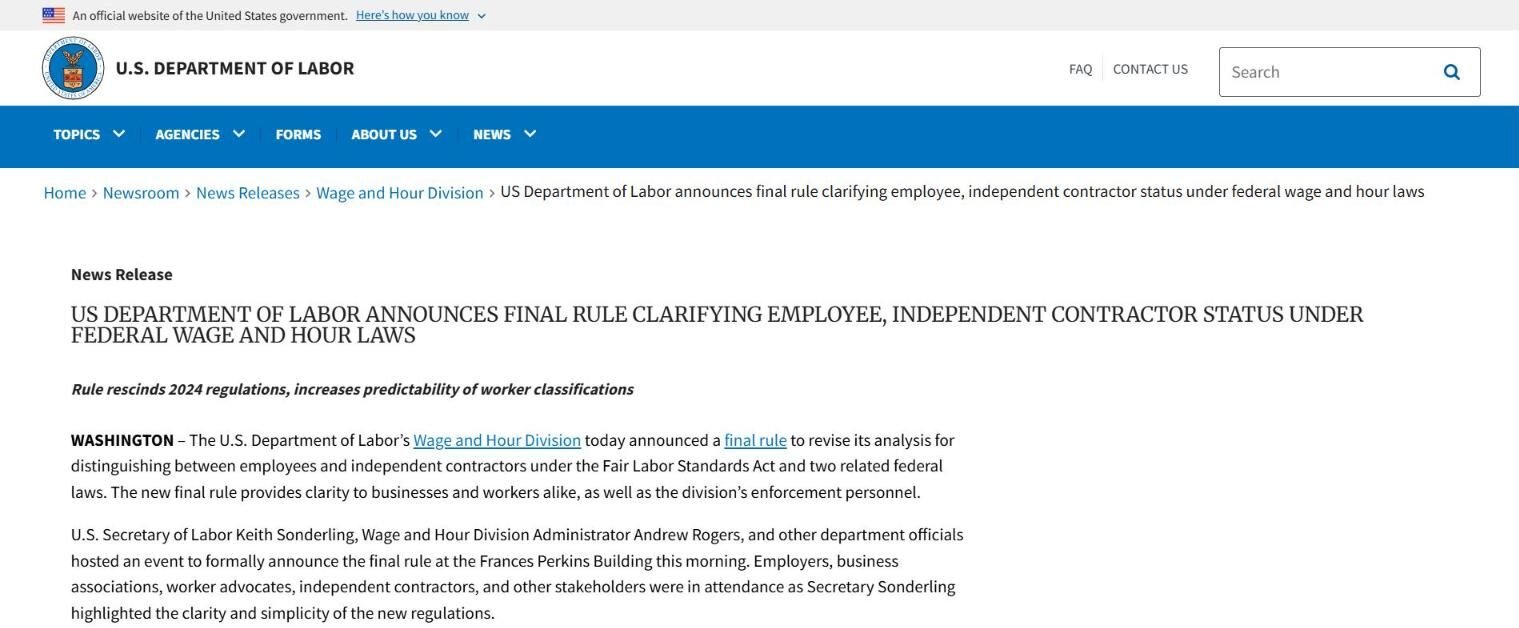
At the announcement, Labor Secretary Keith Sonderling pitched the rule as simpler and more predictable for businesses and workers. Wage and Hour Administrator Andrew Rogers framed it as a balance between protecting employees and leaving room for legitimate independent businesses.
When the independent contractor final rule takes effect
The final rule document says it takes effect 60 days after it’s published in the Federal Register. As of Nov. 19, the department had released the rule but the publication date, and so the exact effective date, hadn’t been set in the text. We’ll update this article when it is.
The independent contractor final rule moved fast by federal standards. The proposal appeared in the Federal Register on Feb. 27, 2026, and drew about 16,500 public comments during a 60-day comment period. The department largely kept the proposal and added example pairs on app-based delivery and truck lease-purchase deals after commenters raised those issues.
The economic reality test: two core factors decide most cases
The economic reality test asks one question: is the worker in business for himself or herself, or economically dependent on the company for work? The rule answers it mainly through two core factors.
- Control over the work. A worker who sets his or her own schedule, picks projects and can work for others leans toward contractor status. A company that sets the schedule or requires exclusive work points toward employment. Normal contract terms don’t count as control here: requiring legal compliance, safety rules, insurance, deadlines or quality standards doesn’t make someone an employee. Detailed instructions on how, when or where to do the work can.
- Opportunity for profit or loss. A worker who can earn more or lose money through initiative, such as managerial skill or business judgment, or through investment in helpers, equipment or materials leans toward contractor status. A worker who can raise earnings only by working more hours or working faster looks like an employee.
When both core factors point to the same answer, the regulation says there is a “substantial likelihood” that answer is accurate. Three other factors come in mostly when the core factors split:
- Skill. Specialized skill the company doesn’t provide points toward contractor status. Work that needs no special skill, or skills the company teaches, points toward employment.
- Permanence. A relationship with a set end date or sporadic work points toward contractor status. An open-ended, continuous one points toward employment. Seasonal work alone doesn’t make someone a contractor.
- Integrated unit of production. Work that sits inside the company’s production process points toward employment. Work that can be separated from it points toward contractor status. The rule says this isn’t the same as asking how important the work is to the business.
One more principle matters a lot in practice. The rule says what actually happens counts more than what a contract says could happen. A right to work for competitors means little if the worker can’t realistically use it.

What tipped the outcome in the DOL’s 14 examples
The examples are the most useful part of the DOL independent contractor rule for HR teams, because several of them come in pairs where one detail flips the factor. We summarized them from the regulation text in the final rule document.
| Worker in the DOL example | What the example shows | The detail that decided it |
|---|---|---|
| Owner-operator truck driver hauling for a logistics company | Control favors contractor | Federally required drug and alcohol testing and agreed delivery deadlines aren’t employer control |
| Food-delivery app worker | Control favors employee | Acceptance-rate penalties and hidden order details made working other apps impractical |
| Food-delivery app worker | Control favors contractor | Free to turn down orders and work for competing apps |
| Farm labor contractor crew (strawberry grower) | Control favors employee | Exclusive work, with pay, schedules and discipline set by the grower |
| Farm labor contractor crew (lettuce grower) | Control favors contractor | Works for several farms, sets his own schedule and supervises his own crew |
| Home-repair worker found through an app | Profit or loss favors contractor | Raises earnings through initiative and own equipment |
| Construction worker who part-owns a food truck | Profit or loss favors employee | Hourly pay and assigned tasks; the food truck is a separate business |
| Truck lessee hauling freight | Profit or loss favors employee | Carrier sets the rates, won’t negotiate and doesn’t disclose them before he commits; no realistic path to owning the truck |
| Truck lessee hauling freight | Profit or loss favors contractor | Negotiates rates, finds backhauls and has a realistic path to ownership |
| Roofing crew member trained by the company | Skill factor favors employee | No prior skills; the company provided training |
| Roofer with specialized skills | Skill factor favors contractor | Brings own expertise; no company training |
| Seasonal ski-resort housekeeper rehired each winter | Permanence favors employee | Indefinite relationship despite seasonal breaks |
| Part-time remote editor at a digital news outlet | Integration favors employee | Works inside the outlet’s editing process next to staff editors |
| Freelance journalist pitching the same outlet | Integration favors contractor | Submits stories the outlet can accept or reject; no role in assignments |
Notice the pattern. In the contractor example, the app tracks the worker’s location and sets customer prices, and the rule says neither shows employer control. What flips the result is whether the worker can realistically turn down orders and take work elsewhere.
2021 vs. 2024 vs. 2026: how the federal test has swung
This is the third federal independent contractor rule in six years. Here’s how they compare, based on the department’s rulemaking pages and the 2024 and 2026 rule texts.
| Feature | 2021 rule | 2024 rule | 2026 rule |
|---|---|---|---|
| Published | Jan. 7, 2021 | Jan. 10, 2024 (effective March 11, 2024) | Announced Nov. 19, 2026; effective 60 days after Federal Register publication |
| Structure | Two core factors plus three other factors | Six factors, no predetermined weight, totality of the circumstances | Two core factors plus three other factors |
| Core factors | Control over the work; chance to profit or lose | None given extra weight | Control over the work; chance to profit or lose through initiative or investment |
| How central the work is | Integrated unit of production | Whether the work is an integral part of the business | Integrated unit of production, which the rule says is different from importance |
| Laws covered | FLSA | FLSA | FLSA, FMLA and MSPA |
In practice, the department stopped using the 2024 test well before the independent contractor final rule. On May 1, 2025, it told investigators not to apply the 2024 analysis in enforcement and to rely on Fact Sheet #13 and a reinstated 2019 opinion letter instead. The new rule makes that shift permanent in the regulations.
Who the new independent contractor rule affects, and what it doesn’t touch
The DOL independent contractor rule reaches any business that uses contractors and is covered by the FLSA. The department’s own estimate in the rule document puts the number of independent contractors at 24.8 million in 2023, and it counts about 2.91 million establishments and government entities that may be affected. It estimates one-time costs of $495.7 million for businesses and contractors to read and understand the rule, and yearly cost savings of about $694.7 million from clearer standards and less litigation. Those are the department’s projections, not measured results.
The new examples show where the department expects the most questions: app-based delivery and service work, trucking and farm labor contracting.
It doesn’t change IRS rules or your 1099s
The department says the rule doesn’t change worker status under any other federal law, including the Internal Revenue Code. For federal taxes, the IRS still uses its common-law test, which looks at behavioral control, financial control and the type of relationship. A worker can pass the FLSA test and still be an employee for payroll tax purposes. Our guide to 1099 vs. W-2 workers covers the tax side, and our Form 1099-NEC guide covers filing.
It doesn’t override state tests like California’s ABC test
The DOL independent contractor rule doesn’t preempt state or local laws. That matters most where states use stricter tests. Under California’s ABC test, as the state’s Labor and Workforce Development Agency explains, the business has to show three things before it can call someone a contractor: it doesn’t control how the person works, the work falls outside what the business normally does, and the person runs an established independent business doing that kind of work. Miss one and the worker is an employee.

So a delivery driver who passes the federal core-factor test could still be an employee in California. If you hire across states, the strictest test you face sets your floor. Our independent contractor vs. employee guide compares the federal, IRS and ABC tests side by side.
What employers should do before the independent contractor rule takes effect
You have roughly two months once the rule is published. Use them to check how your contractor relationships work day to day, not just how the paperwork reads. A short worker misclassification audit now costs far less than back wages later.
- List every contractor. Include what they do, how they’re paid, how long they’ve worked with you and whether they work for anyone else.
- Test control in practice. Who sets their hours? Do managers tell them how to do the work, or only what result you need? Do you block or discourage outside work?
- Test profit or loss. Can the worker raise earnings through business decisions or by investing in helpers, equipment or materials? If the only lever is more hours, that points toward employee status.
- Compare the contract to reality. Flag any right the contract grants on paper that the worker can’t actually use.
- Check state law and IRS rules separately. Run the same people through your state’s test and the IRS common-law test. Reclassify where the strictest test says employee.
- Document the decision. Write down which factors you weighed for each role and why. Keep it with your HR compliance checklist.
- Watch for the publication date. The 60-day clock starts when the independent contractor final rule appears in the Federal Register.
What worker misclassification can cost
Worker misclassification is expensive when it’s caught. Under the FLSA, the Labor Department’s reference guide explains that unpaid minimum wage or overtime can be collected twice over: the missing pay, plus the same amount again as liquidated damages. Claims usually reach back two years, and three if the violation was willful. Employers who break the rules repeatedly or on purpose can be fined on top of that.
If you find a problem, the department’s PAID program gives employers a way to come forward on their own and settle possible FLSA wage and overtime problems, along with some potential FMLA violations. Reclassified workers who now qualify for overtime may also change your pay setup; our salary vs. hourly guide explains the overtime rules.
Our Take / Expert Perspective
The real question about the DOL independent contractor rule isn’t what the test says. It’s how long it lasts. The federal standard has now changed in 2021, 2024 and 2026, each time tracking the party in the White House. Our forecast: worker advocates will challenge the rule in court, and a future administration could rewrite it again.
That doesn’t make the independent contractor rule meaningless. It sets how Wage and Hour investigators will judge your contractors starting on the effective date. In private lawsuits, though, judges decide. Since the Supreme Court’s Loper Bright decision in 2024, courts must use their own judgment on what a statute means and can’t defer to an agency’s reading just because the law is ambiguous. The department itself says the rule doesn’t bind courts. It also says the rule’s guidance is consistent with the outcomes of federal appeals court cases, which should help it hold up, but that isn’t a guarantee.
Who gains? App platforms, trucking companies and farms with genuinely independent crews get clearer federal footing. Who should be careful? Any business with workers in California or another strict-test state, where nothing changed. The biggest mistake we expect to see is a company reclassifying employees as contractors because the federal test looks friendlier, then losing a worker misclassification claim under state law or in an IRS audit.
Our recommendation: run your contractor list through the strictest test you’re subject to, fix the roles that fail, and document the rest before the effective date.
Frequently Asked Questions
What is the new DOL independent contractor rule?
It’s a Labor Department final rule, announced Nov. 19, 2026, that sets how to tell employees from independent contractors under the FLSA, FMLA and MSPA. It rescinds the 2024 six-factor rule and uses an economic reality test led by two core factors: control over the work and the opportunity for profit or loss.
When does the DOL independent contractor rule take effect?
It takes effect 60 days after it’s published in the Federal Register. As of Nov. 19, 2026, the department had announced the rule, but the publication date wasn’t stated in the rule text. Until the effective date, the 2024 regulations stay on the books, although the department stopped applying them in enforcement in May 2025.
What are the core factors in the economic reality test?
In the economic reality test, the first core factor asks who really controls the work. The second asks whether the worker can make or lose money through their own choices and spending. If both point the same way, the rule says that classification is substantially likely to be correct. Skill, permanence and integration help mainly when the core factors conflict.
Does the new independent contractor rule change 1099 or IRS rules?
No. The department says the rule doesn’t change worker status under the Internal Revenue Code or any other federal law outside the FLSA, FMLA and MSPA. For taxes and Form 1099 reporting, the IRS common-law test still applies.
Does the federal rule override California’s ABC test?
No. The DOL independent contractor rule doesn’t preempt state or local laws. A worker who is a contractor under the federal test can still be an employee under California’s ABC test or another state’s stricter standard, so multistate employers need to check each state separately.
This article is for general information only and is not legal advice. Laws differ by state, province and country; consult a qualified attorney for your situation.
Sources
- U.S. Department of Labor: news release announcing the independent contractor final rule, November 19, 2026, checked November 19, 2026
- U.S. Department of Labor, Wage and Hour Division: final rule text, RIN 1235-AA46 (PDF), checked November 19, 2026
- U.S. Department of Labor: 2026 independent contractor rulemaking page, checked November 19, 2026
- U.S. Department of Labor: 2024 independent contractor rule page, checked November 19, 2026
- Federal Register: 2024 final rule, document 2024-00067, January 10, 2024, checked November 19, 2026
- U.S. Department of Labor: May 2025 enforcement guidance release, May 1, 2025, checked November 19, 2026
- U.S. Department of Labor: FLSA handy reference guide, checked November 19, 2026
- Internal Revenue Service: employee or independent contractor guidance, checked November 19, 2026
- California Labor and Workforce Development Agency: ABC test explainer, checked November 19, 2026
- Supreme Court of the United States: Loper Bright opinion, No. 22-451, June 28, 2024, checked November 19, 2026









Leave a Reply