


Last updated: November 21, 2026
Reviewed by an HR compliance professional (PHR, SHRM-CP) on November 13, 2026.
Colorado final paycheck law is one of the strictest in the country: a fired employee is owed final wages immediately, not on the next payday. And the handbook clause that forfeits unused vacation when someone quits without notice? It’s void here. Ignore a written wage demand for 14 days and the penalty starts at twice the unpaid wages or $1,000, whichever is more. For other states, see our final paycheck laws by state table.
Short answer: Under C.R.S. 8-4-109, a fired employee must be paid immediately, or within 6 hours of the next workday if payroll is closed, or 24 hours if it’s closed and off-site. Employees who quit are paid on the next regular payday. Earned vacation counts as wages, and ignoring a written demand costs at least 2x the unpaid amount or $1,000.
Key takeaways
- Firing or layoff: wages are due immediately, with a 6-hour grace period only when the payroll unit is closed (24 hours if it’s also off-site).
- Resignation: wages are due on the next regular payday.
- All earned and determinable vacation must be paid at separation, and a use-it-or-lose-it rule can’t take it away.
- Unpaid wages 14 days after a written demand cost the greater of 2x the wages or $1,000, or 3x or $3,000 if willful.
- Employees have 2 years to sue, or 3 years for a willful violation.
Table of Contents
Colorado final paycheck law at a glance
We checked each rule below against the Colorado Wage Act (C.R.S. 8-4-101 and following, as revised August 6, 2025) and the Colorado Department of Labor and Employment’s (CDLE) INFO #3E on November 12, 2026.
| Situation | When final pay is due | Rule |
|---|---|---|
| Fired or laid off, payroll office open | Immediately | C.R.S. 8-4-109(1)(a) |
| Fired or laid off, payroll unit not scheduled to be open | Within 6 hours of the start of its next regular workday | C.R.S. 8-4-109(1)(a) |
| Fired or laid off, payroll unit closed and off-site | Within 24 hours of the start of its next regular workday | C.R.S. 8-4-109(1)(a) |
| Employee quits or resigns | Next regular payday | C.R.S. 8-4-109(1)(b) |
| Earned vacation | With final wages, under the agreement’s terms | C.R.S. 8-4-101(14); INFO #3E |
| Paid sick leave used only for qualifying reasons | No payout required | INFO #3E |
Federal law doesn’t add a deadline. The U.S. Department of Labor says federal law doesn’t require an immediate final paycheck, so the Colorado rules govern.
Colorado final paycheck after a firing or layoff
When the employer ends the relationship, wages that are earned, vested, determinable and unpaid are due immediately. The statute gives two narrow cushions:
- Payroll unit closed. If the employer’s accounting unit isn’t regularly scheduled to be operational at the time, the wages have to be available no later than 6 hours after the start of that unit’s next regular workday.
- Payroll closed and off-site. If that closed accounting unit is located off-site, the check has to be delivered no later than 24 hours after the start of its next regular workday, to the work site, the employer’s local office or the employee’s last-known mailing address.
A layoff is employer-initiated, so it follows the same clock. In practice, if a store manager lets someone go on a Saturday and the in-house payroll team works weekdays starting at 9 a.m., the wages have to be available by 3 p.m. Monday. If payroll is open when the termination happens, there’s no cushion at all.
Colorado final paycheck after a resignation
Employees who quit or resign are paid on the next regular payday. The employer makes the check available at the work site, its local office or the employee’s last-known mailing address.
There’s a backstop for checks that sit uncollected. If an employee hasn’t received a check left at the work site or local office within 60 days after it was due, the employer has to mail it to the last-known address.
Vacation pay: Colorado’s biggest trap
Colorado treats earned vacation as wages. The Colorado Wage Act says the employer shall pay, upon separation, all vacation pay earned and determinable under the terms of the agreement, and the CDLE’s INFO #3E spells out what that means:
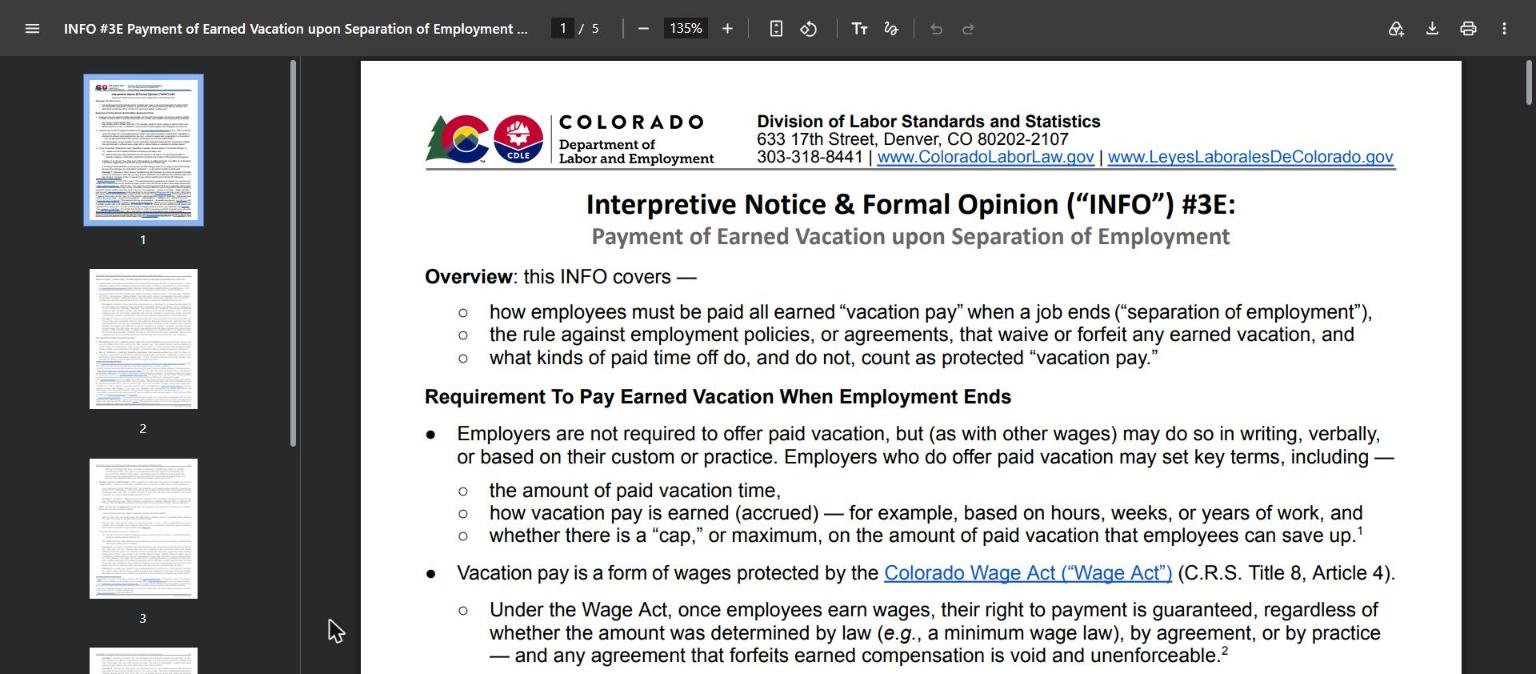
- Every separation counts. Firing, quitting with or without notice, or any other reason. A furlough caused by a full or partial shutdown and genuinely expected to last 30 days or less (or as long as a government emergency order requires) isn’t a separation. If it runs longer, earned vacation must be paid.
- No forfeiture. In Nieto v. Clark’s Market (2021), the Colorado Supreme Court held that a policy forfeiting earned vacation at separation violates the Wage Act. Any term like that is void.
- Labels don’t matter. PTO or personal days usable for any purpose count as vacation pay and must be paid out.
- Sick-only leave is different. Leave usable only for qualifying reasons, like Healthy Families and Workplaces Act sick leave, doesn’t have to be paid at separation. If you rehire the same employee within six months, though, C.R.S. 8-13.3-403(5)(b) requires you to reinstate the sick leave they had accrued but not used.
- Caps are allowed, carefully. You can cap how much vacation employees accrue or use, but you can’t cap carryover in a way that erases time already earned.
If your handbook was written for another state, it probably has a forfeiture clause that’s void in Colorado. Our guide to unlimited PTO covers how open-ended policies work, which is a separate question from paying out accrued balances.
A newer rule makes that balance easier to prove. Since February 1, 2026, COMPS Order #40 has required employers to keep a record of vacation hours accrued, used and available in the current benefit year, and to provide it in writing or electronically when an employee asks, though they only have to answer one request a month unless their own policy allows more. If the vacation payout on a final check looks short, that record is the first thing to ask for.
What counts as wages in a Colorado final paycheck
C.R.S. 8-4-101(14) defines wages broadly. It covers pay for labor or services, bonuses and commissions earned under the terms of an agreement, and vacation pay earned under the agreement. It specifically excludes severance pay.
- Earned bonuses and commissions belong in the final paycheck once they’re earned and determinable under the plan.
- Severance isn’t wages under the Act, so the final paycheck deadline and penalties don’t apply to it. What you owe comes from the separation agreement.
- Pay statements still apply. Under C.R.S. 8-4-103, the final payment needs the same itemized statement as any other: gross wages, all withholdings and deductions, net wages, the pay period dates and the employer’s name and address.
Deductions from a Colorado final paycheck
The final paycheck rule doesn’t stop an employer from setting off deductions that C.R.S. 8-4-105 allows, and it doesn’t require paying compensation that isn’t fully earned yet under the compensation agreement, such as a commission that depends on a later event. Anything else has to be paid on the deadline.
Colorado Wage Act penalties for a late final paycheck
The penalty system starts with a written demand. If an employer doesn’t pay on time, the employee, an agent or the CDLE can send a written demand, file an administrative claim or sue. From there:
| What happens | Result |
|---|---|
| Employer pays all earned, vested and determinable wages within 14 days of the demand | No automatic penalty |
| Employer doesn’t pay within 14 days | Unpaid wages plus a penalty of the greater of 2x the unpaid wages or $1,000 |
| Failure is willful | Unpaid wages plus a penalty of the greater of 3x the unpaid wages or $3,000 |
| Second failure to pay similar wages within 5 years | Treated as willful automatically |
Two details narrow the exposure. A legal tender of the full amount demanded within 14 days can limit the penalty, and the CDLE director may waive it if the employer pays within 14 days of an administrative claim, though not for a repeat failure within 5 years. Employees have 2 years to bring a claim, or 3 years for a willful violation, under C.R.S. 8-4-122.
How a Colorado wage claim works
Employees don’t have to go to court. They can file a Colorado wage claim, formally a wage complaint, with the CDLE’s Division of Labor Standards and Statistics, which investigates when one or more employees file. Under C.R.S. 8-4-111, the employer has 14 days to respond after the complaint is sent, and the division’s reach depends on the amount and the filing date:
| Claims filed | Amount the division can decide | Source |
|---|---|---|
| Through June 30, 2026 | $7,500 or less per employee | C.R.S. 8-4-111 |
| July 1, 2026 through December 31, 2027 | $13,000 or less | C.R.S. 8-4-111; House Bill 25-1001 |
| From January 1, 2028 | Set by CDLE rule every other year: at least $1,000 more than the prior limit, or more if inflation requires | C.R.S. 8-4-111 |
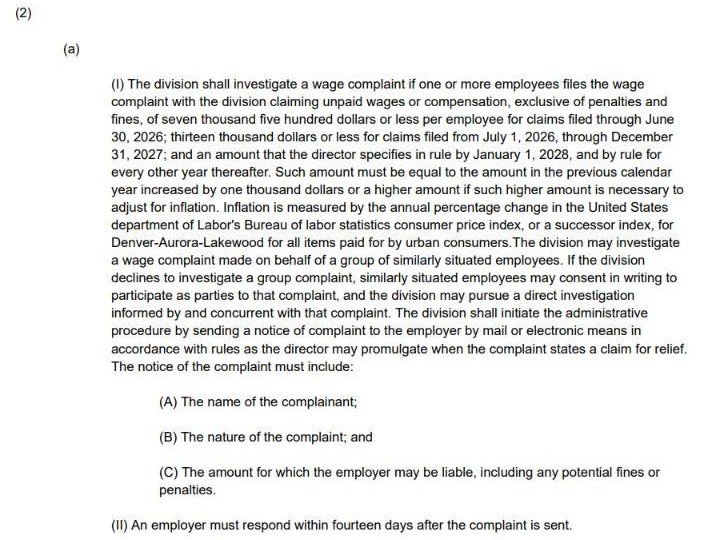
If the division finds wages are owed, it issues a citation and notice of assessment covering the wages, penalties and fines. Fines can reach $50 a day for each employee not paid, for an employer without a good-faith legal justification.
Ignoring the result gets expensive fast. If the employer doesn’t pay within 60 days of the division’s determination, the employee can also recover attorney fees spent enforcing it, an extra fine of 50% of the amount determined and a penalty of the greater of 50% of that amount or $3,000. One more detail matters for the penalty clock: the division’s notice of a complaint counts as the written demand under C.R.S. 8-4-109(3)(a), so the 14-day window can start with that notice.

Attorney fees cut both ways. A court can award fees to an employee who recovers more than the employer tendered, and to an employer whose timely tender beat a claim that lacked substantial justification. In an administrative claim, the division can award fees to an employee who recovers more than $5,000.
2025 changes: owner liability and tougher enforcement
House Bill 25-1001 tightened the Colorado Wage Act, and the CDLE’s posted text of the Act, revised August 6, 2025, reflects it. The changes employers feel most:
- Owners can be the employer. The definition now includes an individual who owns or controls at least 25% of the ownership interest in an employer.
- Higher claim limit. The division can decide claims up to $13,000 filed from July 1, 2026 through 2027.
- Public naming. The division must publish the names of employers found in violation and whether the violation was willful, and it notifies licensing bodies when a willful violation isn’t fixed within 60 days.
- Misclassification fines. Willfully treating employees as contractors can cost $5,000 per misclassified employee, rising to $50,000 per employee for a repeat willful violation that isn’t fixed within 60 days of the division’s finding.
- Deductions have a floor. Payroll deductions can’t reduce pay below the applicable minimum wage.
Retaliation after a wage complaint
C.R.S. 8-4-120 bars employers from intimidating, threatening, blacklisting, firing or otherwise retaliating against employees for protected activity, such as complaining about unpaid wages. A gap of 90 days or less between the protected activity and the adverse action can, on its own, support a finding of retaliatory intent, and a violation is a class 2 misdemeanor.
The practical rule: once a departing or current employee raises a pay issue, route any discipline or schedule change through HR and document the business reason before acting.
A worked example
Say an employee is let go owing $1,800 in final wages and $1,200 in accrued vacation, and the employer pays nothing. The employee sends a written demand, and 14 days pass. This is an illustration using the statute’s formula:
| Scenario | Calculation | Total owed |
|---|---|---|
| Not willful | $3,000 wages + greater of $6,000 (2x) or $1,000 | $9,000 |
| Willful | $3,000 wages + greater of $9,000 (3x) or $3,000 | $12,000 |
| Paid within 14 days of the demand | $3,000 wages | $3,000 |
The $1,000 floor matters for small balances. An employee owed $200 who sends a demand and isn’t paid in 14 days is owed the $200 plus $1,000.
How Colorado compares
Colorado sits with the fastest states. California also requires immediate payment on a firing, as our California final paycheck law guide explains, while Texas gives employers 6 calendar days, per our Texas final paycheck law guide. What sets Colorado apart is the combination: same-day timing, mandatory vacation payout and a penalty that starts at $1,000 even for small amounts.
Colorado final paycheck checklist
- Decide on day one whether the separation is employer-initiated or a resignation.
- For a firing or layoff, have the final check ready at the meeting, or confirm your payroll unit can meet the 6-hour or 24-hour window.
- Add all earned and determinable vacation, including PTO that can be used for any reason.
- Leave out only sick-only leave and compensation not yet earned under the plan.
- Take only deductions C.R.S. 8-4-105 allows.
- Deliver to the work site, local office or last-known mailing address, and mail any check uncollected after 60 days.
- If a demand arrives, pay the undisputed amount within 14 days.
- Keep records of the amount, method and date paid.
Our Take / Expert Perspective
Our take: the Colorado final paycheck law is less about the deadline than the demand letter. The penalty only kicks in when an employer ignores a written demand for 14 days, which means almost every penalty case is a choice made after the employer was told it owed money.
The real exposure is vacation. Since Nieto, any policy that forfeits earned vacation at separation is void, yet many multistate handbooks still say departing employees who skip a notice period lose their balance. In Colorado that clause turns a routine resignation into a wage claim with a $1,000 floor.
Severance doesn’t change the math either. Wages and vacation are owed on the statutory deadline whether or not a separation agreement is signed.
What to do now: pull the vacation and PTO section of your handbook and search for words like forfeit, lose or not paid. If Colorado employees are covered, rewrite it before the next resignation, and give HR a standing rule to pay any written wage demand within 14 days while the details get sorted out.
Frequently Asked Questions
How long does an employer have to give a final paycheck in Colorado if you quit or are fired?
If the employer ends the employment, wages are due immediately, with a 6-hour window only when the payroll unit is closed (24 hours if it’s also off-site). If the employee quits, wages are due on the next regular payday.
Does Colorado require payout of unused vacation?
Yes. All earned and determinable vacation must be paid at separation, and the Colorado Supreme Court held in Nieto v. Clark’s Market that policies forfeiting it are void. Sick-only leave doesn’t have to be paid out.
What is the penalty for a late final paycheck in Colorado?
If wages aren’t paid within 14 days of a written demand, the employer owes the wages plus the greater of 2x the unpaid amount or $1,000. For a willful failure, it’s the greater of 3x or $3,000.
Can a Colorado employer mail the final paycheck?
Yes. The check can be made available at the work site or local office, or sent to the employee’s last-known mailing address, and a check left uncollected for 60 days has to be mailed.
How long do I have to file a wage claim in Colorado?
Two years from when the claim accrued, or three years for a willful violation, under C.R.S. 8-4-122.
Can business owners be personally liable for unpaid wages in Colorado?
They can. Since House Bill 25-1001, the Wage Act’s definition of employer includes an individual who owns or controls at least 25% of the ownership interest in an employer.
This article is for general information only and is not legal advice. Laws differ by state, province and country; consult a qualified attorney for your situation.
Sources
- Colorado Department of Labor and Employment: Colorado Wage Act, C.R.S. 8-4-101 and following (revised August 6, 2025), checked November 12, 2026
- Colorado Department of Labor and Employment: INFO #3E, Payment of Earned Vacation upon Separation of Employment (May 29, 2024), checked November 18, 2026
- Colorado General Assembly: HB25-1001, Enforcement Wage Hour Laws, checked November 18, 2026
- U.S. Department of Labor: Last Paycheck, checked November 18, 2026
- Colorado Department of Labor and Employment: COMPS Order #40 (7 CCR 1103-1), Rules 7.1(F) and 7.2.2 on vacation records, effective February 1, 2026, checked November 21, 2026
- aiandblog: more HR Compliance articles and our Editorial Policy









Leave a Reply