

Last updated: November 19, 2026
Reviewed by an equity research analyst on November 18, 2026.
The Anthropic IPO date was November 19, 2026, when ANT started trading on Nasdaq. The Claude maker priced its shares at $83.00 the day before, above its $70 to $78 range, and the stock closed its first day at $97.17, up 17.1% from that price. Here’s what the filings, the pricing announcement and the first trading day show, and what they change for companies that pay for Claude.
I use Claude for market research on most working days, so this listing matters to me beyond the headlines. What caught my eye isn’t the valuation. It’s that the company behind a tool many teams already rely on will now have to publish its numbers on a fixed schedule, with audited financial statements every year.
Short answer: The Anthropic IPO priced at $83.00 a share on November 18, 2026, above the $70 to $78 range, for 980 million Class A shares. ANT began trading on Nasdaq on November 19, opened at $111.50 and closed at $97.17, up 17.1% from the IPO price. By our math, that’s about $1.28 trillion in market value, excluding options and RSUs.
Key takeaways
- The Anthropic IPO priced at $83.00 on November 18, 2026, above the $70.00 to $78.00 range, for 980 million shares, or about $81.3 billion of stock by our math. ANT opened at $111.50 on November 19 and closed its first day at $97.17, up 17.1% from the IPO price but 12.9% below its first trade.
- Revenue hit $33.2 billion in the first nine months of 2026, up from $2.5 billion a year earlier, with an operating loss of $1.3 billion.
- The founders and the Long-Term Benefit Trust keep control: a single founders’ share carries 50.1% of the general vote, and the trust elects a majority of the board.
- AMD, Broadcom, Google, Micron, Microsoft, NVIDIA and TSMC Partners agreed to buy $26.0 billion of non-voting stock at the Anthropic IPO price.
- The Anthropic IPO doesn’t change Claude contracts by itself, but it brings regular SEC reports, including an audited annual 10-K, that you can use in vendor reviews.
Table of Contents
Anthropic IPO date and timeline
The Anthropic IPO priced on November 18, 2026, and ANT began trading on the Nasdaq Global Select Market on November 19. Anthropic said in its pricing announcement that the offering is expected to close on November 20, subject to customary closing conditions.
The paper trail on the SEC’s EDGAR system shows how quickly the process moved:
- June 1, 2026: Anthropic said it had confidentially submitted a draft Form S-1 to the SEC.
- October 26, 2026: the public Form S-1 went up on EDGAR, already naming ANT as the planned ticker.
- November 2 and 10, 2026: two amendments. The second added the $70 to $78 price range and the share counts.
- November 12, 2026: five free writing prospectuses, the offering materials a company files while it markets its shares.
- November 17, 2026: Amendment No. 3, which says Nasdaq has approved the listing, and a Form 8-A registering the Class A shares under the Securities Exchange Act.
- November 18, 2026: a free writing prospectus on the offering in Japan, and Nasdaq’s certification approving the Class A shares for listing.
- Also November 18, 2026: the SEC declared the registration statement effective, Anthropic filed a Form S-1MEF registering 178,250,000 more Class A shares for the bigger deal (23,250,000 of them for the enlarged underwriters’ option), and it announced the $83.00 price and a deal of 980 million shares.
- November 19, 2026: Dario and Daniela Amodei rang the Nasdaq opening bell at 9:30 a.m. ET. ANT’s first trade came just before noon at $111.50, and the stock closed at $97.17.
- November 20, 2026 (expected): the offering closes, subject to customary closing conditions.
The final Anthropic IPO prospectus, usually filed as Form 424B4, wasn’t yet on Anthropic’s EDGAR filing page when we checked on November 19, 2026. It should confirm the final share count, including the private placement shares. Until then, the numbers below come from the pricing announcement and the S-1.
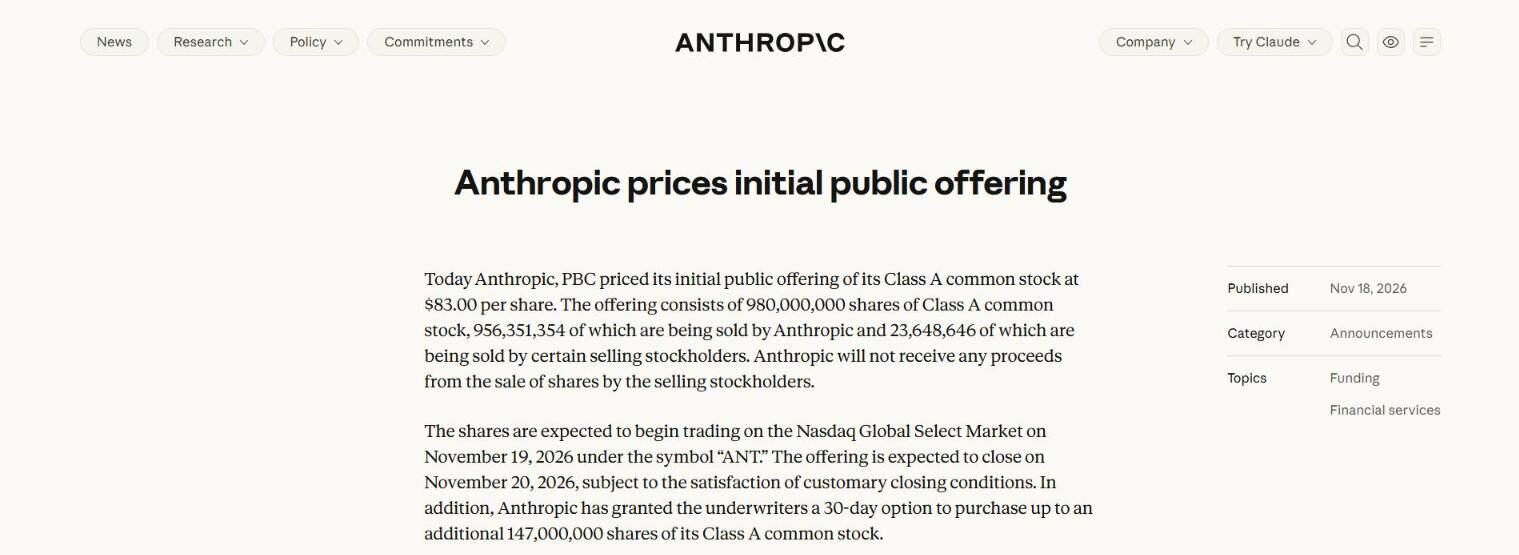
The pricing announcement settles the Anthropic IPO terms. The offering consists of 980,000,000 Class A shares at $83.00: 956,351,354 new shares from the company and 23,648,646 from selling stockholders, up from 825,000,000 shares in the last S-1 amendment. Anthropic also granted the underwriters a 30-day option to buy up to 147,000,000 more Class A shares, which would be newly issued. Anthropic gets no proceeds from the shares the selling stockholders sell.
News coverage puts the Anthropic valuation higher. The Associated Press reported that the $83 price values Anthropic at $1.5 trillion and that the offering raised about $81 billion, without saying which share count it used. Our $1.1 trillion counts only shares outstanding after the offering. The breakdown below the table shows that adding option, RSU and reserved plan shares closes most of that gap, though AP didn’t say whether it counted them.
Anthropic stock on its first day of trading
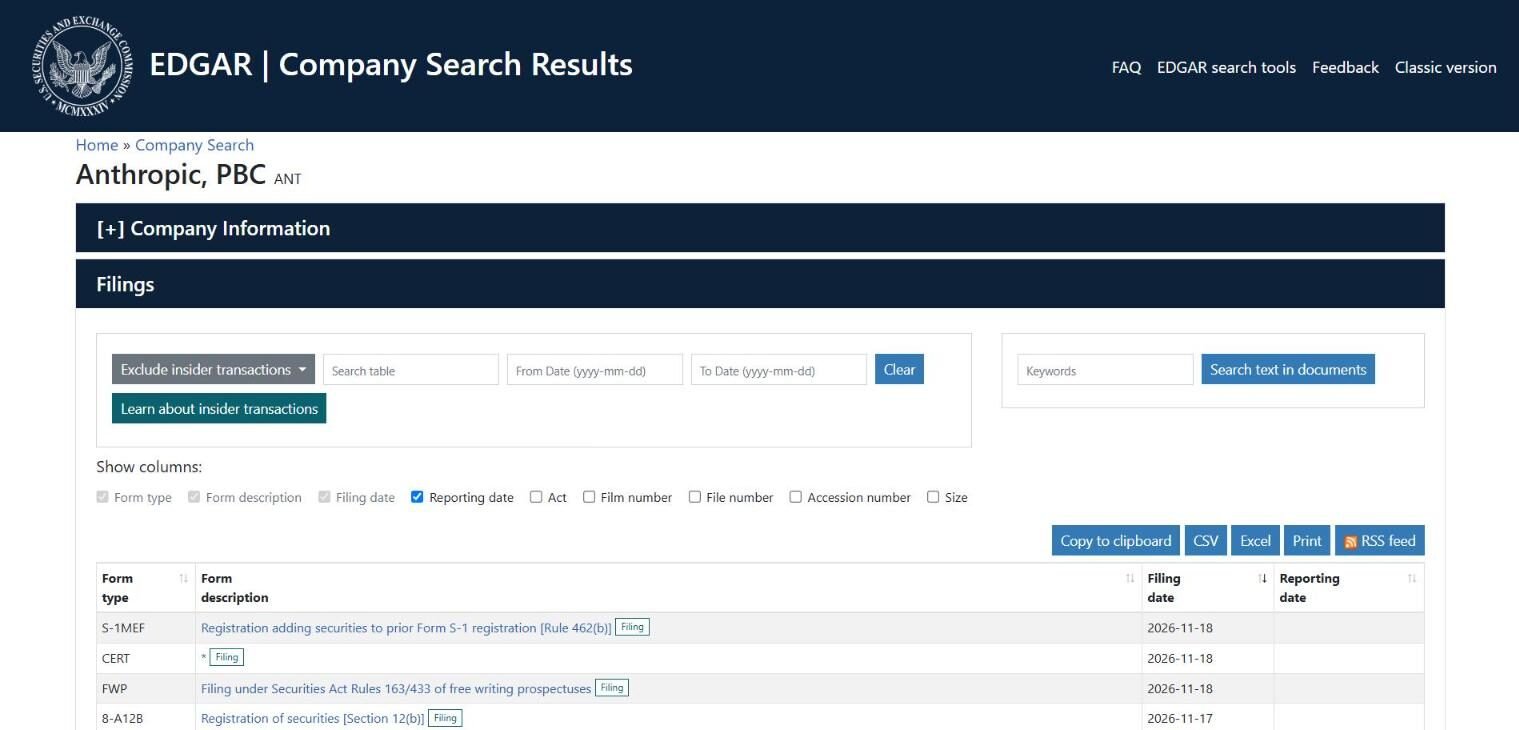
Anthropic stock had a big but uneven debut. Dario and Daniela Amodei rang the Nasdaq opening bell at 9:30 a.m. ET, yet ANT’s first trade didn’t come until just before noon, at $111.50, according to Forbes. That’s 34.3% above the $83.00 Anthropic IPO price. The stock hit $115.10 soon after, then gave back more than half of that gain. It closed at $97.17, up 17.1% from the IPO price but 12.9% below its first trade.
Trading was heavy. More than 600 million shares had changed hands by 1:30 p.m. ET, Forbes reported, citing CNBC. Forbes said that topped SpaceX’s first-day volume of 522 million shares.
Forbes reported a closing market value of $1.27 trillion, without giving a share count. Our count of about 13.2 billion shares times $97.17 gives about $1.28 trillion. The S-1/A’s count of 13.09 billion shares, which predates the final deal terms, gives $1.27 trillion at the same price (our math).
A fully diluted Anthropic valuation is higher. Adding outstanding options and RSUs lifts our figure to about $1.56 trillion, and also counting the 1.92 billion shares reserved under the 2026 equity plan gives about $1.75 trillion (our math). Some outlets reported a fully diluted value close to that last figure without giving their share count.
Anthropic IPO numbers from the S-1, in one table
We pulled these figures from Amendment No. 3 to the Form S-1 filed with the SEC on November 17, 2026, then updated the deal terms from Anthropic’s November 18 pricing announcement. Rows marked “our math” are our own calculations, explained below the table.

| Metric | Figure |
|---|---|
| IPO price | $83.00 per share, set November 18, 2026 (range was $70.00 to $78.00) |
| Shares offered | 980,000,000 Class A shares (956,351,354 from Anthropic, 23,648,646 from existing holders), up from 825,000,000 |
| Extra shares the underwriters can buy | Up to 147,000,000 within 30 days (was 123,750,000) |
| Exchange and Anthropic stock ticker | Nasdaq Global Select Market, ANT |
| Banks acting for the underwriters | Goldman Sachs and Morgan Stanley, with J.P. Morgan, Citigroup, Barclays and others in the group |
| Concurrent private placement | $26.0 billion of non-voting Class N stock at the IPO price, about 313.3 million shares at $83 (our math), contingent on completion of the IPO |
| Gross proceeds at $83 (our math) | About $81.3 billion from the 980 million shares, about $79.4 billion of it to Anthropic before underwriting fees, plus $26.0 billion from the placement |
| Revenue, January to September 2026 | $33.2 billion (vs. $2.5 billion a year earlier) |
| Revenue, July to September 2026 | $17.0 billion (vs. $1.4 billion a year earlier) |
| Operating loss, January to September 2026 | $1.3 billion (vs. $5.2 billion a year earlier) |
| Net loss, January to September 2026 | $104.0 billion, including a $94.3 billion non-cash change in the value of convertible notes and similar instruments |
| Run-rate revenue (company metric) | About $81 billion as of October 31, 2026 |
| Customers paying $100,000 or more over 12 months | More than 11,900, up from more than 950 a year earlier |
| Shares outstanding after the Anthropic IPO and placement | About 13.2 billion at $83 (our math from the S-1 count of 13,086,672,593 at $74) |
| Implied market value (our math) | About $1.1 trillion at $83, excluding outstanding stock options, unsettled RSUs and any exercise of the underwriters’ option |
| First day of trading, November 19, 2026 | Opened at $111.50 and closed at $97.17, up 17.1% from the $83.00 IPO price (Forbes) |
| Market value at the first-day close (our math) | About $1.28 trillion at $97.17 on about 13.2 billion shares, excluding options and RSUs |
How we got the last rows: the S-1 says 13.09 billion shares will be outstanding after the offering and the private placement. That figure starts from shares outstanding on September 30, 2026 and assumes 801.4 million new shares at the $74 midpoint, with no exercise of the underwriters’ option. The final deal adds 155 million new shares, and at $83 the $26.0 billion placement buys about 313.3 million shares instead of 351.4 million. That nets out to about 13.2 billion shares, and 13.2 billion times $83 is about $1.1 trillion.
Treat that as the base Anthropic valuation, before dilution. Outstanding stock options, unsettled restricted stock units and the underwriters’ option are left out, so a fully diluted figure would be higher. Adding the 1.77 billion option shares and about 1.07 billion RSU shares the S-1 lists brings the count to about 16.05 billion, or roughly $1.33 trillion at $83. Counting the 1.92 billion shares reserved for future awards under the 2026 equity plan as well, which haven’t been granted, gives about $1.49 trillion.

Run-rate revenue is Anthropic’s own metric, built by annualizing recent usage and subscription fees. It isn’t audited revenue.
Who controls Anthropic after the IPO
Buying Anthropic stock gets you a slice of the economics, not much say in how the company is run. Anthropic is a Delaware public benefit corporation. Its board must balance shareholders’ financial interests, the interests of people materially affected by its conduct, and its stated purpose: “the responsible development and maintenance of advanced AI for the long-term benefit of humanity.”
The S-1 describes five classes of common stock:
- Class A: the shares sold in the IPO. One vote each.
- Class N: the same economics as Class A, with no vote. Held mainly by strategic partners, and converts to Class A when sold to an unaffiliated buyer.
- Class T: held by the Long-Term Benefit Trust, a group of financially disinterested trustees. It elects the Class T directors, who make up a majority of the board. No economic rights.
- Class F: one share, held by an LLC owned by the seven co-founders, including CEO Dario Amodei and President Daniela Amodei. It carries 50.1% of the vote on general shareholder matters. No economic rights.
- Class E: issued to employees other than the co-founders. It votes only on limited matters and has no economic rights.
Because the trust elects a majority of the board, the filing calls Anthropic a “controlled company” under Nasdaq rules, which can exempt it from some board-independence requirements. Anthropic says it expects to use that exemption only for its nominating and corporate governance committee. Its board currently has a majority of independent directors, and its audit and compensation committees are fully independent.
What the Anthropic IPO means for businesses that use Claude
Picture a team that has built its drafting or code-review routine around Claude. Nothing in their contract changes on listing day. What changes is what they can check: a 10-K and quarterly 10-Qs instead of press coverage. If you buy AI tools for a team, I’d start a vendor file now with the S-1 and add each filing as it comes out, not after something goes wrong.
You get SEC-filed numbers for vendor reviews
Once Anthropic is public, it has to file a Form 10-Q for each of its first three fiscal quarters, a Form 10-K every year and a Form 8-K, usually within four business days, when certain major events happen, as the SEC explains. For procurement and security teams, that’s a steady record for the vendor file: audited annual figures, plus CEO and CFO certifications on every 10-K and 10-Q. If you run a formal review, our AI vendor questionnaire lists the other questions to ask.
Compute is the biggest cost and a named use of the cash
The filing says the Anthropic IPO proceeds will go to general corporate purposes, including compute and infrastructure, hiring, possible acquisitions and taxes tied to employee stock awards. Compute is already the biggest cost: $18.8 billion in the first nine months of 2026. Anthropic also says its Opus 5.5 model cut customers’ cost per task by about 40% compared with Opus 5. That’s the company’s claim, so check it against your own bills.
Customers are expanding fast, so watch your own usage
Anthropic reports net revenue retention of about 900% as of September 30, 2026. In plain terms, existing customers as a group are spending far more than they did a year earlier. If your teams keep adding Claude Code seats or new API use cases, set budget alerts before the bill surprises finance.
Legal risk is now on the record
The 2025 results include a $1.5 billion settlement of Bartz v. Anthropic, a copyright class action that Anthropic agreed to settle in September 2025. A federal court approved the settlement in July 2026. The risk factors also warn that rulings in AI copyright cases against other developers could affect Anthropic’s business. If you publish or ship anything Claude writes, read the IP indemnity terms in your agreement.
What to do this week
- Save the S-1 risk factors to your AI vendor file and flag anything about data use, uptime or legal exposure. Our AI risk assessment template has a section for this.
- Pull your Claude contract and check three clauses: IP indemnity, how your data may be used, and how much notice you get before price changes.
- Set API spend alerts or seat caps if usage is growing across teams.
- Add the first earnings report after the Anthropic IPO to your next vendor review.
- Don’t switch or drop AI tools because of the Anthropic stock price. If you’re weighing options anyway, our Gemini vs ChatGPT and Copilot vs ChatGPT comparisons can help.
Our Take / Expert Perspective
The real question for most of our readers isn’t whether Anthropic stock is a good investment. It’s whether going public makes Anthropic a different kind of vendor. In the short run, it doesn’t. The same people control the company, and the trust-plus-founder structure is built to keep it that way.
I wouldn’t change any tool or vendor plan because of this listing. The share price tells you about investor mood, not about whether the product fits your work. What I would change is the paperwork: read the risk factors, note the founder-and-trust control structure and re-check your IP indemnity and price-change notice clauses. Judge Claude, or any rival, on output quality, cost and terms, the same way you did last month.
What does change is visibility. Quarterly revenue went from $1.4 billion in the third quarter of 2025 to $17.0 billion a year later. The company posted a $974 million operating profit in the second quarter of 2026 and a $567 million operating loss in the third, which included $1.96 billion of non-cash charitable contributions. Public filings will show whether results settle down, and that matters more to a buyer than the Anthropic stock price.
Our forecast: over the next 3 to 12 months, enterprise buyers will start asking AI vendors for the same financial evidence they ask of cloud providers. Public filings make Anthropic easier to vet than its private rivals. The trade-off is concentrated control. Class A holders get a vote, but they can’t outvote the founders’ share and the trust.
Our recommendation: put the S-1 risk factors and Anthropic’s first post-IPO earnings report into your next AI vendor review. Pair them with your AI governance framework so spending and risk get checked together.
Frequently Asked Questions
Is Anthropic going public, and what is the Anthropic IPO date?
Yes. The Anthropic IPO priced on November 18, 2026, and its Class A shares started trading on the Nasdaq Global Select Market under ANT on November 19, 2026. They opened at $111.50 and closed the first day at $97.17, up 17.1% from the IPO price. The offering is expected to close on November 20, subject to customary closing conditions.
What is the Anthropic stock ticker?
Anthropic has been approved to list its Class A common stock on the Nasdaq Global Select Market under the symbol ANT. That’s stated on the cover of Amendment No. 3 to its S-1, filed November 17, 2026.
What was the Anthropic IPO price?
The Anthropic IPO price was $83.00 per share, set on November 18, 2026. That’s above the $70.00 to $78.00 range in the S-1, and the offering grew from 825 million to 980 million Class A shares.
What is the Anthropic valuation at the IPO price?
Neither the S-1 nor the pricing announcement gives an Anthropic valuation at the $83 price. By our math, about 13.2 billion shares outstanding after the offering and private placement, multiplied by $83.00, comes to about $1.1 trillion. That excludes outstanding stock options, unsettled restricted stock units and any exercise of the underwriters’ option, so a fully diluted figure is higher. News reports, including the Associated Press, cite $1.5 trillion without giving a share count. Adding options, RSUs and shares reserved under the 2026 equity plan to our count gives about $1.49 trillion, which is one way to reach a figure that size. At the first-day close of $97.17, our share count gives about $1.28 trillion, while Forbes reported $1.27 trillion.
Can I buy Anthropic stock?
Yes. Anthropic stock has traded under the ticker ANT since November 19, 2026, and you can buy and sell it through brokerage accounts that offer Nasdaq-listed stocks, though availability varies by broker and country. Before pricing, the amended S-1 said Anthropic expected retail allocations in the US and other countries to be up to 20% of the Class A shares offered, depending on demand, partly through broker platforms including Charles Schwab, Fidelity, Robinhood, SoFi, Trade-PMR and E*TRADE, subject to each platform’s own terms. The pricing announcement doesn’t say how many shares went to retail investors.
Does the Anthropic IPO change anything for businesses that use Claude?
Not directly. Your contract stays the same unless it’s changed under its own terms. The practical difference is transparency: as a public company, Anthropic must file quarterly and annual reports, which give procurement teams certified financial data for vendor reviews.
This article is for general information only and is not investment advice. Consult a licensed financial professional before making any investment decision.
Sources
- U.S. Securities and Exchange Commission: Anthropic, PBC Form S-1/A, Amendment No. 3, filed November 17, 2026, checked November 18, 2026
- U.S. Securities and Exchange Commission: Anthropic, PBC Form S-1/A, Amendment No. 2, filed November 10, 2026, checked November 18, 2026
- U.S. Securities and Exchange Commission: Anthropic, PBC Form 8-A, filed November 17, 2026, checked November 18, 2026
- U.S. Securities and Exchange Commission: EDGAR filing index for Anthropic, PBC (CIK 0002130357), checked November 19, 2026
- Anthropic: Anthropic confidentially submits draft S-1 to the SEC, checked November 18, 2026
- U.S. Securities and Exchange Commission: Exchange Act Reporting and Registration, checked November 18, 2026
- U.S. Securities and Exchange Commission: Form CERT, Nasdaq certification approving Anthropic’s Class A shares for listing, filed November 18, 2026, checked November 18, 2026
- Anthropic: Anthropic prices initial public offering, November 18, 2026, checked November 18, 2026
- U.S. Securities and Exchange Commission: Anthropic, PBC Form S-1MEF, filed November 18, 2026, checked November 18, 2026
- Associated Press via PBS NewsHour: Anthropic prices its IPO at $83 per share, valuing the AI giant at $1.5 trillion, November 18, 2026, checked November 18, 2026
- Forbes: Live coverage of Anthropic’s first day of trading on Nasdaq, November 19, 2026, checked November 19, 2026





Leave a Reply