


Last updated: November 18, 2026
Reviewed by a certified public accountant (CPA) on November 13, 2026.
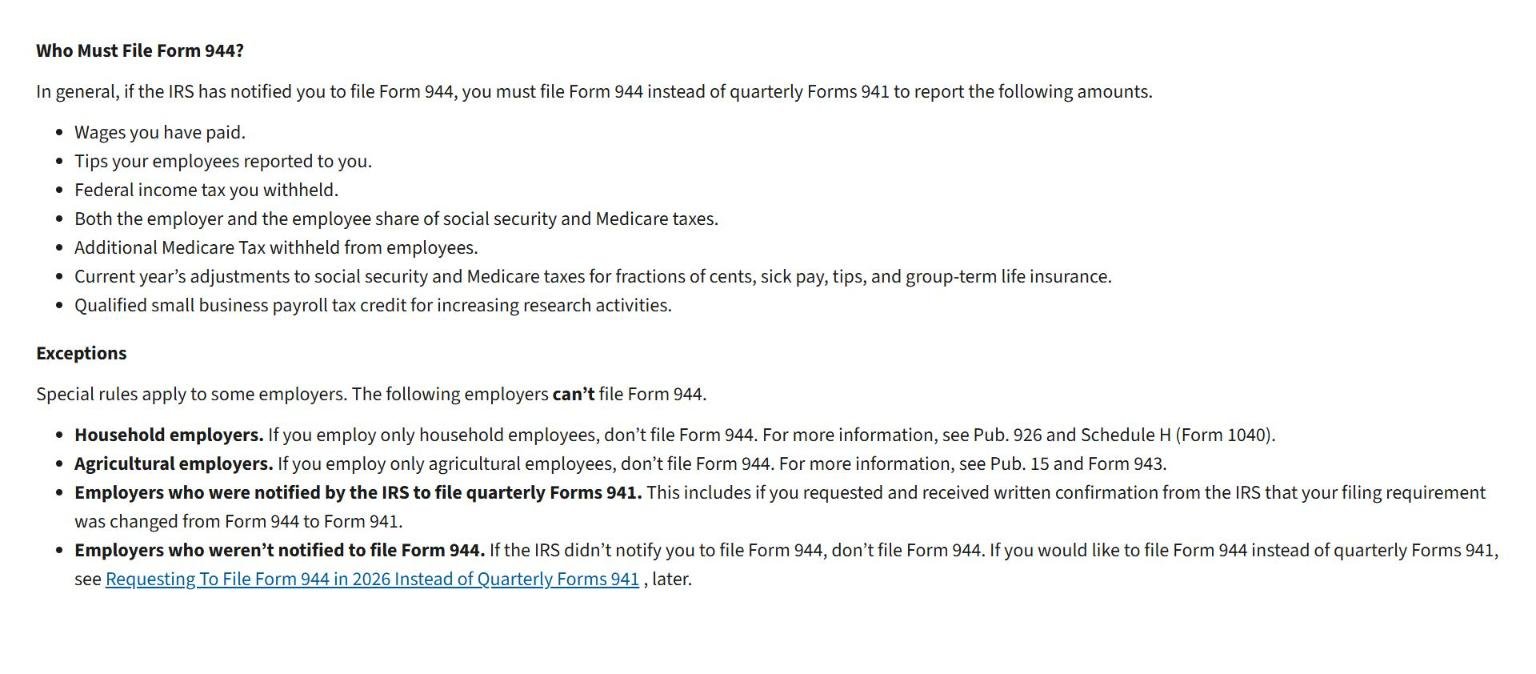
Form 944 is the IRS’s annual employment tax return for the smallest employers, and it replaces four quarterly Forms 941 with one filing. Being small doesn’t let you pick it, though. The IRS has to tell you in writing to file it, and that notice goes only to employers whose yearly payroll tax bill is $1,000 or less.
Short answer: Form 944 is for employers that owe $1,000 or less a year in Social Security, Medicare and withheld federal income tax, which usually means $5,000 or less in wages. You file it only after the IRS notifies you in writing. The 2026 return is due February 1, 2027, or February 10 if every deposit was made on time.
Key takeaways
- Eligibility turns on tax owed, not headcount: $1,000 or less a year in Social Security, Medicare and withheld income tax.
- Without a written IRS notice, you keep filing quarterly Form 941, even if your liability is small.
- For 2026, requests to switch ran January 1 to April 1 by phone, or by letter postmarked January 1 to March 16.
- If your total liability for the year is under $2,500, you can pay it with the return instead of depositing.
- Mistakes on a filed annual return are fixed on Form 944-X, not Form 941-X.
Table of Contents
What Form 944 is and who can file it
Officially called the Employer’s Annual Federal Tax Return, Form 944 covers the same taxes as Form 941: income tax withheld from paychecks plus the employee and employer shares of Social Security and Medicare. The difference is timing. According to the IRS Instructions for Form 944, it’s aimed at employers that owe $1,000 or less a year in those taxes.
The IRS translates that into wages: under current rates, an employer that would otherwise file quarterly Forms 941 can ask to file annually if it expects to pay $5,000 or less in wages subject to Social Security and Medicare tax. Two groups can’t use it at all:
- Household employers who only employ people in their home.
- Agricultural employers who only employ farmworkers.
The most misunderstood rule is the notice. Filing this annual return is required only if the IRS has notified you in writing. Being small isn’t enough; without that letter, Form 941 every quarter is still the default.
Form 944 vs 941: the differences at a glance
The comparison below comes from the IRS instructions for Form 944 and Form 941-X, checked November 12, 2026.
| Point | Form 944 | Form 941 |
|---|---|---|
| How often you file | Once a year | Every quarter |
| Who files | Employers the IRS has notified in writing; liability of $1,000 or less | Most employers |
| When it’s due | January 31 after the tax year, moved to the next business day on weekends | April 30, July 31, October 31 and January 31 |
| Grace period for timely depositors | February 10 if all deposits were made on time and in full | See the Form 941 instructions |
| Correction form | Form 944-X | Form 941-X |
Form 940, the federal unemployment (FUTA) return, is separate and annual for everyone. Our Form 940 guide covers it.
How to request Form 944, or switch back to Form 941
The IRS sets a request window at the start of each year. For calendar year 2026, the IRS instructions gave these options:
- Call the IRS at 800-829-4933 (267-941-1000 from outside the U.S.) between January 1 and April 1, 2026.
- Or write to the IRS with a request postmarked between January 1 and March 16, 2026, sent to Ogden, UT 84201-0038 or Cincinnati, OH 45999-0038, depending on where you’d mail a return without a payment.
- Wait for the written notice. If it doesn’t arrive, you file quarterly Forms 941 for 2026.
The same phone numbers and deadlines apply in reverse. An annual filer that has grown and wants to file quarterly can request Form 941 in the same window. For 2027, the 2026 instructions say to call between January 1 and April 1, 2027, or send a written request postmarked between January 1 and March 15, 2027.
Form 944 due date for 2026 wages
The return is due January 31 after the tax year. When that date falls on a weekend, it moves to the next business day, which is why the 2025 return was due February 2, 2026.
January 31, 2027 is a Sunday, so under the same rule the 2026 return is due Monday, February 1, 2027. If you made every deposit on time and in full, the IRS gives you until February 10, 2027 to file. Forms W-2 for the same year share the February 1, 2027 deadline.
Form 944 deposit rules
Filing once a year doesn’t always mean paying once a year. Whether you have to deposit during the year depends on how much tax builds up:
| Your liability | What to do |
|---|---|
| Less than $2,500 for the whole year | No deposits required. You can pay with the return. |
| $2,500 or more for the year, but less than $2,500 in a quarter | Deposit by the last day of the month after the quarter ends. |
| $2,500 or more in a quarter | Deposit monthly or semiweekly, under your deposit schedule. |
| $100,000 or more on any day | Deposit by the next business day. |
Semiweekly depositors also attach Form 945-A to report their daily tax liability, and the IRS can assess deposit penalties if it’s missing. Paying a required deposit with the return instead can trigger a penalty as well.
A Form 944 example with 2026 numbers
Take a sole-owner consulting firm that pays one part-time assistant $4,800 in 2026. The rates come from the IRS instructions, and the withholding figure is an assumption for the example:
| Item | Calculation | Amount |
|---|---|---|
| Social Security tax (employee and employer) | $4,800 x 12.4% | $595.20 |
| Medicare tax (employee and employer) | $4,800 x 2.9% | $139.20 |
| Federal income tax withheld | Assumed from the employee’s Form W-4 | $240.00 |
| Total liability for the year | $974.40 |
The total stays under $1,000, so this employer fits the annual-filer profile, and because it’s under $2,500 it can pay with the return. Raise the assistant to $6,000 and the same math lands above $1,000. That’s the point to think about switching back to quarterly filing for the next year.
High earners don’t change the math for small employers, but for reference, the Social Security wage base is $184,500 for 2026 and $192,300 for 2027, according to the Social Security Administration. Medicare has no wage cap.
How to fill out Form 944, line by line
The line numbers below follow the 2026 Form 944 and the IRS Instructions for Form 944, checked November 18, 2026. Check them again in later years, because the IRS adds or renumbers lines when the law changes.
| Line | What you enter | Watch for |
|---|---|---|
| 1 | Taxable wages, tips and other pay for the year, the amounts that also go in box 1 of your employees’ Forms W-2 | Pre-tax 401(k) deferrals stay out of box 1 but are still Social Security and Medicare wages |
| 2 | The federal income tax you withheld (or were required to withhold) during the year, including on tips, taxable fringe benefits and supplemental unemployment pay | Leave out income tax withheld by a third-party sick pay payer |
| 3 | A check box if none of the line 1 pay is subject to Social Security or Medicare tax | If you check it, skip to line 5 |
| 4a | Taxable Social Security wages, times 12.4% | Stop at the wage base for each employee: $176,100 for 2025, $184,500 for 2026 |
| 4b | Taxable Social Security tips, times 12.4% | Tips employees reported to you; service charges aren’t tips |
| 4c | Taxable Medicare wages and tips, times 2.9% | No wage cap |
| 4d | Wages above $200,000 paid to any one employee, times 0.9% | Additional Medicare Tax has no employer share |
| 5 | Line 2 plus line 4e, the total of lines 4a to 4d | Your tax before adjustments |
| 6 | Current-year adjustments, such as fractions of cents, third-party sick pay and uncollected employee tax on tips | Prior-year errors go on Form 944-X, not here |
| 7 to 9 | Total after adjustments, less the research payroll tax credit from Form 8974 on line 8 | Line 9 drives the $2,500 deposit test and can’t be below zero |
| 10 | Deposits made for the year, plus overpayments applied from earlier returns | Use deposit records, not payroll reports |
| 11 | Balance due, if line 9 is more than line 10 | Nothing to pay if it’s under $1 |
| 12a to 12e | Overpayment, and whether you want a refund or a credit on your next return | Check one box only; refunds now go by direct deposit |
Parts 2 to 5: deposits, closing, designee and signature
Part 2 (line 13) is about your deposit schedule. If line 9 is under $2,500, check the first box and move on. At $2,500 or more, monthly schedule depositors enter each month’s liability based on when wages were paid, not when deposits were made, and the total on line 13m must equal line 9. Semiweekly depositors leave those boxes blank and attach Form 945-A instead.
Part 3 (line 14) applies only if you closed the business or stopped paying wages. Enter the last date you paid wages and attach a statement naming the person who keeps the payroll records and where they’re kept.
Part 4 lets you name a third-party designee, such as your bookkeeper, with a five-digit PIN. That person can answer IRS questions about the return but can’t bind you, and the permission expires one year after the due date.
Part 5 is the signature. The owner signs for a sole proprietorship; a president, vice president or other principal officer for a corporation; a responsible partner, member or officer for a partnership; and the fiduciary for a trust or estate. A paid preparer also signs and enters a PTIN.
The example employer’s return
Using the consulting firm above, and assuming no pre-tax deductions, the return reads: line 1, $4,800; line 2, $240.00; line 4a, $4,800 of wages and $595.20 of tax; line 4c, $4,800 and $139.20; line 4e, $734.40; and line 5, $974.40. With no adjustments or credits, lines 7 and 9 are also $974.40.
Because line 9 is under $2,500, the firm didn’t have to deposit during the year. Line 10 is zero, line 11 shows a $974.40 balance due paid with the return, and the first box on line 13 is checked.
Filing, paying and correcting Form 944
- E-file it. The IRS encourages electronic filing and lets you e-file and pay a balance due in one step with electronic funds withdrawal. Some providers charge a fee.
- Pay electronically. The instructions ask for balance-due payments to be made electronically, and refunds can now go by direct deposit.
- Correct with Form 944-X. If you find an error on a filed annual return, file Form 944-X separately. Form 941-X is only for Form 941.
- Keep the records. Our guide to how long to keep employee records covers payroll retention.
Form 944 penalties and interest
Filing once a year doesn’t soften the penalties. IRS Publication 15 (2026) says the deposit penalties apply to Form 944 filers, and the late-filing and late-payment penalties work the same way they do for quarterly filers:
| Problem | Penalty | Source |
|---|---|---|
| Late return | 5% of unpaid tax per month or partial month, usually capped at 25% | Publication 15 |
| Late payment | 0.5% a month or part of a month on the tax still owed, up to 25% | Publication 15 |
| Deposit made 1 to 5 days after the due date (calendar days) | 2% of the late deposit | IRS failure to deposit page |
| Deposit made 6 to 15 days after the due date | 5% of the late deposit | IRS failure to deposit page |
| Deposit made 16 or more days after the due date | 10% of the late deposit | IRS failure to deposit page |
| Still unpaid more than 10 days after the IRS’s first notice, or once you receive a demand for immediate payment, whichever comes first | 15% of the amount still owed | IRS failure to deposit page |
| Trust fund taxes not withheld or not paid over | Trust fund recovery penalty equal to 100% of the unpaid trust fund tax, which can be charged personally to responsible people who act willfully | Publication 15 |
Deposit penalties don’t stack. A deposit 20 days late costs 10%, not 2% plus 5% plus 10%, according to the IRS failure to deposit penalty page. The IRS does charge interest on penalties, though, and it keeps running until the balance is paid.

One break helps employers who move from Form 944 back to quarterly filing: Publication 15 says the deposit penalty won’t apply to a late deposit of January taxes if the full amount is deposited by March 15. If you believe a penalty shouldn’t apply, the Form 944 instructions point to Form 843 to request abatement. Since July 2026, the IRS’s Automatic Exemption from Penalty program has replaced First Time Abate. If you filed and paid Form 944 on time for the prior three years, it relieves failure-to-file, failure-to-pay and most deposit penalties, though not penalties for skipping electronic deposits.
New employers: asking for Form 944 on Form SS-4
A new business doesn’t have to wait for the January call window. Line 14 of Form SS-4, the EIN application, asks whether you want to file Form 944. According to the IRS Instructions for Form SS-4 (revised December 2025), you check it if you expect your employment tax liability for a full calendar year to be $1,000 or less, which generally means $5,000 or less in total wages.
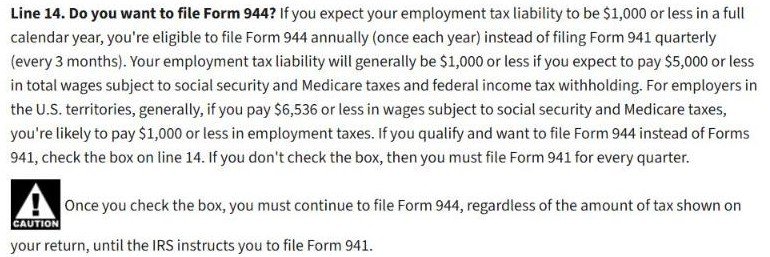
Think before you tick it. The same instructions say that once you check the box, you must keep filing Form 944, whatever the tax on your return, until the IRS tells you to file Form 941. Our view: if you expect to hire in your first year, leave the box blank and file quarterly from the start.
5 common Form 944 mistakes
- Filing annually without an IRS notice. Small liability alone doesn’t qualify you.
- Stopping Form 941 before the notice arrives. Keep filing quarterly until you have the letter.
- Paying everything with the return after crossing $2,500. Once the year’s liability reaches $2,500, deposit rules apply.
- Skipping Form 945-A as a semiweekly depositor. The IRS can assess deposit penalties without it.
- Correcting on the wrong form. Use Form 944-X, not Form 941-X.
Our Take / Expert Perspective
Our take: Form 944 saves less work than it looks. Payroll software files Form 941 automatically, so for most employers the real savings are three fewer returns to review, not three fewer calculations.
The bigger risk is drift. The annual return fits a business with one part-time employee, but many owners request it and then hire. Once wages pass roughly $5,000, you’re past the $1,000 liability line, and an annual return means an error can sit unnoticed for a full year before anyone looks at it. Quarterly filing catches a wrong withholding setup in three months.
Who it suits: very small employers with stable, predictable payroll, like a single part-time assistant or a family member on payroll, who would rather not file four returns. Who should skip it: anyone planning to hire in the next 12 months, or anyone close to the $2,500 deposit threshold, since you’ll be depositing during the year anyway.
What to do now: if you file annually today, project your 2027 payroll before the request window opens in January. If it’ll top $5,000 in wages, ask the IRS to move you back to Form 941 for 2027.
Frequently Asked Questions
Who files Form 944 instead of Form 941?
Only employers the IRS has notified in writing, which generally means businesses that owe $1,000 or less a year in Social Security, Medicare and withheld income tax. If you qualify and want to switch, call the IRS or send a written request in the window it sets at the start of each year, and wait for written confirmation before you change forms.
Is Form 944 being discontinued?
No. As of November 2026, the IRS still lists Form 944 as a current form, with a 2026 revision and instructions, and its page shows no recent developments. It remains the once-a-year return for the smallest employers.
When is Form 944 due for 2026?
February 1, 2027, because January 31 falls on a Sunday. If all your deposits were made on time and in full, you have until February 10, 2027.
Do Form 944 filers make tax deposits?
Only if liability reaches $2,500 for the year. Under that, you can pay with the return; above it, you deposit quarterly, monthly or semiweekly depending on how much builds up.
How do I correct a mistake on Form 944?
File Form 944-X for the year with the error. It’s filed separately from your next annual return, and the IRS’s employment tax correction page explains each type of adjustment.
What is the penalty for filing Form 944 late?
Generally 5% of the unpaid tax for each month or part of a month the return is late, up to 25%, plus 0.5% a month on tax paid late and interest. Late deposits during the year carry their own penalties of 2% to 15%.
This article is for general information only and is not tax, accounting or financial advice. Consult a licensed CPA or financial professional for your situation.
Sources
- Internal Revenue Service: IRS Instructions for Form 944 (2026), checked November 18, 2026
- Internal Revenue Service: Instructions for Form 941-X (Rev. April 2026), checked November 18, 2026
- Social Security Administration: Contribution and Benefit Base, checked November 18, 2026
- Internal Revenue Service: Publication 15 (2026), Employer’s Tax Guide, checked November 18, 2026
- Internal Revenue Service: Failure to Deposit Penalty, checked November 18, 2026
- Internal Revenue Service: Instructions for Form SS-4 (Rev. December 2025), checked November 18, 2026
- aiandblog: more Tax articles and our Editorial Policy









Leave a Reply