


Last updated: November 18, 2026
Reviewed by a certified public accountant (CPA) on November 18, 2026.
The December Fed meeting, set for Dec. 8-9, is the central bank’s last rate decision of 2026. Officials raised rates in September, two of them dissented in favor of another increase in October, and wholesale prices rose at their fastest annual pace in almost four years in the latest data.
Short answer: The Federal Reserve’s policy committee meets Dec. 8-9, 2026, and will release its rate decision and updated economic projections on Wednesday, Dec. 9. The federal funds target range stands at 3.75%-4%. Two officials dissented in October in favor of a hike, and producer prices rose 6.5% in the 12 months through October.
Key takeaways
- The Fed raised its target range a quarter point to 3.75%-4% on Sept. 16, 2026, and left it unchanged on Oct. 28 in a 10-2 vote.
- Governor Lisa Cook and Cleveland Fed President Beth Hammack, the two dissenters in October, favored another quarter-point increase.
- Officials’ median projection in September put the federal funds rate at 4.1% at the end of 2026, above the current midpoint of 3.875%.
- Consumer prices rose 3.7% in the 12 months through September. No 12-month figure was published for October because October 2025 data were never collected.
- The prime rate stands at 7%; a quarter-point Fed increase would typically lift it to 7.25%, along with rates on loans tied to prime.
Table of Contents
When is the Fed meeting in December 2026?
The Federal Open Market Committee meets Tuesday, Dec. 8, and Wednesday, Dec. 9, its final scheduled session of the year, according to the Federal Reserve’s meeting calendar. The Fed’s December calendar lists the meeting at 2 p.m. Eastern on Dec. 9, the time the October statement was released, and the chair’s news conference at 2:30 p.m. Minutes are scheduled for Dec. 30.
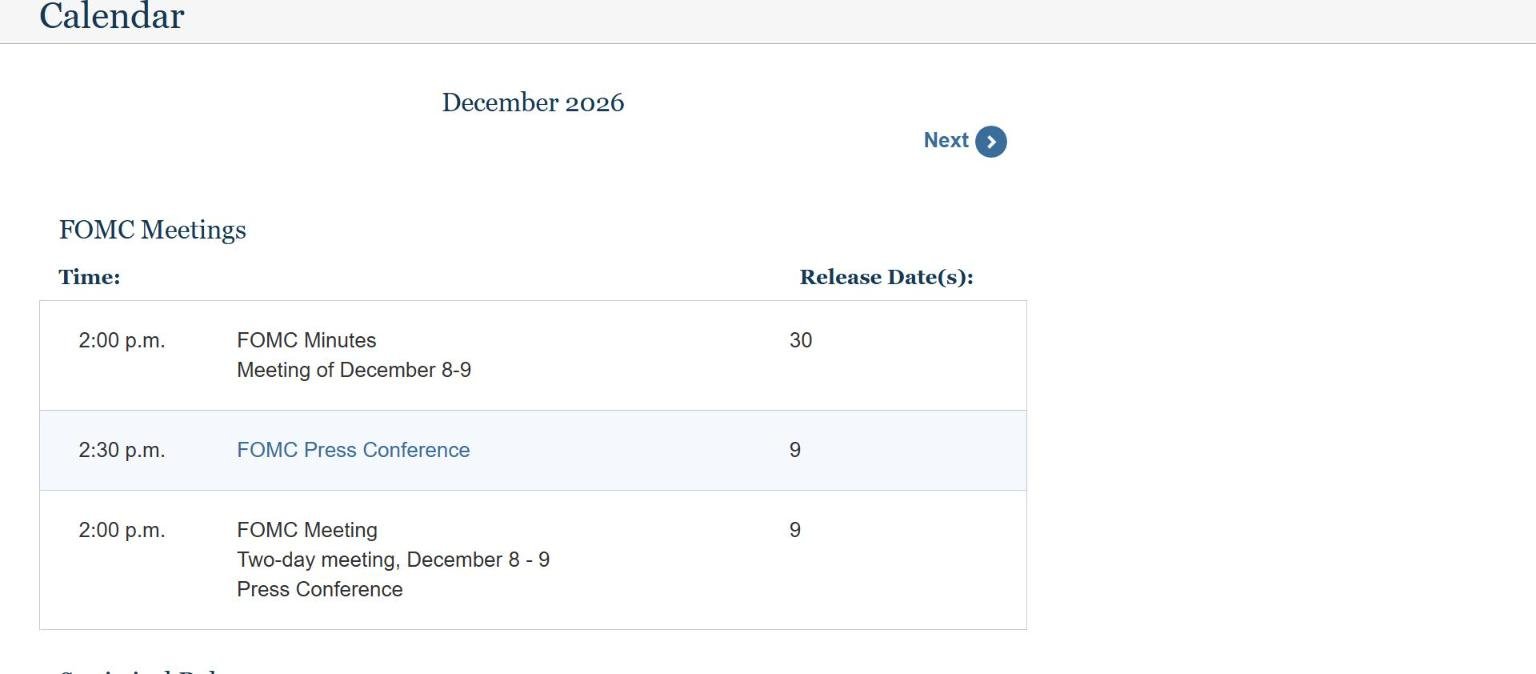
The December session is one of four meetings this year at which officials publish a Summary of Economic Projections, their forecasts for growth, unemployment, inflation and the federal funds rate. The package includes the so-called “dot plot,” which shows each official’s projection of the appropriate rate.
The next Fed meeting after that is Jan. 26-27, 2027, according to a revised tentative 2027 schedule released Nov. 12.
Where rates stand going into the December Fed meeting
Rates are higher than at the start of the year, and policymakers are debating whether to raise them further.
- Sept. 16, 2026: The Fed raised the target range a quarter point to 3.75%-4% in a 12-0 vote.
- Oct. 28, 2026: It held the range steady in a 10-2 vote, saying in its statement that inflation “remains elevated” and economic activity is “expanding at a strong pace.”
- Dissents: Governor Lisa D. Cook and Cleveland Fed President Beth M. Hammack each preferred a quarter-point increase in October.
- September projections: The median official expected the federal funds rate to end 2026 at 4.1% and PCE inflation of 3.7% in the fourth quarter from a year earlier.

Minutes of the October meeting, released Nov. 18 by the Federal Reserve, showed almost all participants judged that further increases broadly in line with the September projections would likely be appropriate under their baseline outlooks. A few who supported holding rates steady described the decision as a close call, and a couple said an increase of more than a quarter point could warrant consideration in December if incoming inflation data were unfavorable. The New York Fed’s Survey of Market Expectations, cited in the minutes, showed the median respondent expecting one increase in December and another in March 2027.
The 4.1% projection implies one more increase. Projections are reported as the midpoint of a range, and the current range of 3.75%-4% has a midpoint of 3.875%. A 4%-4.25% range, the result of one more quarter-point move, would have a midpoint of 4.125%, which rounds to 4.1%. Officials will publish new projections Dec. 9.
The inflation numbers the Fed will weigh
Two Bureau of Labor Statistics reports released in November will feed into the December debate, and one of them is missing a key figure.
Consumer prices: a missing annual number
Prices paid by consumers increased 0.4% in October, according to the October 2026 Consumer Price Index published Nov. 10, while the index excluding food and energy increased 0.3%. Because October 2025 prices were not collected while federal funding had lapsed, the Bureau of Labor Statistics did not report 12-month changes for most series. Gasoline, one of the exceptions, was 37.4% higher than a year earlier.
The most recent full annual reading, for September 2026, showed consumer prices up 3.7% from a year earlier and core prices up 2.6%. The gap was driven largely by energy, which rose 20.4% over 12 months. Food prices rose 2.5%.
Wholesale prices: fastest rise since 2022
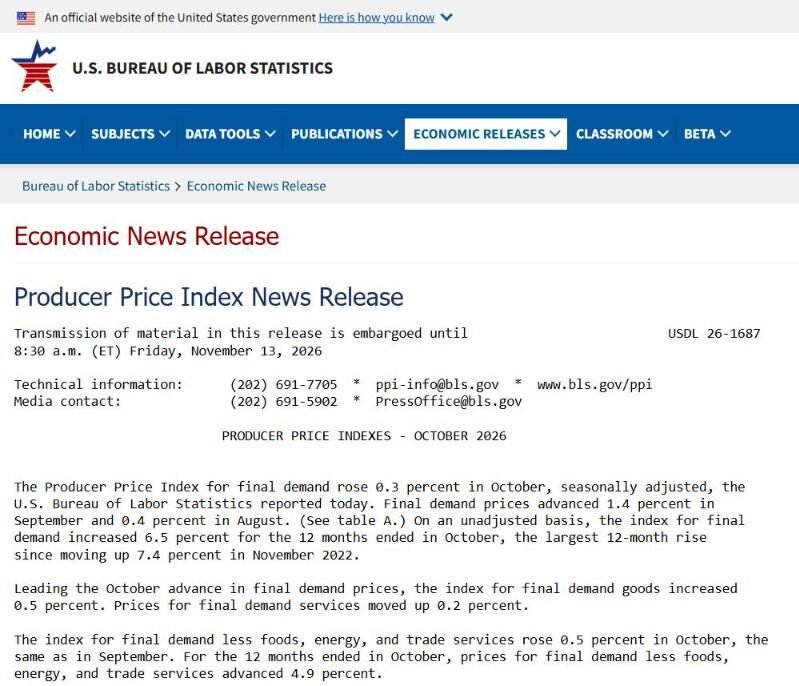
Final-demand producer prices increased 0.3% in October and were 6.5% higher than a year earlier, according to the Producer Price Index published Nov. 13. The 12-month increase was the largest since November 2022. Excluding food, energy and trade services, producer prices were 4.9% higher. Economists monitor producer prices because cost increases at the wholesale level can reach consumers with a lag.
Data still due before the decision
Several more government reports are due just before and just after officials vote, and the November inflation figures fall in the second group. Each is scheduled for 8:30 a.m. Eastern, according to the agencies’ release calendars.
- Nov. 25: The Bureau of Economic Analysis releases its second estimate of third-quarter GDP and the Personal Income and Outlays report for October, which includes the personal consumption expenditures price index. The Fed measures its 2% inflation goal with that index.
- Dec. 4: The Bureau of Labor Statistics publishes the November jobs report, the last monthly jobs report before the meeting.
- Dec. 8: BEA releases October trade figures on the first day of the meeting.
- Dec. 10: The November Consumer Price Index comes out the morning after the decision.
- Dec. 15: The November Producer Price Index follows.
Officials will have the October PCE figures and the November jobs data when they vote, but not November’s consumer or producer prices. Finance teams tracking the decision should read the Nov. 25 and Dec. 4 releases first. The Dec. 10 CPI report will show whether inflation is moving the way the Fed’s projections assume.
Key numbers going into the December Fed meeting
| Indicator | Latest reading | Source and date |
|---|---|---|
| Federal funds target range | 3.75% to 4.00% | FOMC statement, October 28, 2026 |
| Effective federal funds rate | 3.88% | Fed H.15, November 17, 2026 |
| Bank prime loan rate | 7.00% | Fed H.15, November 17, 2026 |
| 3-month Treasury yield (constant maturity) | 4.33% | Fed H.15, November 17, 2026 |
| 2-year Treasury yield | 4.80% | Fed H.15, November 17, 2026 |
| 10-year Treasury yield | 5.10% | Fed H.15, November 17, 2026 |
| CPI, 12 months to September | 3.7% (core 2.6%) | BLS, October 14, 2026 |
| CPI, October, one month | 0.4% (core 0.3%) | BLS, November 10, 2026 |
| PPI final demand, 12 months to October | 6.5% (core 4.9%) | BLS, November 13, 2026 |
| Median year-end 2026 fed funds projection | 4.1% | FOMC projections, September 16, 2026 |
The Fed’s H.15 rate table shows the 2-year Treasury yield at 4.80%, nearly a full percentage point above the effective federal funds rate of 3.88%. In our reading, that gap suggests bond investors expect short-term rates to stay high or rise over the next two years rather than fall.
What a December rate hike would mean for your business
The Fed does not set loan rates directly, but its decisions move the benchmarks banks use to price them.
- Prime-based loans and credit lines: The prime rate, now 7%, sits 3 percentage points above the top of the Fed’s target range, a spread major U.S. banks have used for years. A quarter-point Fed increase would typically lift prime to 7.25%, and variable-rate loans tied to it would reset at their next adjustment date.
- SOFR-based loans: The Secured Overnight Financing Rate has closely tracked the federal funds rate, so rates on these loans would likely rise as well, typically at the next reset.
- Cash balances: Three-month Treasury yields are about 4.3%, so cash left in a non-interest-bearing operating account carries an opportunity cost.
- Capital spending: Higher borrowing costs raise the return a financed equipment purchase or project must earn. Our CapEx vs OpEx guide explains how leasing and buying are treated differently in the accounts.
A worked example. A company with a fully drawn $500,000 credit line at prime plus 1% now pays 8%, or $40,000 a year in interest. If prime rises to 7.25%, the rate becomes 8.25% and annual interest rises to $41,250, an increase of $1,250 for each quarter point, before fees.
What finance teams should do before December 9
- List each variable-rate loan and credit line with its benchmark (prime or SOFR), spread and next reset date.
- Apply the worked example above to your own balances for a quarter-point and a half-point increase.
- Review loan covenants based on interest coverage or EBITDA. Our EBITDA guide explains how lenders use the measure in covenants.
- Move cash above your operating buffer into an account or instrument that pays a market rate.
- Include two rate scenarios in the 2027 budget and report the difference in month-end close reporting so leadership sees it early.
Our Take / Expert Perspective
For businesses, the December decision matters less than an assumption built into many 2027 budgets: that rates will fall next year. The September projections, the October dissents, the 6.5% rise in wholesale prices and the 2-year Treasury yield all point the other way.
The missing annual CPI figure for October adds uncertainty. Officials are likely to rely more on monthly data, producer prices and their own projections, which gives the December dot plot more weight than usual.
Companies with prime-based credit lines, small businesses that depend on credit cards and short-term loans, and companies planning financed capital spending in early 2027 are the most exposed. Companies with surplus cash stand to benefit, since they can earn around 4% on it.
Our forecast, which is only a forecast: if the December projections show a year-end 2027 median above 4%, lenders will build “higher for longer” into 2027 loan renewals. We recommend stress-testing 2027 budgets at current rates plus 0.5 percentage point before Dec. 9, so that a rate increase changes the forecast rather than the plan.
Frequently Asked Questions
When is the December Fed meeting, and what time is the decision?
The Federal Open Market Committee meets Dec. 8-9, 2026. The rate decision and new Summary of Economic Projections are due Wednesday, Dec. 9. The Fed’s December calendar lists the meeting at 2 p.m. Eastern, the same time the October statement was released, and the chair’s news conference at 2:30 p.m.
Where can I watch the Fed’s December press conference?
On the Federal Reserve’s website. The Fed posts video of each news conference on its meeting page, as it did for the Oct. 28 meeting, and adds a PDF transcript. The December news conference is scheduled for 2:30 p.m. Eastern on Dec. 9.
What is the current federal funds rate?
The target range is 3.75%-4%. The Fed set it on Sept. 16, 2026, and kept it there on Oct. 28. The effective federal funds rate was 3.88% on Nov. 17, 2026, according to the Fed’s H.15 release.
Will the Fed raise rates in December 2026?
That will not be known until the vote. Two officials dissented in favor of an increase in October, and minutes of that meeting show almost all participants saw further increases broadly in line with the September projections as likely appropriate. Futures pricing described in the minutes also put high odds on a quarter-point increase by year-end. The answer will come in the Dec. 9 statement and projections.
Why is there no annual CPI inflation rate for October 2026?
Because October 2025 prices were not collected while federal funding had lapsed. Without that base month, the Bureau of Labor Statistics could not calculate 12-month changes for most October 2026 indexes. The most recent full annual rate is 3.7%, for the 12 months through September 2026.
How does a Fed rate hike affect business loans?
Many variable-rate business loans are tied to the prime rate or SOFR, both of which move with the federal funds rate. Prime is 7%, so a quarter-point increase would typically raise it to 7.25%. Fixed-rate loans are unaffected, but new loans and renewals are likely to cost more.
This article is for general information only and is not tax, accounting or financial advice. Consult a licensed CPA or financial professional for your situation.
Sources
- Board of Governors of the Federal Reserve System: Meeting calendars and information, checked November 16, 2026
- Board of Governors of the Federal Reserve System: Federal Reserve issues FOMC statement, October 28, 2026, checked November 16, 2026
- Board of Governors of the Federal Reserve System: Minutes of the Federal Open Market Committee, October 27–28, 2026, released November 18, 2026, checked November 18, 2026
- Board of Governors of the Federal Reserve System: Federal Reserve issues FOMC statement, September 16, 2026, checked November 16, 2026
- Board of Governors of the Federal Reserve System: Summary of Economic Projections, Table 1, September 16, 2026, checked November 16, 2026
- Board of Governors of the Federal Reserve System: H.15 Selected Interest Rates, data for November 17, 2026, checked November 18, 2026
- Board of Governors of the Federal Reserve System: Revised tentative schedule of FOMC meetings in 2027, November 12, 2026, checked November 16, 2026
- U.S. Bureau of Labor Statistics: Consumer Price Index, October 2026, checked November 16, 2026
- U.S. Bureau of Labor Statistics: Consumer Price Index, September 2026, checked November 16, 2026
- U.S. Bureau of Labor Statistics: Producer Price Index, October 2026, checked November 16, 2026
- Board of Governors of the Federal Reserve System: Calendar: December 2026, checked November 18, 2026
- Board of Governors of the Federal Reserve System: October 27-28, 2026 FOMC Meeting press conference, checked November 18, 2026
- U.S. Bureau of Labor Statistics: Schedule of Releases for the Employment Situation, checked November 18, 2026
- U.S. Bureau of Labor Statistics: Schedule of Releases for the Consumer Price Index, checked November 18, 2026
- U.S. Bureau of Labor Statistics: Schedule of Releases for the Producer Price Index, checked November 18, 2026
- U.S. Bureau of Economic Analysis: Release Schedule, checked November 18, 2026





Leave a Reply