


Last updated: November 15, 2026
Reviewed by a certified public accountant (CPA) on November 15, 2026.
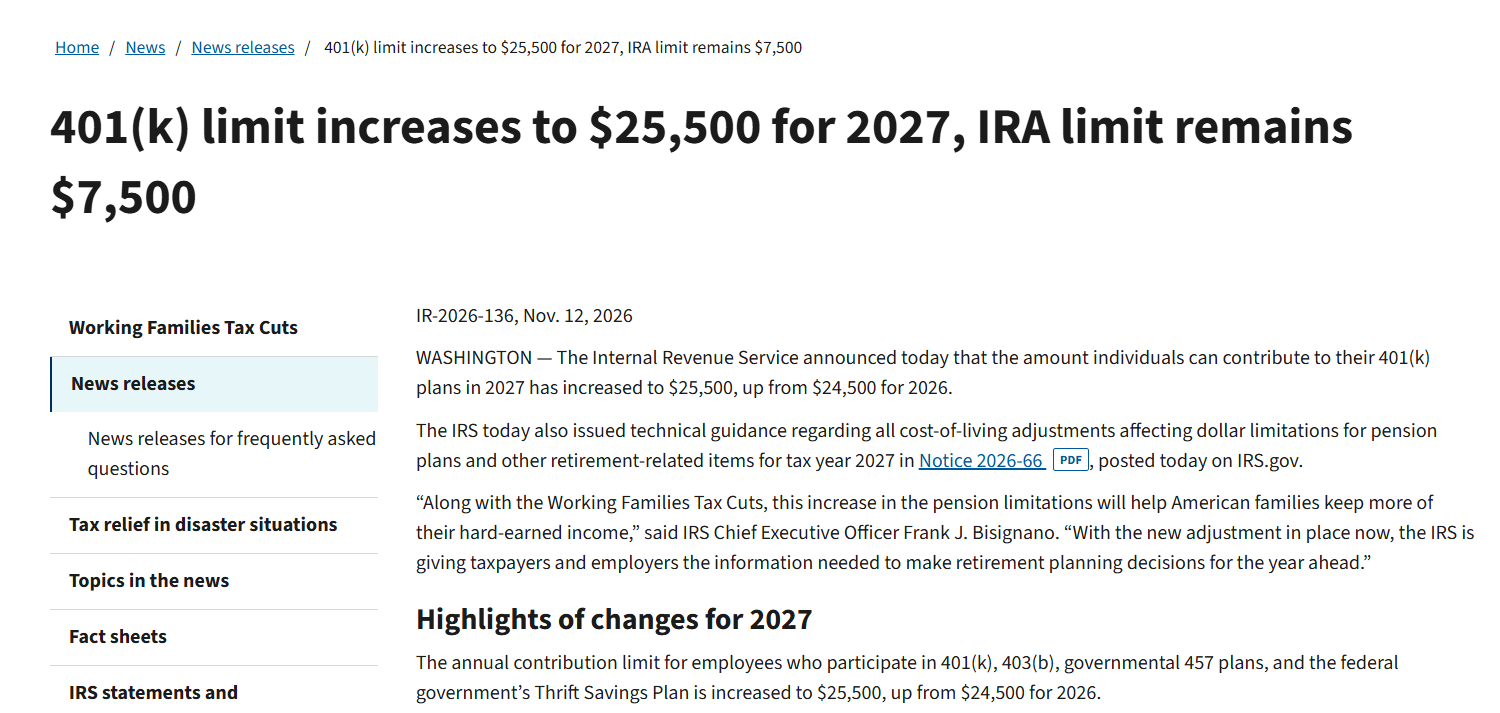
It’s official: the 401k contribution limits 2027 are set. On November 12, 2026, the IRS raised the employee deferral limit to $25,500, $1,000 more than in 2026, and the Milliman and Marsh forecasts from October were right to the dollar. The bigger 2027 change still isn’t a number. Catch-ups for higher earners must now go in as Roth, and the wage test that decides who counts as a higher earner is $155,000.
Short answer: The IRS announced the 2027 401(k) limits on November 12, 2026, in news release IR-2026-136 and Notice 2026-66. You can defer $25,500, plus an $8,500 catch-up at age 50 and over, or $11,750 at ages 60 to 63. Total annual additions rise to $75,000. If your 2026 FICA wages topped $155,000, your catch-ups must be Roth.
Key takeaways
- 2027 deferral limit: $25,500 for 401(k), 403(b), governmental 457(b) and Thrift Savings Plan accounts, up from $24,500.
- Catch-ups: $8,500 at age 50 and over and $11,750 at ages 60 to 63. Total annual additions: $75,000.
- Roth catch-up rule: if your 2026 FICA wages from the plan sponsor exceed $155,000, your 2027 catch-ups go in as Roth.
- Employer figures: compensation limit $375,000, highly compensated employee threshold $170,000, key employee threshold $245,000.
- The IRA limit stays at $7,500 with a $1,100 catch-up, and the SIMPLE limit rises to $17,500.
Table of Contents
401k contribution limits 2027 at a glance
Here are the official 2027 figures next to 2026. The 2027 numbers come from IRS Notice 2026-66, released with news release IR-2026-136 on November 12, 2026, and the 2026 numbers come from IRS Notice 2025-67.
| Limit | 2026 | 2027 (official) | Change |
|---|---|---|---|
| Employee deferral, 402(g) | $24,500 | $25,500 | +$1,000 |
| Catch-up, age 50 and over | $8,000 | $8,500 | +$500 |
| Higher catch-up, ages 60 to 63 | $11,250 | $11,750 | +$500 |
| Total annual additions, 415(c) | $72,000 | $75,000 | +$3,000 |
| Compensation limit, 401(a)(17) | $360,000 | $375,000 | +$15,000 |
| Highly compensated employee threshold | $160,000 | $170,000 | +$10,000 |
| Key employee threshold | $235,000 | $245,000 | +$10,000 |
| Roth catch-up wage threshold | $150,000 | $155,000 | +$5,000 |
| Governmental 457(b) deferral | $24,500 | $25,500 | +$1,000 |
| SIMPLE deferral (most plans) | $17,000 | $17,500 | +$500 |
Forecast vs official: how the projections did
Before the announcement, this page ran the Milliman and Marsh projections reported by 401(k) Specialist in October. Every one of them matched Notice 2026-66:
| Limit | Projected (October 2026) | Official (November 12, 2026) | Result |
|---|---|---|---|
| Employee deferral | $25,500 | $25,500 | Exact |
| Catch-up, 50 and over | $8,500 | $8,500 | Exact |
| Catch-up, ages 60 to 63 | $11,750 | $11,750 | Exact |
| Total annual additions | $75,000 | $75,000 | Exact |
| Compensation limit | $375,000 | $375,000 | Exact |
| HCE threshold | $170,000 | $170,000 | Exact |
| Roth catch-up wage threshold | $155,000 | $155,000 | Exact |
| Key employee threshold | No projection found | $245,000 | n/a |

How the IRS set the 2027 limits
The IRS updates retirement plan limits for inflation once a year, based on the change in the Consumer Price Index from the third quarter of a base period to the third quarter of the current year. That’s why it can’t lock in next year’s limits until September inflation data comes out. For 2027, it announced them on November 12, 2026; the 2026 limits came out on November 13, 2025.
The limits also move in set increments. The deferral and catch-up limits round down to the nearest $500 multiple, while other limits use bigger steps. That’s why forecasters can be confident: once September inflation data arrives, the result either reaches the next $500 step or falls short. According to the 401(k) Specialist report, Milliman measured CPI growth of 3.7% for the 12 months ended September 30, 2026, and put the annual increase factor at roughly 3.5%.
The employee deferral limit
The deferral limit, set by section 402(g) of the tax code, caps what you can contribute to a 401(k) from your paycheck each year, counting both pre-tax and Roth deferrals. The same 401(k) limit covers 403(b) plans and the federal Thrift Savings Plan, and governmental 457(b) plans carry a separate limit of the same size. For 2027, the 401(k) limit is $25,500, and the governmental 457(b) limit matches it.
Two practical points:
- It applies per person, not per plan. According to the IRS page on 401(k) contribution limits, you generally total your elective deferrals across every plan you participate in. If you change jobs partway through the year, tracking the combined amount is up to you.
- Excess deferrals have to be fixed by April 15. If you go over, notify the plan before April 15 of the next year so the excess and its earnings can be paid out. Excess amounts not withdrawn in time get taxed twice: once in the year deferred and again on distribution.
Here’s what maxing out the 2027 limit looks like per paycheck, before any catch-up:
| Pay frequency | Per paycheck at the 2027 limit of $25,500 | Per paycheck at the 2026 limit of $24,500 |
|---|---|---|
| Weekly (52) | $490.38 | $471.15 |
| Biweekly (26) | $980.77 | $942.31 |
| Semimonthly (24) | $1,062.50 | $1,020.83 |
| Monthly (12) | $2,125.00 | $2,041.67 |
If your plan calculates the match per pay period, spreading contributions evenly over the year matters. Front-loading can cost you match dollars in later paychecks unless the plan offers a true-up.
Catch-up contributions at 50, and the 60 to 63 window
If you’re 50 or older by year-end and your plan permits it, you can contribute beyond the regular deferral limit:
- Standard catch-up: $8,000 for 2026 and $8,500 for 2027.
- Higher catch-up for ages 60 to 63: $11,250 for 2026 and $11,750 for 2027. The SECURE 2.0 Act created this window for people who are 60, 61, 62 or 63 at year-end. At 64, you go back to the standard catch-up.
Combined, an employee aged 61 in 2027 can defer $25,500 plus $11,750, or $37,250. An employee aged 55 can defer $25,500 plus $8,500, or $34,000.
If you’re about to turn 60, check with your plan administrator that the plan offers the higher catch-up and how it applies it.

The Roth catch-up rule takes full effect in 2027
SECURE 2.0 requires higher earners’ catch-up contributions to go in as Roth, after-tax money. The IRS issued final regulations in September 2025. According to IRS news release IR-2025-91, the Roth catch-up provisions generally apply to contributions in taxable years beginning after December 31, 2026, with later dates for certain governmental and collectively bargained plans. Before 2027, plans could use a reasonable, good-faith reading of the statute.
Whether you’re affected depends on your prior-year wages from the employer sponsoring the plan. Notice 2026-66 sets the threshold at $155,000 and applies it to 2026 wages, so your 2026 FICA wages decide whether your 2027 catch-ups must be Roth. For 2026, the figure was $150,000. The test uses FICA wages, so self-employment income doesn’t count toward it.
In practice, that means:
- For affected employees: your catch-up dollars go in as Roth. You give up the upfront deduction on that portion, but qualified withdrawals later come out tax-free.
- For employers: payroll and recordkeeping systems have to flag who crossed the threshold and send their catch-ups to Roth. Plans without a Roth option yet should confirm with their recordkeeper how catch-ups will be handled.
- For everyone else: if your prior-year wages from the employer were at or below the threshold, you can still pick pre-tax or Roth for catch-ups.
The total contribution limit
Section 415(c) caps total annual additions to your defined contribution account: your deferrals, employer matching and profit-sharing contributions, after-tax contributions and forfeitures. For 2026, it’s the lesser of 100% of compensation or $72,000, and for 2027, it’s $75,000.
Catch-up contributions sit on top of that cap. The IRS page lists $80,000 as the 2026 total with the standard catch-up, or $83,250 for ages 60 to 63. For 2027, the same math gives $83,500 and $86,750.
This limit matters most for people with generous employer contributions, solo 401(k) owners and plans that allow after-tax contributions for a “mega backdoor Roth” approach.
Limits that matter to employers
Plan sponsors and HR teams track a different set of figures:
- Compensation limit, 401(a)(17): the maximum pay that can be counted when calculating contributions and running nondiscrimination tests. It’s $360,000 for 2026 and $375,000 for 2027.
- Highly compensated employee threshold: $160,000 for 2026 and $170,000 for 2027. Employees above it are tested separately in nondiscrimination testing, so a jump can change who’s considered highly compensated.
- Key employee threshold: $235,000 for 2026 and $245,000 for 2027, used in top-heavy testing.
Now that the official figures are out, update payroll deduction caps, plan documents that hard-code limits, enrollment materials and any HR guidance already sent out for 2027.
If you’re tidying up plan errors before year-end, our coverage of the IRS EPCRS update for retirement plan corrections walks through the current correction programs.
403(b) and 457(b) plans in 2027
If you work for a school, hospital, charity or government employer, your plan may be a 403(b) or 457(b) instead of a 401(k). The 2027 401(k) limit carries straight over to 403(b) plans, which share the same deferral cap and catch-up rules, at $25,500 for 2027.
Governmental 457(b) plans work differently. Notice 2026-66 sets their deferral limit under section 457(e)(15) at $25,500 for 2027, up from $24,500, and it’s a separate limit, not one shared with 401(k) and 403(b) deferrals. An employee with both a 403(b) and a governmental 457(b) can generally defer up to the limit in each, which can double what they shelter in a year. Check your plan documents, since 457(b) catch-up rules include special provisions close to retirement age.
Solo 401(k) owners
If you’re self-employed with no employees besides a spouse, a solo 401(k) lets you contribute in two capacities. As the employee, you can defer up to the 401(k) limit, $24,500 for 2026 and $25,500 for 2027, plus any catch-up. As the employer, you can add a profit-sharing contribution, subject to a deduction limit of 25% of compensation. For sole proprietors and partners, compensation is calculated after the deduction for half of self-employment tax and the contribution itself, as IRS Publication 560 explains.
Together, the two pieces can’t top the section 415(c) total, $72,000 for 2026 and $75,000 for 2027, before catch-ups. Solo owners often reach that overall cap long before they run out of income to put in.
What the increase is worth
A $1,000 bump in the deferral limit sounds modest, but for someone who maxes out, it’s real money. In the 24% federal bracket, putting the extra $1,000 in pre-tax defers $240 of federal income tax for 2027, before any state effect. Put the same $1,000 in as Roth and you pay that tax now but take qualified withdrawals tax-free later.
The bigger lever is the catch-up. Someone aged 61 using the full higher catch-up can defer $37,250 in 2027, about 46% more than the base 2027 limit allows.
IRA and SIMPLE limits for 2027
The same IRS announcement set the 2027 IRA and SIMPLE figures:
- IRA contribution limit: $7,500 for 2027, unchanged, plus a $1,100 catch-up at age 50 and over.
- SIMPLE plan limit: $17,500 in most plans and $19,100 in certain plans, with a $4,000 catch-up at age 50 and over and a $5,250 catch-up for ages 60 to 63.
- Roth IRA income phase-out: $158,000 to $173,000 for single filers and $250,000 to $260,000 for married couples filing jointly.
- Traditional IRA deduction phase-out, if you’re covered by a workplace plan: $83,000 to $93,000 for single filers and $133,000 to $153,000 for married couples filing jointly.
Key 2027 dates
- November 12, 2026: the IRS released the official 2027 limits in IR-2026-136 and Notice 2026-66.
- January 1, 2027: new limits take effect for calendar-year 401(k) plans, and the final Roth catch-up regulations generally apply to contributions in taxable years beginning after December 31, 2026.
- April 15, 2027: the last day to have excess 2026 deferrals paid out without double taxation.
- Throughout 2027: keep an eye on combined deferrals if you switch jobs, and check that your first paychecks reflect your new 401(k) election.
What to do now that the 2027 limits are official
Five steps, now that the numbers are final:
- Raise your 2027 election. If you max out, set it to $25,500, plus $8,500 at age 50 and over or $11,750 at ages 60 to 63.
- Check the Roth catch-up test. If your 2026 FICA wages from your employer will top $155,000, expect your 2027 catch-ups to go in as Roth.
- Coordinate between jobs. The $25,500 limit is per person, so track combined deferrals if you switch employers in 2027.
- Employers: update payroll caps first. Change deduction caps before the first 2027 payroll, then plan documents that hard-code limits and enrollment materials.
- Employers: test the Roth routing. Make sure payroll flags employees above $155,000 in 2026 FICA wages and sends their catch-ups to Roth.
Common mistakes
- Leaving last year’s cap in payroll. Update 2027 deduction caps to $25,500, plus catch-ups, before the first 2027 payroll.
- Going over the limit after a job change. The 401(k) limit follows you, not the plan.
- Missing the April 15 correction deadline for excess deferrals.
- Assuming the higher catch-up continues at 64. It stops.
- Overlooking the Roth catch-up rule. Higher earners’ catch-ups have to be Roth for plan years beginning in 2027.
- Mixing up the deferral limit and the total limit. Employer contributions count toward the 415(c) cap, not the 402(g) deferral limit.

Our Take / Expert Perspective
Our take: the forecasters nailed every number, so the $1,000 increase was priced in weeks ago. The real 2027 story is still the Roth catch-up rule.
This is the first year the final regulations apply in full, and the test looks back at last year’s pay. Anyone above $155,000 in 2026 FICA wages from the plan sponsor gets Roth-only catch-ups. That puts the burden on payroll systems, not on savers.
Our forecast, and it’s only a forecast: the most common 2027 plan errors will be catch-ups taken pre-tax for employees who should have been in Roth. Employers that test the routing in December will avoid most of the cleanup.
For savers, the trade-off isn’t bad. Paying tax now on catch-up dollars buys tax-free growth, and people in their 50s and early 60s often benefit from having both pre-tax and Roth money to draw on in retirement.
Our recommendation: change your 2027 election to $25,500 plus any catch-up this month. If you earned above $155,000 this year, ask HR how your catch-ups will be handled from January.
Frequently Asked Questions
What is the 401(k) contribution limit for 2027?
It’s $25,500 for employee deferrals, up from $24,500 in 2026. The IRS set it on November 12, 2026, in Notice 2026-66. Catch-up contributions come on top.
What is the 401(k) catch-up limit for 2027?
The standard catch-up for people 50 and older is $8,500, up from $8,000. The higher catch-up for ages 60 to 63 is $11,750, up from $11,250.
When did the IRS announce the 2027 limits?
On November 12, 2026, in news release IR-2026-136 and Notice 2026-66. Calendar-year plans apply the new limits from January 1, 2027.
Do I have to make Roth catch-up contributions in 2027?
Only if your 2026 FICA wages from the employer sponsoring the plan exceed $155,000, the threshold in Notice 2026-66. Below that, you can still choose pre-tax or Roth for catch-ups. Under the final regulations, the rule generally applies to contributions in taxable years beginning after December 31, 2026.
Does the 401(k) limit include employer matching?
No. The employee deferral limit covers only your own contributions. Employer matching and profit-sharing count toward the separate total annual additions limit, $75,000 for 2027.
What happens if I contribute too much to my 401(k)?
Ask your plan to pay out the excess and its earnings by April 15 of the following year. If you miss that date, the excess is taxed in the year you contributed it and again when it’s distributed.
This article is for general information only and is not tax, accounting or financial advice. Consult a licensed CPA or financial professional for your situation.
Sources
- IRS: 401(k) limit increases to $25,500 for 2027, IRA limit remains $7,500 (IR-2026-136), checked November 15, 2026
- IRS: Notice 2026-66, 2027 cost-of-living adjustments for retirement plans, checked November 15, 2026
- IRS: Notice 2025-67, 2026 cost-of-living adjustments for retirement plans, checked November 7, 2026
- IRS: 401(k) limit increases to $24,500 for 2026, IRA limit increases to $7,500, checked November 7, 2026
- IRS: Retirement topics: 401(k) and profit-sharing plan contribution limits, checked November 7, 2026
- IRS: IR-2025-91, final regulations on the Roth catch-up rule, checked November 7, 2026
- 401(k) Specialist: 2027 401(k) contribution limits all but official (the Milliman and Marsh projections compared above), checked November 7, 2026
- aiandblog: Editorial Policy
Photos: Towfiqu barbhuiya, Vitaly Gariev and Katie Harp on Unsplash.









Leave a Reply