


Last updated: November 13, 2026
Reviewed by an HR compliance professional (PHR, SHRM-CP) on November 13, 2026.
Religious discrimination in the workplace, and religious accommodation in particular, has become the EEOC’s clearest enforcement priority, and its own data already shows the shift: findings of reasonable cause in religion charges rose from 127 in fiscal 2024 to 406 in fiscal 2025. At the American Bar Association’s labor and employment conference this month, attorneys told employers to expect more of these claims, not fewer. The law itself hasn’t changed since 2023. Who’s enforcing it, and how hard, has.
Short answer: Title VII bars employers with 15 or more employees from treating workers differently because of religion, tolerating religious harassment or refusing a religious accommodation unless it would cause substantial increased costs. That standard comes from Groff v. DeJoy (2023). The EEOC made religious liberty a priority in its June 4, 2026 enforcement plan, so review how managers handle requests now.
Key takeaways
- EEOC reasonable-cause findings in religion charges jumped from 127 in FY2024 to 406 in FY2025, while new charges rose only from 3,640 to 3,710.
- Monetary benefits for religion charges, outside litigation, rose from $19.0 million to $46.83 million over the same year.
- Since Groff v. DeJoy, an employer must show substantial increased costs to deny an accommodation; coworker dislike of a religion doesn’t count.
- The EEOC says it has taken more than 40 public actions on religious liberty since January 2025.
- Attorneys at the ABA conference expect claims tied to schedules, harassment, training content and shared-facility policies.
Table of Contents
Why attorneys expect more religious accommodation claims
Three things lined up in 2026. The first is policy. On June 4, 2026, EEOC Chair Andrea Lucas signed a new National Enforcement Plan for fiscal 2025 through 2029, replacing the previous strategic plan. Religious liberty is one of the four Chair priorities in that plan: accommodation requests, religious bias, religious harassment and retaliation all fall under it. The plan also lists the employer’s duty to accommodate under Groff v. DeJoy as an area where the agency wants to develop the law.
The second is activity. In its October 26, 2026 announcement of the ITS Logistics conciliation, the EEOC said it had taken more than 40 public actions to defend employees’ religious liberty since January 2025, counting lawsuits, consent decrees and public conciliations.
The third is people. HR Dive reported on November 10 that the White House nominated Matthew Zandi to an open EEOC seat, a move that would leave Republicans with a majority of the commission’s seats. A day later, HR Dive reported that the nominee for general counsel, Catherine Eschbach, named protecting religious Americans’ rights as a priority at her hearing, and that panelists at the ABA Labor and Employment Law conference expect more religious accommodation claims, including objections to shared bathroom and locker room policies and to training content.
The EEOC numbers behind religious discrimination in the workplace
We pulled the EEOC’s Table E4f, which covers religion-based charges under Title VII from fiscal 1997 through 2025, from its EEOC charge data page on November 13, 2026. The last three years tell the story:
| Fiscal year | Charges received | Charges resolved | Reasonable cause findings | Merit resolutions | Monetary benefits* |
|---|---|---|---|---|---|
| FY2023 | 4,341 | 8,583 | 111 | 1,237 | $22.3 million |
| FY2024 | 3,640 | 4,914 | 127 | 805 | $19.0 million |
| FY2025 | 3,710 | 4,124 | 406 | 934 | $46.83 million |
*Monetary benefits obtained through the administrative process; the EEOC’s table excludes litigation recoveries.
Our calculation from those figures: reasonable cause findings went from about 2.6% of resolved religion charges in FY2024 to about 9.8% in FY2025. Charges barely moved. What changed is how often the agency sided with the worker.
For context, religion charges were 2,111 in FY2021 and spiked to 13,814 in FY2022, the year COVID-19 vaccine mandates drew a wave of religious exemption requests. The FY2025 jump doesn’t come from volume. It comes from findings.
Litigation points the same way. A summary of the EEOC’s FY2025 performance report by the law firm Smith, Gambrell & Russell counts 10 new religious discrimination lawsuits out of 94 merits suits, more than three times the FY2024 number.
Title VII religious discrimination rules: four employer duties
Title VII of the Civil Rights Act of 1964 covers employers with 15 or more employees, according to the EEOC’s religious discrimination page. The statute’s definition of religion is broad. Under 42 U.S.C. 2000e(j), it covers “all aspects of religious observance and practice, as well as belief.” That gives employers four duties:
- Don’t discriminate. Hiring, firing, pay, promotion and assignments can’t turn on an employee’s religion, or lack of one.
- Don’t allow harassment. Religious slurs, mockery and pressure to join or drop a faith can create a hostile work environment.
- Accommodate. Adjust schedules, dress rules or duties for a sincerely held belief unless doing so causes undue hardship.
- Don’t retaliate. Asking for an accommodation or complaining about bias is protected activity.
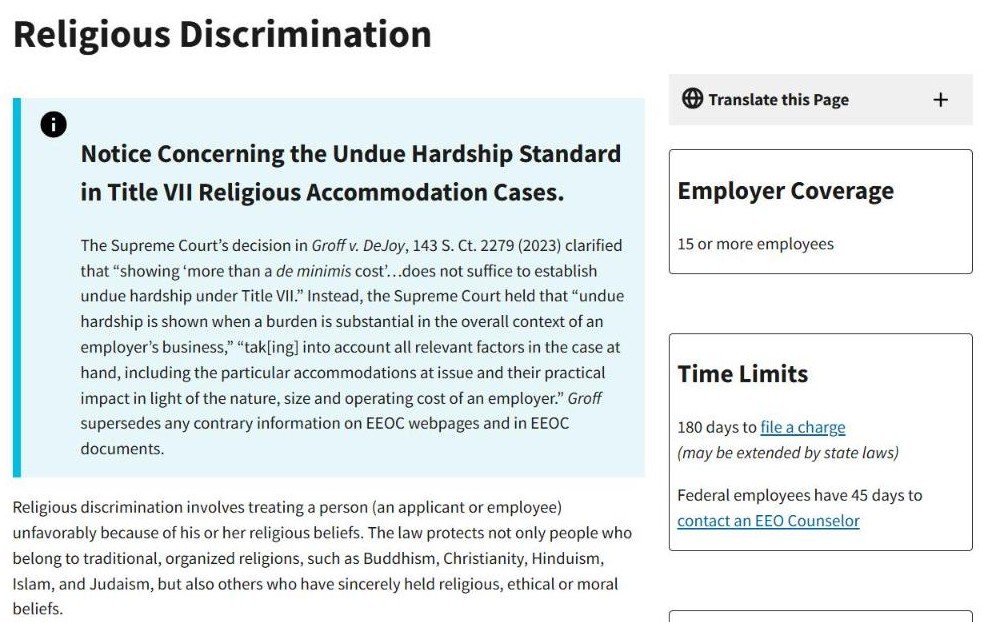
Title VII religious discrimination also covers association. The EEOC says treating someone differently because they’re married to, or associated with, a person of a particular religion can be discrimination too.
Religious organizations get narrower rules under section 702 of Title VII, which lets them prefer members of their own faith for employment. Everyone else plays by the four duties above.
How Groff v. DeJoy changed religious accommodation
Before June 29, 2023, many employers treated any cost above a trivial one as undue hardship. In Groff v. DeJoy, the Supreme Court unanimously rejected that reading. Writing for the Court, Justice Alito said an employer must show the burden would bring “substantial increased costs in relation to the conduct of its particular business.” Three practical consequences follow:
- Bring numbers. “It’s inconvenient” won’t carry the defense. Overtime cost, lost coverage and safety effects, sized against your business, will.
- Coworker hostility isn’t hardship. The Court said hardship that comes from employees’ dislike of a religion, or of accommodating it, can’t count.
- Look at the alternatives. An employer can’t stop at one bad option. If forcing others to take overtime is too costly, it still has to consider options such as voluntary shift swaps.
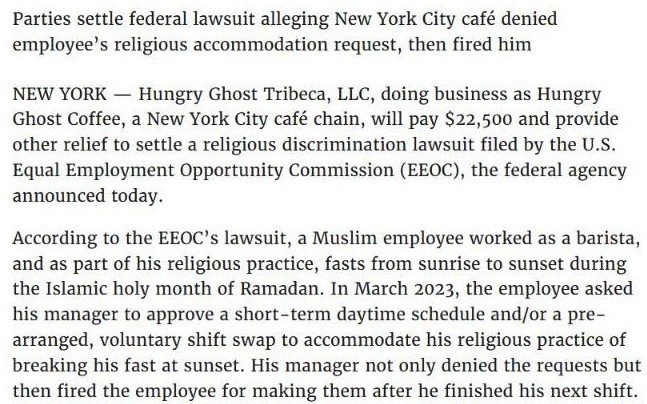
The EEOC’s October 6, 2026 settlement with Hungry Ghost Coffee shows the pattern. According to the EEOC, a Muslim barista who fasted during Ramadan wanted either temporary daytime hours or a coworker who’d agreed in advance to trade shifts, so he could be off work when his fast ended at sunset. The manager refused both and let him go once his next shift was over. The café agreed to pay $22,500 and to train managers at all locations under a two-year consent decree.
Religious accommodation in the workplace: examples and how Groff applies
The EEOC names four common types of religious accommodation in the workplace: flexible schedules, voluntary shift swaps, job reassignment, and changes to workplace policies such as dress and grooming rules. The table below is our working summary of how those play out for the requests employers see most. It isn’t a list of what’s always required; each answer depends on your operation and the numbers.
| Request | Options to consider first | Hardship argument that’s weak after Groff | What to document |
|---|---|---|---|
| Sabbath or holy day off | Voluntary swaps, a different fixed day off, split shifts | “Others would complain” | Coverage cost per shift, swaps attempted, staffing data |
| Prayer time during shifts | Unpaid or flexible breaks, a quiet space | “We’ve never done that” | Break coverage, safety-critical posts |
| Religious dress, beard or head covering | Exceptions to dress or grooming codes | Customer preference | Specific safety rule and why alternatives fail |
| Fasting schedule changes | Temporary schedule shift, swap list | “It sets a precedent” | Hours available, swap offers made |
| Objection to a specific task | Reassignment of that task, a colleague swap | General disruption | How often the task occurs and who else can do it |
Notice what the right-hand column has in common. Each item is a fact you can count, which is what Groff asks you to bring.
Where the next EEOC religious discrimination claims will come from
Based on the EEOC’s 2026 actions and the ABA panel discussion reported by HR Dive, four areas stand out:
- Scheduling. Sabbath, holiday and fasting requests remain the most familiar claims, and Groff made them easier to win.
- Harassment in chats and channels. In the ITS Logistics conciliation, the EEOC found reasonable cause that a Jewish employee faced antisemitic comments and postings that coworkers and managers shared. The company agreed to pay $96,135.54 in back pay and $300,000 in compensatory damages, plus three years of reporting.
- Objections to workplace policies. Panelists predicted religious accommodation claims challenging shared bathroom and locker room policies, an area where federal positions and some state laws pull in different directions.
- Training content. A former EEOC commissioner on the panel said employers may need to check whether training itself created a hostile environment for an employee with a religious objection.
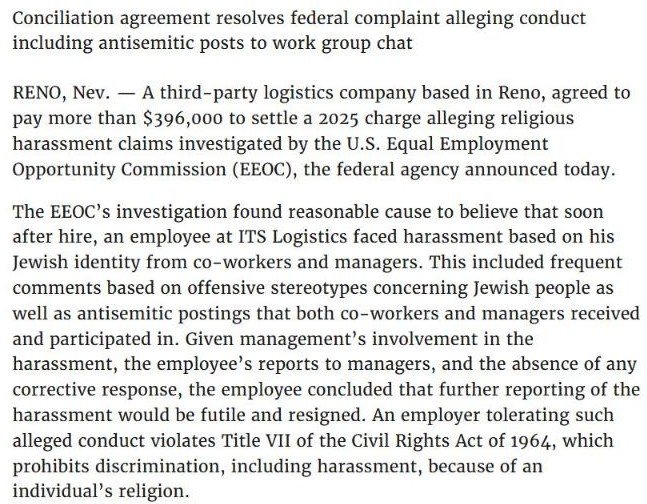
The harassment cases are the ones employers most often lose by default. In the ITS matter, managers took part, the employee reported, and nobody corrected it.
How to handle a religious accommodation request, step by step
- Treat any request that mentions faith, belief or observance as an accommodation request, even if the employee doesn’t use the word.
- Don’t ask for a letter from clergy by default. Ask for more information only if you have an objective reason to doubt sincerity.
- Talk with the employee about what they need and what would work, and write down the options discussed.
- Check low-cost options first: voluntary swaps, schedule changes, break changes, dress code exceptions or reassigning a single task.
- If you think an option costs too much, put a dollar figure or an operational effect on it, sized to your business.
- Ignore coworker resentment as a factor. Address it as a management issue instead.
- Give the decision in writing, with the reason and any alternative you can offer.
- Keep the file. EEOC rules require keeping personnel records for at least one year, and longer once a charge is filed; see our guide to how long to keep employee records.
- Make sure nothing about the request shows up in evaluations, schedules or discipline afterward.
What a religious discrimination claim can cost
The clock for an EEOC charge is usually 180 days from the discriminatory act, and it stretches to 300 days in states and cities that have their own agency enforcing a comparable law. If the claim succeeds, back pay is uncapped, while compensatory and punitive damages combined are capped by employer size under Title VII:
| Employer size | Cap on compensatory and punitive damages |
|---|---|
| 15 to 100 employees | $50,000 |
| 101 to 200 employees | $100,000 |
| 201 to 500 employees | $200,000 |
| More than 500 employees | $300,000 |
Those caps come from the EEOC’s remedies guidance. The ITS conciliation shows how a single case reaches the cap range for compensatory damages before anyone files a lawsuit, with consent-decree training and reporting costs on top.
A 30-day checklist to prevent religious discrimination in the workplace
- Add religion explicitly to your harassment policy, and cover group chats, messaging channels and social posts that coworkers share.
- Train front-line managers to spot accommodation requests and route them to HR the same day.
- Create a one-page accommodation log with the request, options discussed, cost analysis and decision.
- Review dress, grooming and scheduling rules for blanket bans that leave no room for exceptions.
- Review training materials for content that could draw a religious objection, and decide how you’ll handle opt-out requests.
- Map where your state law differs from federal positions, especially on shared facilities, before you change any policy.
- Add these items to your annual HR compliance checklist.
Our Take / Expert Perspective
Our take: on religious discrimination in the workplace, the lesson for employers is that the EEOC’s priorities shifted, while Title VII didn’t. The same accommodation duty that applied in 2024 applies now. What’s different is that the agency is finding cause far more often, settling for more money and publicizing the results, which is how enforcement teaches the market.
The employers who lose these cases aren’t usually hostile to religion. They’re busy. A manager says no to a shift swap because it’s easier, or a group chat runs unchecked for months. Those are process failures, and they’re cheaper to fix than to defend.
The harder part is policy conflict. Religious objections to shared facilities, pronoun practices or training content can collide with state laws that protect LGBTQ+ workers. Forecast, not fact: we expect the EEOC to bring at least a few test cases in this area in 2027, and employers in states with strong LGBTQ+ protections will be caught between agencies.
What to do now: write a single accommodation procedure that requires a documented cost analysis before any denial, and have every denial reviewed by HR or counsel before it goes to the employee.
Frequently Asked Questions
What counts as religious discrimination in the workplace?
Treating an applicant or employee differently because of their religious beliefs or practices, or lack of them, in hiring, firing, pay or assignments. It also covers religious harassment, refusing a reasonable accommodation without undue hardship and retaliating against someone who asked for one.
What is undue hardship for religious accommodation after Groff v. DeJoy?
The employer has to prove the accommodation would cost substantially more, measured against its own business, not just a little more. Coworker hostility toward the religion doesn’t count, and the employer has to consider alternatives such as voluntary shift swaps.
Does Title VII apply to small businesses?
Title VII applies to employers with 15 or more employees. Many state and local laws cover smaller employers, so check your state’s rules even if you’re under 15.
Can an employer ask for proof of a religious belief?
Only when there’s an objective reason to question whether the belief is sincere, and then only for the information needed. Asking every employee for a clergy letter isn’t required by the law and can look like a barrier to the request.
How long does an employee have to file an EEOC religious discrimination charge?
Usually 180 days from the discriminatory act. In places with a state or local fair employment agency covering the same kind of claim, the window is 300 days.
Why is the EEOC focusing on religious discrimination now?
Its June 4, 2026 National Enforcement Plan puts religious discrimination in the workplace under one of its four Chair priorities, and the agency says it has taken more than 40 public religious liberty actions since January 2025.
This article is for general information only and is not legal advice. Laws differ by state, province and country; consult a qualified attorney for your situation.
Sources
- U.S. Equal Employment Opportunity Commission: National Enforcement Plan, Fiscal Years 2025 – 2029 (Directives Transmittal 600.001), checked November 13, 2026
- U.S. Equal Employment Opportunity Commission: Table E4f, Title VII Religion-Based Charge Receipts and Resolutions, FY 1997 – FY 2025, checked November 13, 2026
- U.S. Equal Employment Opportunity Commission: Nevada Logistics Company to Pay Over $396,000 to Resolve EEOC Religious Harassment Charge and Hungry Ghost Coffee Settles EEOC Religious Discrimination and Retaliation Suit, checked November 13, 2026
- U.S. Equal Employment Opportunity Commission: Religious Discrimination, Time Limits for Filing a Charge and Remedies for Employment Discrimination, checked November 13, 2026
- Supreme Court of the United States: Groff v. DeJoy, No. 22-174 (June 29, 2023), checked November 13, 2026
- Cornell Law School LII: 42 U.S.C. 2000e, checked November 13, 2026
- HR Dive: A wave of religious discrimination claims is coming, attorneys say (November 11, 2026) and its November 10, 2026 report on the EEOC nomination, checked November 13, 2026
- Smith, Gambrell & Russell: The EEOC’s FY 2025 Performance Report, checked November 13, 2026
- aiandblog: more HR Compliance articles and our Editorial Policy









Leave a Reply