


Last updated: November 7, 2026
Reviewed by an HR compliance professional (PHR, SHRM-CP) on November 8, 2026.
Running your own I-9 audit is the cheapest protection an employer can get against a government I-9 inspection. You gather every Form I-9, compare it with payroll and the rules, and correct problems properly before anyone else sees them. Handle it carelessly, though, and the internal audit causes fresh trouble: backdated forms, discriminatory sampling or requests for documents you have no right to demand.
Short answer: An internal I-9 audit is a voluntary review of your Forms I-9 that catches missing forms, errors and expired work authorization before a government inspection does. Check every form or a neutral sample, let employees fix Section 1 and the employer fix Section 2, never backdate, and attach a signed explanation to each correction.
Key takeaways
- No law requires internal I-9 audits, but federal guidance from the Justice Department and ICE explains how to run one without discriminating.
- Review every form or a sample chosen on neutral criteria, never by citizenship status or national origin.
- Section 1 can be corrected only by the employee (or their preparer or translator); Section 2 and Supplement B only by the employer.
- Don’t backdate, erase or use correction fluid. Strike through the error, write the fix, initial and date it, and attach an explanation.
- Retain each Form I-9 for three years after hire or one year after employment ends, whichever is later, and be able to produce forms within three business days of an inspection request.
Table of Contents
What is an I-9 audit?
An I-9 audit is a review of the Forms I-9 an employer holds for its workers. There are two very different kinds: an internal audit you decide to run, and a government inspection that begins with a Notice of Inspection. This guide covers the first, the I-9 audit you’re in charge of.
In December 2015 the federal government issued joint guidance on internal audits from the Justice Department’s Office of Special Counsel for Immigration-Related Unfair Employment Practices (now the Immigrant and Employee Rights Section) and U.S. Immigration and Customs Enforcement. It says the law doesn’t require an internal audit, though an employer may run one to stay compliant with the employer sanctions provisions of the Immigration and Nationality Act. It’s available as the Justice Department and ICE internal audit guidance.
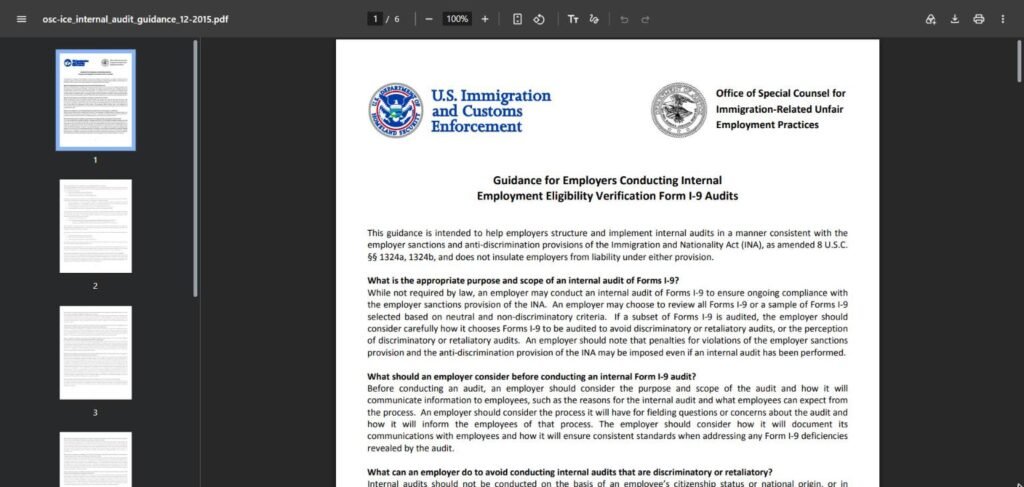
The same guidance includes a warning: penalties can still apply even after an internal audit. An I-9 audit lowers your risk; it doesn’t wipe out past violations.
Internal I-9 audit vs government inspection
You set the schedule and terms of an internal I-9 audit. A government inspection sets them for you. The table lays out the practical differences.
| Internal I-9 audit | Government inspection | |
|---|---|---|
| Who starts it | You | A federal agency, usually after serving a notice |
| Required? | No, it’s voluntary | Yes, you must respond |
| Time to produce forms | Your own timeline | Within three business days of an inspection request, per the USCIS handbook |
| Scope | All forms or a neutral sample you choose | Set by the agency |
| What you can fix | Errors, using the correction rules | Fixes made after notice can still be scrutinized |
| Main risk | Discrimination or retaliation if done badly | Penalties for violations found |
The U.S. Citizenship and Immigration Services Handbook for Employers M-274 says you must be able to produce Forms I-9 within three business days of an inspection request from the Department of Homeland Security, the Justice Department’s Civil Rights Division or the Department of Labor. That tight window is the strongest case for auditing before anyone asks.
Why an I-9 audit matters more after ICE’s 2026 changes
An I-9 audit has always cost less than an inspection, and the gap grew in 2026. ICE’s Form I-9 inspection fact sheet gives employers at least three business days to produce forms after a Notice of Inspection and at least ten business days to fix technical or procedural errors. Anything outside that technical list counts as a substantive violation from the outset.
Morgan Lewis reports that ICE revised the fact sheet on March 16, 2026, reclassifying roughly 11 error types from technical to substantive, among them a missing employee date of birth and incomplete List A, B or C details in Section 2. Remote verification failures and electronic I-9 system problems are now substantive as well, and kept document copies no longer cure missing Section 2 data. The firm notes that correcting forms after a Notice of Inspection doesn’t reduce liability for substantive violations, and puts paperwork penalties at $288 to $2,861 per form.
Here’s what that means for your I-9 audit:
- Put Section 2 completeness first. Check every List A, B and C field, not only whether some document was recorded.
- Check remote verification records. If you used the DHS-authorized alternative procedure, make sure every step was documented.
- Test your electronic I-9 system. Audit trails and signatures now carry substantive risk.
- Audit before, not after. Corrections from a routine I-9 audit are treated very differently from corrections made once ICE has come calling.
Before you start: set the scope fairly
The biggest legal risk in an I-9 audit isn’t an unchecked box. It’s picking who gets audited for the wrong reason. The joint guidance says internal audits shouldn’t be based on an employee’s citizenship status or national origin, or carried out in retaliation against anyone.
- Choose your scope: review every Form I-9, or a sample picked on neutral, non-discriminatory criteria, like all forms from one hiring year or one location.
- Mind the timing: the guidance asks employers to think about whether an audit’s timing, scope or selective nature could make it look discriminatory or retaliatory. Launching an audit right after a workplace complaint is the obvious case.
- Decide who runs it: a third-party auditor is allowed, but you stay liable for any violations the auditor commits.
- Set consistent standards for handling each type of deficiency, and keep records of what you tell employees.
Put your audit kit together before opening the first file:
- A payroll export covering current employees and former employees still within the retention period
- Every Form I-9, along with any attached Supplement A and Supplement B pages
- Copies of employee documents, if your company retains them
- Your E-Verify case list, if you’re enrolled
- An empty correction log: employee, finding, who fixed it, date fixed, memo attached (yes or no)

The 12-step I-9 audit checklist
Take these steps in order. The first three show which forms you ought to have; the others check what’s on them.
Step 1: Build the list of people who need a Form I-9
Run a payroll report of all current employees, plus former employees whose forms are still within the retention period. The handbook requires a Form I-9 for everyone on payroll hired after November 6, 1986.
Step 2: Match payroll to forms and find the missing ones
Match the list against the forms you actually hold. If a Form I-9 was never completed or has gone missing, the joint guidance says to fill in the current version as soon as possible, enter the real date employment began and attach a signed, dated explanation. Don’t backdate it.
Step 3: Separate forms you no longer need to keep
For former employees, keep the form for three years after the hire date or one year after employment ends, whichever is later. The handbook offers a shortcut: under two years of work, keep it three years from the first day of employment; over two years, keep it one year after they left. Never throw out a current employee’s form.
Worked example: someone hired March 1, 2022, leaves June 30, 2026. Three years after hire is March 1, 2025, and one year after leaving is June 30, 2027. The later date applies, so keep the form until June 30, 2027. Do the same two-date check for each former employee and note the destroy-after date in your log.
Step 4: Check Section 1
Section 1 is the employee’s part. Check that the name, address, date of birth, attestation box, signature and date are complete, and that an expiration date appears where the attestation requires one. List any gaps for the employee to correct.
Step 5: Check Supplement A if a preparer or translator helped
If someone assisted the employee with Section 1, their certification block in Supplement A should be filled in and signed.
Step 6: Check Section 2 and its timing
Section 2 is the employer’s part. Confirm the first day of employment, the document details and the reviewer’s name, title, signature and date, and check that Section 2 was finished within three business days of the employee’s first day of work.
Step 7: Check the documents recorded
Section 2 should list either one List A document or one List B document plus one List C document. Flag any form where the employer recorded more documents than necessary, or relied on an unacceptable document.
A common over-documentation case: the employee showed a U.S. passport (List A), yet Section 2 also lists their driver’s license and Social Security card. Those extra entries aren’t needed. Follow the handbook’s correction method: strike through them, initial and date the change, attach a memo and don’t request anything new from the employee.
Step 8: Check expiration dates and Supplement B
For employees with time-limited work authorization, check that each required reverification was recorded on time in Supplement B. A form showing expired authorization and no reverification should go to the top of the fix list.
Step 9: Check the form edition
Each Form I-9 should be on an edition that was valid when it was completed. When we checked in November 2026, the USCIS Form I-9 page listed the 01/20/25 edition as current and accepted the 08/01/23 edition until May 31, 2027.
Step 10: Correct errors using the official method
Strike through the incorrect information, add the correct or missing details, then initial and date the change. Section 1 is fixed by employees (or their preparer or translator); Section 2 and Supplement B by the employer. Attach a written explanation. If the employee has already left, attach a signed, dated statement describing the error and why it couldn’t be fixed.
A correction memo can be written in plain language. Something like this does the job:
Internal Form I-9 audit, [month and year]. On [date], we found that Section 2 of [employee name]’s Form I-9 listed the first day of employment as [wrong date]. The correct date is [right date]. We corrected the entry by striking through it, writing the correct date, and initialing and dating the change. Corrected by [name, title]. Signed and dated [date].
Step 11: Redo sections with many errors
When a section has several errors, the handbook allows you to redo it on a new Form I-9 and attach that to the old one. A new Form I-9 also works for substantial errors, such as a blank section or a Section 2 completed from unacceptable documents. Either way, explain the change in a signed memo.
Step 12: Check E-Verify cases, if you’re enrolled
Check that every employee hired after you enrolled has an E-Verify case. The joint guidance is firm on this. If you deliberately skipped cases as a business practice, don’t go back and create them now. If you missed one by mistake, create it immediately.

Common I-9 audit findings and how to fix them
| Finding | Who fixes it | How |
|---|---|---|
| Form I-9 missing entirely | Employee and employer | Complete the current edition now, enter the real start date, attach a signed explanation, no backdating |
| Section 1 blank or incomplete | Employee (or preparer or translator) | Complete or correct it, initial and date |
| Section 2 blank | Employer | Complete it now with the current date, attach an explanation |
| Wrong date entered in Section 2 | Employer | Line through, correct, initial and date; never backdate |
| Too many documents recorded | Employer | Line through the extra entries, initial, date and explain |
| Expired work authorization never reverified | Employer | Reverify now in Supplement B with a document the employee chooses |
| Document that doesn’t look genuine | Employer, with the employee | Raise it privately and let the employee choose a different acceptable document |
| Correction fluid or erased text found | Employer | Attach a signed, dated explanation of the change |
How to talk to employees during an I-9 audit
The joint guidance favors an open process. Let employees know in writing that an I-9 audit is underway, explain its scope and purpose, and say whether it’s your own decision or a response to a government directive.
When you spot a problem on someone’s form, tell that employee privately about the specific issue. Give them copies of their Form I-9 and related documents, use their language where you can and explain how they can ask questions.
There are two lines you can’t cross. First, you can’t demand specific documents to fix a form; you can say the questioned document can’t be used again, but the employee picks another acceptable one. Second, the guidance says employers shouldn’t fire employees because of an audit unless the employee can’t establish identity or work authorization.
A brief written notice can kick things off:
We’re reviewing our company’s Forms I-9 as part of our regular compliance work. The review covers [all employees / employees hired in a given year] and isn’t a response to any government action. If something on your form needs updating, we’ll reach out privately, show you the form and explain what’s needed. Questions? Contact [name] at [email].

What about documents that look wrong?
During an I-9 audit the standard is the same as at hire: you must accept documents that reasonably appear genuine and relate to the person who presented them. If a photocopy later makes you think a document falls short of that standard, the guidance says to raise it with the employee and let them pick a different document from the Lists of Acceptable Documents.
Don’t draw conclusions from a photocopy alone, and don’t treat employees differently because of how they look, how they sound or where they come from. That’s how an audit meant to cut risk becomes a discrimination claim.
Our Take / Expert Perspective
Our take: most employers see an I-9 audit as a paperwork tidy-up. The government’s own guidance frames it as an employee-relations event, and that’s the better way to see it. The forms are straightforward. What’s hard is setting a fair scope, being open with people about what’s happening, and fixing errors without backdating or asking for too many documents.
The employers who get hurt audit in reaction to something: after a complaint, in one department, with a manager deciding who seems suspicious. Even if every correction is technically correct, the pattern can look like retaliation or discrimination. The ones who come out ahead audit on a calendar, covering every form or a neutral sample, with a written memo for each fix.
Timing matters too. Three business days isn’t long enough to find out your I-9 files are a mess. With an annual internal I-9 audit, an inspection request becomes a matter of pulling files rather than a scramble.
Our forecast: as E-Verify mandates spread across states and automatic EAD extensions mostly ended in October 2025, expect more Section 2 and reverification errors to surface in audits over the coming year. You can fix them if you find them first.
What to do this quarter: book an all-forms I-9 audit, send the written notice and keep one log of every correction and memo.
Frequently Asked Questions
Is an internal I-9 audit required by law?
No. The Justice Department and ICE guidance says an internal audit isn’t required, though employers may run one to stay compliant. Doing one doesn’t shield you from penalties for any violations it turns up.
How often should I run an I-9 audit?
No frequency is set in law. A yearly review of all forms is common, along with a smaller check after heavy hiring periods. Choose a schedule and keep to it so the timing never looks targeted.
Can I fix an employee’s Section 1 myself?
No. Section 1 can be corrected only by the employee, or by a preparer or translator who assists them. The employer corrects Section 2 and Supplement B.
What if a Form I-9 is missing for a current employee?
Fill in the current edition of Form I-9 as soon as you can, enter the real date employment began and attach a signed, dated explanation. Don’t backdate the form.
Can an I-9 audit lead to firing someone?
The guidance says employers shouldn’t terminate employees because of an audit unless the employee can’t show identity or work authorization. Give the employee a fair chance to correct problems and present acceptable documents first, and speak with employment counsel before acting.
Should I use an outside auditor?
Yes. The guidance permits a third-party auditor, but your company remains liable for any violations the auditor commits, so hold their process to the same rules.
This article is for general information only and is not legal advice. Laws differ by state, province and country; consult a qualified attorney for your situation.
Photos: Wesley Tingey, Viktor Talashuk, Cytonn Photography and Amy Hirschi on Unsplash.
Sources
- U.S. Department of Justice and U.S. Immigration and Customs Enforcement: Guidance for Employers Conducting Internal Employment Eligibility Verification Form I-9 Audits (December 2015), checked November 6, 2026
- U.S. Citizenship and Immigration Services: Handbook for Employers M-274, Sections 9.0 and 10.0, checked November 6, 2026
- U.S. Citizenship and Immigration Services: I-9, Employment Eligibility Verification, checked November 6, 2026
- aiandblog: more HR Compliance articles and our Editorial Policy








Leave a Reply