

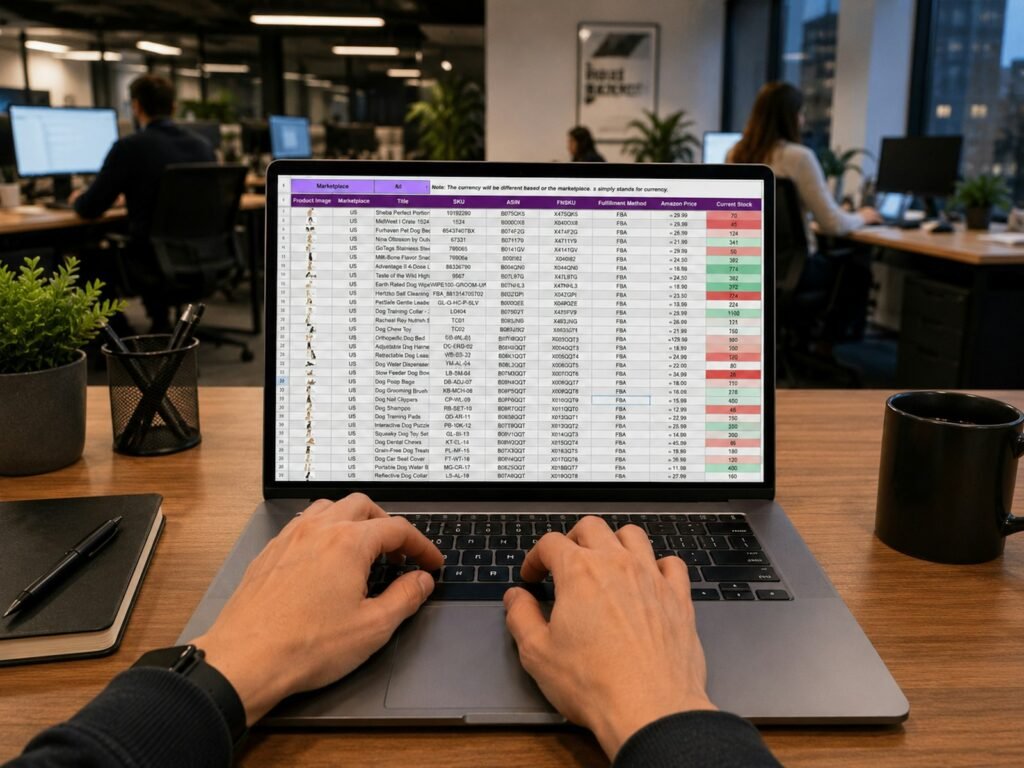
Last updated: November 7, 2026
Reviewed by a certified public accountant (CPA) on November 10, 2026.
A trial balance lists every general ledger account with its ending debit or credit balance, then totals them to confirm debits equal credits. Bookkeepers run it as a quick sanity check before adjusting entries, financial statements and tax returns, and it’s usually the first report accountants ask for when they take over someone else’s books.
Short answer: A trial balance shows every general ledger account with a nonzero balance in two columns, debits and credits, as of a set date. Matching totals mean the books balance arithmetically. That doesn’t mean they’re correct: errors like a missing transaction or a posting to the wrong account still balance.
Key takeaways
- It comes in three versions: unadjusted (before adjusting entries), adjusted (after them) and post-closing (after closing entries, showing only balance sheet accounts).
- A balanced report catches arithmetic slips and one-sided postings, but not omissions, wrong-account postings or mistakes that cancel each other out.
- When totals don’t match, a difference divisible by 9 often signals a transposed or shifted number.
- A difference equal to double one entry usually means that entry landed on the wrong side.
- Accountants rely on the adjusted version as the bridge to the balance sheet, income statement and tax workpapers.
Table of Contents
What a trial balance is
Double-entry bookkeeping records every transaction with equal debits and credits. If every entry followed that rule, the sum of all debit balances in the ledger has to match the sum of all credit balances. The trial balance checks exactly that.
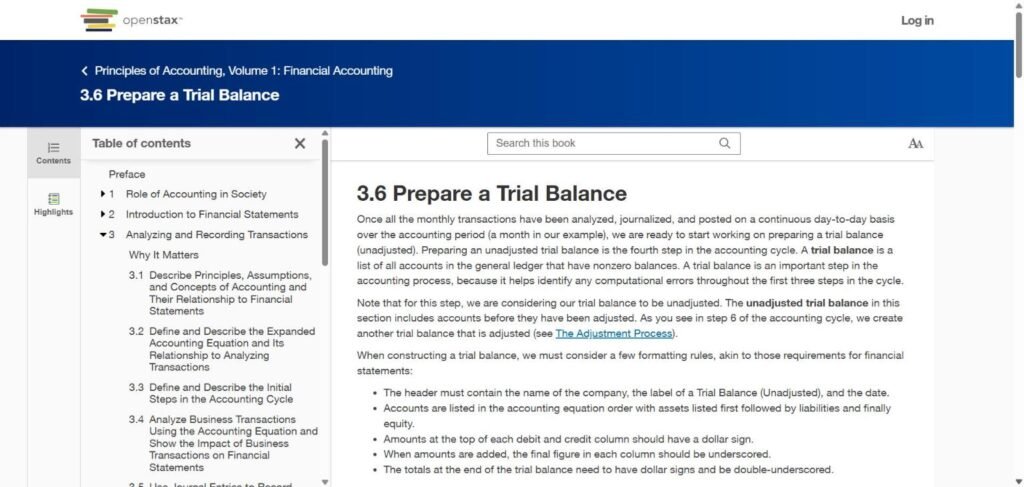
The open textbook *Principles of Accounting*, from OpenStax at Rice University, defines it as a list of all general ledger accounts carrying nonzero balances, prepared once transactions have been posted. It also stresses the lesson every bookkeeper eventually learns: matching totals don’t rule out mistakes.
Most accounting software generates the report in seconds, so its value now has less to do with arithmetic and more to do with review. It gives a one-page view of every balance in the business, which makes anything unusual easy to spot.

Trial balance example
Below is the year-end trial balance for a fictional consulting firm before any adjusting entries. Asset and expense accounts normally carry debit balances, while liabilities, equity and revenue normally carry credit balances.
| Account | Debit | Credit |
|---|---|---|
| Cash | $42,000 | |
| Accounts receivable | $18,500 | |
| Prepaid insurance | $3,600 | |
| Equipment | $25,000 | |
| Accumulated depreciation | $5,000 | |
| Accounts payable | $7,200 | |
| Unearned revenue | $4,800 | |
| Owner’s capital | $40,000 | |
| Service revenue | $163,000 | |
| Salaries expense | $96,000 | |
| Rent expense | $24,000 | |
| Software expense | $6,900 | |
| Utilities expense | $4,000 | |
| Totals | $220,000 | $220,000 |
The columns agree, so the ledger balances arithmetically. But look at what’s absent: no depreciation expense for the year and no insurance expense, even though a prepaid balance exists. Those gaps are exactly what the next step, adjusting entries, takes care of.
The three types of trial balance
| Type | When it’s prepared | What it includes | Main use |
|---|---|---|---|
| Unadjusted | After routine transactions are posted, before adjustments | All accounts with balances | Spot errors and plan adjustments |
| Adjusted | After adjusting entries for accruals, deferrals and depreciation | All accounts, with corrected balances | Prepare financial statements |
| Post-closing | After closing entries move revenue, expenses and drawings into equity | Balance sheet accounts only | Confirm the ledger is ready for the new period |
Unadjusted
This is the first view of the period’s balances. In the example above, the unadjusted version shows that the firm still has to record depreciation, expire prepaid insurance and recognize any unearned revenue that has now been earned.
Adjusted
Suppose the firm books $5,000 of depreciation, $2,400 of insurance expense from the prepaid balance and $3,000 of revenue earned from the unearned balance. The adjusted version would then show depreciation expense of $5,000, accumulated depreciation of $10,000, prepaid insurance of $1,200, insurance expense of $2,400, unearned revenue of $1,800 and service revenue of $166,000. The totals change but still agree at $225,000 per side, since only the depreciation entry added a new amount to both columns.
Post-closing
Closing entries reset revenue and expense accounts to zero and move net income into equity. So the post-closing version lists only assets, liabilities and equity, the accounts that roll forward into next year.
How to prepare one in 6 steps
- Post every transaction for the period to the general ledger, bank feeds, bills, invoices and payroll included.
- Reconcile the bank and credit card accounts so cash balances are correct before you lean on them.
- Run the report as of the period-end date from your accounting system, or list each account’s ending balance in a spreadsheet.
- Put each balance in the debit or credit column based on its normal balance.
- Add up both columns and check that they agree.
- Go through every line looking for balances that seem off in size or direction, like a credit balance in accounts receivable.
Step 6 is where the real value lies. A balanced report showing negative cash or a debit balance in accounts payable is still telling you something’s wrong.

What a balanced trial balance can still hide
Matching totals only prove that debits and credits agree. These errors leave the totals equal:
- Omission: a transaction that never got recorded.
- Wrong account: a debit posted to office supplies rather than equipment, or to the wrong customer.
- Principle: booking an asset purchase as an expense, or the other way around.
- Duplicate entries: the same bill entered twice, on both sides.
- Compensating errors: two separate mistakes that happen to cancel each other out.
- Reversed entries: debiting the account that should have been credited and vice versa, for equal amounts.
That’s why the report starts a review rather than ending it. Account reconciliations, analytical review and supporting schedules catch what the totals miss.
How to find out-of-balance errors: a 7-step method
Manual systems and spreadsheets can fall out of balance. When that happens, work through these checks in order:
- Add both columns again. Simple arithmetic is the most common culprit.
- Confirm every balance sits in the correct column. A credit balance typed into the debit column creates a difference of twice that amount.
- Divide the difference by 2. If the result matches an amount in the ledger, look for an entry posted to the wrong side.
- Divide the difference by 9. If it divides cleanly, look for a transposition, like $4,500 entered as $5,400 (a $900 difference), or a slide, like $7,200 entered as $720 (a $6,480 difference).
- Search for the exact difference. It could be one entry posted to just a single account.
- Compare with the previous period’s report to spot accounts whose balances moved unexpectedly.
- Trace postings for the suspect accounts from the journal to the ledger, one line at a time.
Worked fix: tracing a $2,700 difference
Suppose a spreadsheet trial balance shows $222,700 in debits and $220,000 in credits, a $2,700 difference.
- Half of $2,700 is $1,350. There’s no $1,350 entry, so a wrong-side posting looks unlikely.
- $2,700 divided by 9 is $300, a whole number, which makes a transposition a strong suspect.
- Checking the debit balances for swapped digits, the bookkeeper finds software expense entered as $9,600 rather than $6,900. The 6 and the 9 had switched places.
Fixing software expense to $6,900 brings both columns back to $220,000. The divide-by-9 test didn’t identify the account, but it told her what type of error to hunt for, narrowing the search from every line to a few likely candidates.
Modern accounting software won’t save an entry unless debits equal credits, so an out-of-balance report usually points to a data import, a corrupted file or a problem with a manual journal entry. If the system itself shows unequal totals, contact the software’s support team.
Trial balance vs. balance sheet vs. general ledger
| Report | What it shows | Who uses it |
|---|---|---|
| General ledger | Every transaction in every account | Bookkeepers and auditors tracing detail |
| Trial balance | Each account’s ending balance in debit and credit columns | Accountants preparing adjustments and statements |
| Balance sheet | Assets, liabilities and equity in a formatted statement | Owners, lenders, investors |
| Income statement | Revenue and expenses for a period | Owners, lenders, investors, tax preparers |
The trial balance sits between the ledger and the financial statements, and every figure on the balance sheet and income statement should trace back to it.
Where the trial balance fits in month-end close and tax prep
During a monthly close, the unadjusted report is pulled once transactions are posted and the bank is reconciled. Accountants then go account by account, posting accruals, deferrals and depreciation, and pull the adjusted version as the foundation for the month’s financial statements.
At year-end, CPAs preparing business tax returns typically begin with the adjusted trial balance. Each account is mapped to a line on the return, and book-to-tax differences, like depreciation methods or meals that are only partly deductible, are handled in the tax workpapers. A clean, clearly labeled report saves the preparer real hours, which often shows up straight in the fee.

The 10-column worksheet: how accountants used to do it by hand
Before accounting software, accountants built a ten-column worksheet across a wide sheet of paper. It’s still a helpful way to see how the parts connect:
- Unadjusted trial balance, debit
- Unadjusted trial balance, credit
- Adjustments, debit
- Adjustments, credit
- Adjusted trial balance, debit
- Adjusted trial balance, credit
- Income statement, debit
- Income statement, credit
- Balance sheet, debit
- Balance sheet, credit
Each account moves from left to right. Revenue and expense balances flow into the income statement columns, while assets, liabilities and equity flow into the balance sheet columns. The difference between the income statement columns is net income, and adding it to the balance sheet credit column brings that pair into balance as well. Spreadsheets still use this layout for small engagements because it shows every adjustment in one view.
Using it to review a new client’s books
When an accountant inherits a set of books, the trial balance is the first diagnostic tool. A practical order for reviewing it:
- Check equity against last year’s tax return. Opening retained earnings or owner’s capital should match the prior year’s closing figures. If they don’t, prior-year adjustments never made it into the books.
- Look for stale balance sheet accounts. A loan balance unchanged for six months, or an old “undeposited funds” amount, usually means postings were missed.
- Watch for accounts that shouldn’t be there. Duplicate bank accounts, personal expenses or several nearly identical expense accounts signal cleanup work.
- Scan for round numbers. Large round amounts in expense or revenue accounts are often estimates or plugs that need backing up.
- Request the reconciliations supporting cash, receivables, payables and payroll liabilities.
For a small business, this review takes about an hour and usually reveals how much cleanup the engagement really involves.
Sending a trial balance to your accountant
A few details make the report much more useful to whoever gets it:
- Use the exact period-end date and note whether it’s on an accrual or cash basis.
- Include account numbers alongside names so balances can be mapped fast.
- Add a comparative column for the same date last year, or last month for monthly reviews.
- Export to a spreadsheet, not only a PDF, so the accountant can work with it directly.
- Flag open questions beside the related accounts, like a disputed bill or a refinanced loan.
Review checklist: 8 questions before you rely on it
- Does each asset account carry a debit balance and each liability a credit balance?
- Does cash match the bank reconciliation?
- Does accounts receivable match the customer aging report?
- Does accounts payable match the vendor aging report?
- Do payroll liabilities line up with the most recent payroll filings?
- If you own fixed assets, is there depreciation expense for the period?
- Do any suspense, “ask my accountant” or uncategorized accounts carry balances?
- Do revenue and major expenses look sensible next to last month and last year?
Common trial balance mistakes
- Assuming balanced totals prove the books are correct.
- Skipping reconciliations before running the report.
- Leaving balances sitting in suspense or uncategorized accounts at period-end.
- Running the report as of the wrong date, particularly around year-end.
- Overlooking abnormal balances, like negative inventory or a debit in accounts payable.
Our Take / Expert Perspective
Our take: software has turned the trial balance from an arithmetic test into a review tool, and that’s where its value lies today. Systems hardly ever fall out of balance now. Books still go wrong constantly, through miscategorized expenses, missing accruals and duplicate bills, and none of those throw off the totals.
The lesson for owners and new bookkeepers is to read the report, not just run it. Spending ten minutes scanning each line for odd signs, stale balances and suspicious round numbers catches more problems than any automated check. It’s also the best single document to give a new accountant, since it lays out the whole business on one page.
Forecast, not fact: as AI tools begin reviewing ledgers automatically, the trial balance will become the standard input they draw on, so clean account names and a tidy chart of accounts will matter more, not less.
Our recommendation: run the unadjusted trial balance at every month-end, work through the eight-question checklist above and keep a one-line note beside any balance you can’t explain until it’s sorted out.
Frequently Asked Questions
What is the purpose of a trial balance?
It confirms that total debits equal total credits in the general ledger and provides a one-page summary of every account balance. Accountants use it to catch errors, plan adjusting entries and prepare financial statements.
What’s the difference between an unadjusted and an adjusted trial balance?
The unadjusted version comes before adjusting entries for accruals, deferrals and depreciation. The adjusted version includes those entries and is the basis for financial statements.
Why is my trial balance not balancing?
Typical causes include addition mistakes, a balance in the wrong column, a transposed number or an entry posted to only one account. Divide the difference by 2 and by 9 to narrow down the likely error.
What errors does a trial balance not detect?
It misses transactions that were never recorded, entries posted to the wrong account, duplicate entries, reversed entries and pairs of mistakes that cancel out. Reconciliations and review pick those up.
Is a trial balance a financial statement?
No. It’s an internal working report. The balance sheet, income statement and cash flow statement are built from it, but the trial balance itself isn’t released to outside users.
How often should you prepare a trial balance?
At a minimum at every month-end, before closing the books. Many businesses also run one ahead of meeting their accountant, applying for a loan or preparing tax returns.
This article is for general information only and is not tax, accounting or financial advice. Consult a licensed CPA or financial professional for your situation.
Sources
- OpenStax (Rice University): Principles of Accounting, Volume 1, 3.6 Prepare a Trial Balance, checked November 7, 2026
- aiandblog: Claude for Excel for accountants and our Editorial Policy
Photos: Gorilla ROI Data Connector, Jakub Żerdzicki, Cht Gsml and Vitaly Gariev on Unsplash.









Leave a Reply