


Last updated: November 7, 2026
Reviewed by a certified public accountant (CPA) on November 10, 2026.
LLC vs S corp isn’t truly a choice between two types of company. An LLC is a legal entity formed under state law, while an S corporation is a federal tax status that an LLC or corporation can elect. Most small business owners begin as an LLC and later weigh whether electing S corp tax treatment saves enough self-employment tax to be worth the extra work.
Short answer: An LLC is a business entity under state law; S corp is an IRS tax election. By default, a single-member LLC is taxed like a sole proprietorship, so every dollar of profit faces 15.3% self-employment tax. Electing S corp status lets the owner draw a reasonable salary, subject to payroll tax, and take the remainder as distributions free of payroll tax. In our $120,000 example, that saves roughly $7,000 before added costs.
Key takeaways
- The IRS requires an S corporation to be a domestic corporation with no more than 100 allowable shareholders and a single class of stock.
- An LLC elects S status on Form 2553, signed by every owner and filed within 2 months and 15 days of the start of the tax year.
- S corporations have to pay shareholder-employees reasonable compensation before making distributions, and the IRS can reclassify distributions as wages.
- Added costs include payroll processing, a separate Form 1120-S, unemployment taxes on salary and, in some states, entity-level taxes like California’s 1.5% tax with an $800 minimum.
- The election usually pays off only once profit sits comfortably above a reasonable salary for the owner’s role.
Table of Contents
What an LLC is
A limited liability company is formed under state law by filing articles of organization. Its main legal advantage is liability protection: owners’ personal assets are generally shielded from the business’s debts and lawsuits, provided they keep personal and business finances separate.
For federal taxes, an LLC is flexible. The defaults are:
- A single-member LLC is disregarded. Its income and expenses go on the owner’s Schedule C, and the owner pays self-employment tax on net earnings.
- A multi-member LLC is taxed as a partnership, files Form 1065 and issues each member a Schedule K-1. Active members usually owe self-employment tax on their share.
An LLC can override that default by electing to be taxed as a corporation, either a C corporation or, if it qualifies, an S corporation.
None of these tax decisions affects the legal protection. The liability shield comes from forming the entity correctly and keeping it separate: its own bank account, contracts signed in the company’s name, adequate insurance and records of major decisions. Owners who pay personal bills from the business account or skip basic formalities risk having a court disregard the entity in a lawsuit, regardless of its tax status.

What an S corporation is
An S corporation is a corporation, or an entity eligible to be taxed as one, that has elected under Subchapter S of the tax code to pass its income, losses and credits through to shareholders. According to the IRS, to qualify it has to:
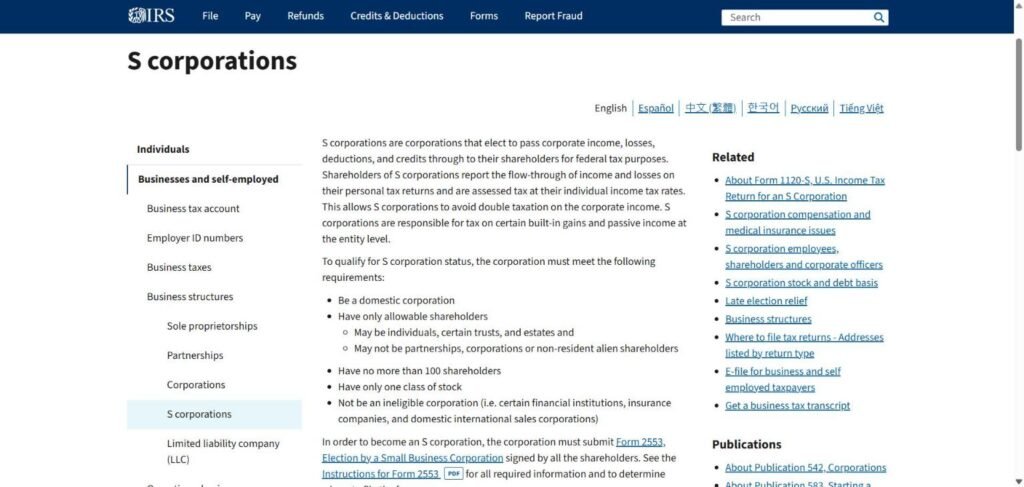
- Be a domestic corporation.
- Have only allowable shareholders, like individuals, certain trusts and estates. Partnerships, corporations and nonresident aliens can’t be shareholders.
- Have no more than 100 shareholders.
- Have just one class of stock.
- Not be an ineligible corporation, like certain financial institutions and insurance companies.
The S corporation files Form 1120-S every year, and shareholders report their share of income on their own returns. The company itself usually pays no federal income tax, although a few situations, like built-in gains from a former C corporation, can trigger entity-level tax.
LLC vs S corp at a glance
| Single-member LLC (default) | LLC or corporation taxed as an S corp | |
|---|---|---|
| What it is | A state-law entity | A federal tax election |
| Federal return | Schedule C on the owner’s Form 1040 | Form 1120-S, plus K-1s to owners |
| Owner’s pay | Draws; no payroll | Reasonable salary through payroll, plus distributions |
| Self-employment or payroll tax | 15.3% self-employment tax on most net earnings | Payroll taxes on salary only; none on distributions |
| Ownership limits | None for tax purposes | Up to 100 allowable shareholders, one class of stock |
| Extra costs | Low | Payroll processing, separate return, unemployment taxes, possible state entity taxes |
| Flexibility in profit splits | Partnerships can allocate flexibly | Distributions must follow ownership percentages |
How the S corp election saves tax: a $120,000 example
Jordan operates a one-person marketing consultancy as a single-member LLC with $120,000 of net profit. The figures below are illustrative and keep the math simple by ignoring the income tax effects of deducting payroll and self-employment taxes.
As a default single-member LLC:
- Net earnings subject to self-employment tax: $120,000 x 92.35% = $110,820
- Self-employment tax: $110,820 x 15.3% = $16,955
With an S corp election and a $65,000 salary:
- Payroll taxes on the salary, employer and employee shares together: $65,000 x 15.3% = $9,945
- The remaining profit, roughly $55,000 before the employer’s payroll costs, can go out as distributions without payroll tax.
Gross saving: roughly $7,010 a year.
Next, subtract the costs that come with running an S corporation:
| Extra annual cost | Illustrative amount |
|---|---|
| Payroll service | $600 |
| Additional tax return preparation (Form 1120-S) | $1,500 |
| Federal unemployment tax on salary | $42 |
| State unemployment tax on salary | Varies by state |
| State entity-level tax, if any | Varies by state |
Under these assumptions, Jordan saves about $4,800 or more a year, depending on state taxes. At $60,000 of profit with a $45,000 salary, the saving nearly disappears once costs are counted.

Reasonable compensation: the rule that limits the savings
The tax saving relies on paying yourself a salary below your total profit, but it can’t be artificially low. The IRS says S corporations have to pay reasonable compensation to a shareholder-employee for services before making non-wage distributions, and payments to corporate officers that are really pay for services must be treated as wages.
The IRS lists factors that courts have weighed, including:
- Training and experience.
- Duties and responsibilities.
- Time and effort put into the business.
- Dividend history.
- What comparable businesses pay for similar services.
A practical approach: document what it would cost to hire someone else to do your job, using salary surveys, government wage data or local job postings for similar roles, and set your salary within that range. Revisit it every year as your role and the business evolve, and keep the documentation with your corporate records. Paying yourself nothing while taking big distributions is the pattern that attracts attention.
How to elect S corp status: Form 2553
An LLC that wants S corp treatment files Form 2553, Election by a Small Business Corporation, signed by every shareholder. Key timing rules from the instructions:
- File no more than 2 months and 15 days after the beginning of the tax year the election is meant to take effect, or at any point during the previous tax year.
- For a calendar-year business, that usually means filing by March 15 for the election to begin January 1 of that year.
- An eligible entity that meets the requirements generally doesn’t have to file Form 8832 as well; Form 2553 doubles as the classification election.
- If you miss the deadline, Rev. Proc. 2013-30 may offer late election relief if you request it within 3 years and 75 days of the intended effective date and meet the other conditions.
Once the election is in place, set up payroll, start withholding on your salary and file Form 1120-S by its due date each year.
Other differences that matter
Ownership and investors
S corporations can’t have more than 100 shareholders, can’t have partnerships or corporations as shareholders and can’t have nonresident alien owners. They’re also restricted to one class of stock, so every share must carry identical distribution rights. That rules them out for businesses planning to raise venture capital using preferred stock.
Profit splits
Multi-member LLCs taxed as partnerships can allocate profits in ways that don’t track ownership percentages, if the operating agreement permits it and the allocations satisfy tax rules. S corporation distributions have to follow ownership percentages exactly.
State taxes
Some states tax S corporations or LLCs at the entity level. California, for instance, taxes S corporations at 1.5% of California source income, with an $800 annual minimum franchise tax. Run the state numbers before electing, since in some states they eat up a big share of the federal saving.
The qualified business income deduction
Owners of both pass-through types may qualify for the qualified business income deduction. In an S corporation, the owner’s salary isn’t qualified business income, so a bigger salary shrinks that deduction while raising payroll tax. Good planning balances the two.
Retirement and benefits
An S corporation salary makes it easier to fund certain retirement plans through payroll. On the flip side, health insurance for more-than-2% shareholders follows its own reporting rules, which your payroll provider has to handle correctly.

Multi-member LLCs: partnership or S corp?
For an LLC with two or more owners, the comparison is partnership taxation versus S corporation treatment. Under partnership rules, active members usually owe self-employment tax on their share of business income, and the operating agreement can set flexible profit allocations. Under S corp treatment, each working owner draws a reasonable salary through payroll, the rest goes out strictly by ownership percentage and payroll tax applies only to the salaries.
Partnerships fit owners who put in different amounts of capital and work, or who want allocations that don’t match ownership. S corporations fit owners with similar roles and stable ownership, where the payroll tax saving matters for each of them.
A first-year timeline after the S corp election
- January to mid-March: file Form 2553 with every owner’s signature and keep proof of filing.
- Before the first salary payment: register for state payroll withholding and unemployment accounts, and set up a payroll service.
- Every payday: run payroll on the owner’s salary and deposit payroll taxes on time.
- Each quarter: file Form 941 and the state payroll returns.
- By January 31: issue a Form W-2 to each owner-employee.
- By March 15 for a calendar-year company: file Form 1120-S and issue Schedules K-1, or ask for an extension.
Keep business and personal spending apart the whole way through. Blending them makes it hard to show which payments were salary, which were distributions and which were reimbursements.
Switching back
Owners sometimes elect S status and later decide the costs aren’t worth it, or bring in an investor who can’t hold S corporation shares. Revoking the election usually requires consent from shareholders owning more than half the shares, and once an election ends, the company generally has to wait five years before electing again unless the IRS agrees. Plan the change with your adviser, since leaving S status can carry state tax and accounting consequences too.
When the S corp election usually makes sense
- Steady profits well above a reasonable salary for the work you do.
- You’re prepared to run payroll and file a separate business return each year.
- Your state doesn’t pile on costs that wipe out the saving.
- You don’t need multiple classes of ownership or non-U.S. investors.
It usually doesn’t make sense in a new business’s first year with uncertain or uneven profits, for owners whose profit roughly matches a market salary or for businesses planning to raise equity from investors who’ll want preferred stock.
Common mistakes
- Treating “S corp” as a kind of company you form rather than a tax election you make.
- Setting an unreasonably low salary to maximize distributions.
- Missing the Form 2553 deadline and assuming the election applies regardless.
- Leaving state entity taxes and payroll costs out of the savings calculation.
- Taking distributions out of line with ownership in a multi-owner S corporation.
Our Take / Expert Perspective
Our take: the LLC vs S corp question really comes down to how much profit you earn above a fair salary for your own work. Below that line, the S election adds cost and paperwork for little or no benefit. Well above it, the payroll tax saving is real and repeats every year.
The biggest risk isn’t the IRS form but the salary. Owners who pay themselves a token wage and take everything else as distributions invite precisely the recharacterization the IRS warns about. A salary backed by real market data protects the saving and keeps year-end planning simple.
Forecast, not fact: as Social Security wage bases climb each year, to $184,500 in 2026 and $192,300 in 2027, the payroll tax cost on high self-employment income keeps rising, which will push more profitable sole proprietors to take another look at the election.
Our recommendation: have your CPA run a side-by-side projection every fall using next year’s expected profit, a documented salary and your state’s entity taxes, and elect only when the net saving after all costs clearly justifies the extra administration.
Frequently Asked Questions
Is an S corp better than an LLC?
Neither is better across the board, because they aren’t alternatives in the same sense. An LLC is a legal entity; S corp is a tax election an LLC can make. The election helps when profits sit well above a reasonable salary for the owner’s work.
Can an LLC be an S corp?
Yes. An eligible LLC can elect S corporation taxation by filing Form 2553. It remains an LLC under state law but files Form 1120-S for federal taxes.
How much do you need to make for an S corp to be worth it?
There’s no set figure. It depends on a reasonable salary for your role, your state’s taxes and the extra costs of payroll and a separate return. Have your CPA compare the self-employment tax you’d owe with the payroll tax and costs under S corp treatment.
When is Form 2553 due?
No more than 2 months and 15 days after the start of the tax year the election takes effect, or any time during the previous tax year. For a calendar-year business, that’s usually March 15. Late election relief may be possible in some cases.
What is reasonable compensation for an S corp owner?
It’s what a business would pay someone else for the same work. The IRS points to factors like training, duties, time spent and what comparable businesses pay for similar services.
Do S corps pay self-employment tax?
Owners don’t pay self-employment tax on S corporation income. Instead, their salary is subject to regular payroll taxes, and distributions above that salary generally avoid payroll and self-employment tax.
This article is for general information only and is not tax, accounting or financial advice. Consult a licensed CPA or financial professional for your situation.
Sources
- IRS: S corporations, checked November 7, 2026
- IRS: S corporation compensation and medical insurance issues, checked November 7, 2026
- IRS: Instructions for Form 2553, checked November 7, 2026
- California Franchise Tax Board: S corporations, checked November 7, 2026
- Social Security Administration: Contribution and benefit base, checked November 7, 2026
- aiandblog: IRS EPCRS update for retirement plan corrections and our Editorial Policy
Photos: Olena Kholina, Annika Wischnewsky, Mina Rad and Romain Dancre on Unsplash.









Leave a Reply