


Last updated: November 15, 2026
Reviewed by an information security professional (CISSP) on November 15, 2026.
CMMC 2.0 requirements haven’t gone away, but the program’s next step is on hold. On July 13, 2026, the Department of War suspended Phase 2, which would have made a third-party Level 2 certification from a C3PAO a condition of award from November 10, 2026, as WilmerHale reported. What hasn’t paused: Phase 1 self-assessments, the NIST SP 800-171 requirements and annual affirmations for every company handling Controlled Unclassified Information (CUI) in defense work.
Short answer: CMMC 2.0, the Cybersecurity Maturity Model Certification program, has three levels. Level 1 covers 15 basic requirements for Federal Contract Information, Level 2 covers the 110 requirements of NIST SP 800-171 Rev. 2 for CUI, and Level 3 adds 24 requirements from NIST SP 800-172. Phase 1 self-assessments apply now. Phase 2 C3PAO certification was suspended on July 13, 2026, pending a review.
Key takeaways
- The CMMC program rule, 32 CFR Part 170, has been in effect since December 16, 2024; the DFARS contract rule took effect November 10, 2025.
- Phase 1 still applies: Level 1 (Self) or Level 2 (Self) as a condition of award, plus annual affirmations in SPRS.
- Phase 2, planned for November 10, 2026, was suspended on July 13, 2026. A reform review ended September 11, 2026, and as of October 30, 2026, its report hadn’t been published.
- A Level 2 plan of action is allowed only with a score of at least 80% of the maximum, and it must close within 180 days.
- Contractors must file annual affirmations of continuous compliance in SPRS and flow the requirements down to subcontractors.
Table of Contents
What CMMC 2.0 is
The Cybersecurity Maturity Model Certification (CMMC) program checks that defense contractors protect two types of information:
- Federal Contract Information (FCI): information provided by or generated for the government under a contract that isn’t intended for public release.
- Controlled Unclassified Information (CUI): sensitive government information that requires safeguarding under law, regulation or policy.
“CMMC 2.0” is the streamlined three-level model the Department of Defense announced in 2021 and later wrote into two rules. Per the National Law Review, those are the program rule at 32 CFR Part 170, effective December 16, 2024, and the acquisition rule adding DFARS clause 252.204-7021, published September 10, 2025, and effective November 10, 2025.

CMMC 2.0 requirements by level
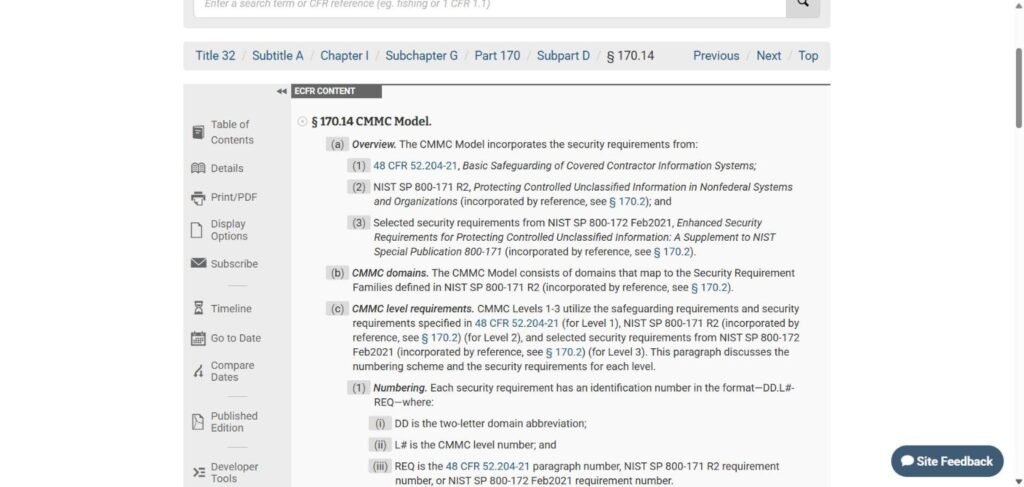
The program rule at 32 CFR 170.14 sets out the levels:
| Level | Protects | Requirements | Assessment |
|---|---|---|---|
| Level 1 | FCI | The 15 requirements in FAR 52.204-21(b)(1) | Annual self-assessment with affirmation |
| Level 2 | CUI | Identical to NIST SP 800-171 Rev. 2 | Self-assessment or C3PAO certification, as the contract specifies |
| Level 3 | CUI in the highest-priority programs | 24 selected requirements from NIST SP 800-172 (February 2021), on top of Level 2 | Assessment by DCMA’s DIBCAC, after a Level 2 C3PAO certification |
NIST SP 800-171 Rev. 2 has 110 security requirements in 14 families, among them access control, incident response and system integrity. Level 3’s extra requirements include round-the-clock security operations, an incident response team that can deploy within 24 hours, annual penetration testing and supply chain risk management.
CMMC Level 2 requirements in practice
For a company that handles CUI, Level 2 comes down to six things:
- Implement all 110 requirements of NIST SP 800-171 Rev. 2 on every system that stores, processes or transmits CUI.
- Write a System Security Plan that shows how each requirement is met.
- Score yourself and post the result in SPRS before award or option exercise.
- Use a plan of action only for low-weight gaps, with a score of at least 80% of the maximum, and close it within 180 days.
- Have a senior official affirm continuous compliance in SPRS every year.
- Flow the same requirements down to subcontractors that handle CUI.
While Phase 2 is suspended, contracts call for a Level 2 self-assessment rather than a C3PAO certification. The requirements themselves don’t change.
The phased rollout and where it stands now
The DFARS rule set four phases. The first is in force, and the rest are on hold.
- Phase 1, from November 10, 2025: Level 1 (Self) or Level 2 (Self) in applicable solicitations and contracts. Still in effect.
- Phase 2, planned for November 10, 2026: Level 2 (C3PAO) certification as a condition of award. Suspended on July 13, 2026.
- Phase 3 and Phase 4, planned for November 10, 2027, and November 10, 2028: on hold, since the suspension also covers pending and future implementation milestones, according to WilmerHale.
Under the implementing memo, contracting officers amend active solicitations to remove Level 2 (C3PAO) and Level 3 requirements. Existing contracts get the same change before the next option period or administrative modification, as Holland & Knight summarizes it. Until a contract is modified, its current terms still bind, and no CMMC waivers are being granted during the review.
The Department set up a CMMC Reform Task Force for a 60-day review, which ended on September 11, 2026. As of October 30, 2026, the report wasn’t public. Federal News Network reported that one option under discussion is a narrower Phase 2 restart, according to Secureframe’s CMMC news log. Treat that as a reported option, not a decision.
What contractors must do under DFARS 252.204-7021
The DFARS clause creates ongoing duties. Drawing on the National Law Review and Goodwin’s summary:
- Have the required CMMC status at the level the contract requires, or higher, for every system that stores, processes or transmits FCI or CUI.
- Provide CMMC unique identifiers (UIDs) for each relevant system with proposals, and report changes to the contracting officer.
- Affirm continuous compliance annually in the Supplier Performance Risk System (SPRS), through a senior affirming official.
- Post self-assessment results in SPRS before award or option exercise when self-assessment applies.
- Close out any plan of action within the allowed time to move from conditional to final status.
- Flow down requirements to subcontractors and suppliers that handle FCI or CUI.
Contracting officers have to check SPRS before award, and they can’t award, exercise an option or extend performance until the CMMC requirement is met. The final rule removed a proposed 72-hour reporting requirement for certain lapses; incident reporting still runs under DFARS 252.204-7012.
POA&M rules: what you can and can’t defer
A plan of action and milestones (POA&M) gives a contractor conditional status while it fixes some gaps. 32 CFR 170.21 sets the limits:
- Level 1: no POA&M is allowed. All 15 requirements must be met.
- Level 2: a POA&M is permitted only when the assessment score reaches at least 80% of the maximum, no requirement on it carries a point value above 1 (with a narrow exception for CUI encryption that isn’t FIPS-validated), and none of six named requirements, including several physical protection controls, appear on it.
- Level 3: the same 80% threshold, plus a list of Level 3 requirements that can’t be deferred.
- Closeout: every POA&M must be closed and confirmed by a closeout assessment within 180 days, or the conditional status expires.
In practice, major gaps rule out Level 2; POA&Ms are only for small, low-weight items.

CMMC 2.0, NIST SP 800-171 and DFARS 7012
CMMC doesn’t replace the rules contractors already had; it verifies them.
- DFARS 252.204-7012 has for years required contractors handling covered defense information to implement NIST SP 800-171 and report cyber incidents to DoD. It still applies, and incident reporting still runs through it.
- DFARS 252.204-7019 and 7020 require contractors to post a NIST SP 800-171 assessment score in SPRS and give DoD access for assessments.
- CMMC adds the requirement to achieve and maintain a specific status, through self-assessment or independent assessment, before award.
Put simply, companies already following NIST SP 800-171 in practice should find CMMC Level 2 mostly a matter of evidence and verification. Companies that weren’t will see the gap laid bare.
How a CMMC Level 2 certification assessment works
Where a contract requires Level 2 (C3PAO), the process usually runs like this:
- Choose an authorized C3PAO, a third-party assessment organization authorized through the CMMC ecosystem’s accreditation body.
- Prepare documentation: your System Security Plan, network diagrams, asset inventory, policies and evidence for each requirement.
- Assessment: assessors test each NIST SP 800-171 requirement using the assessment objectives in NIST SP 800-171A, through interviews, document review and testing.
- Results: the C3PAO records the outcome, and you receive final or conditional status depending on whether a permitted POA&M remains.
- Closeout, if needed, within 180 days.
- Maintain status with annual affirmations and reassessment on the program’s cycle.
Cloud services and CMMC level 2
Plenty of small contractors keep CUI in cloud email or file sharing. DFARS 252.204-7012 requires cloud services that store, process or transmit covered defense information to meet security requirements equivalent to the FedRAMP Moderate baseline, plus incident reporting and other obligations. Before putting CUI in any cloud service, confirm with the provider how it meets those requirements and which responsibilities remain yours.
Budgeting for CMMC compliance
Costs swing too much to quote a reliable average, but what drives them is predictable:
- Scope size: how many users, devices and locations touch CUI.
- Starting maturity: how much of NIST SP 800-171 is already implemented and documented.
- Technology changes: multifactor authentication, logging, endpoint protection and compliant cloud services.
- Outside help: consultants for gap assessments and documentation, and the C3PAO assessment itself.
- Ongoing operations: monitoring, training, evidence collection and annual affirmations.
A smaller scope lowers nearly all of these costs, so scoping is the first decision to get right.
Worked example: a small machine shop
Take a hypothetical 40-person machine shop that makes parts for a prime contractor and receives technical drawings marked CUI.
- Level needed: Level 2, since it handles CUI. Whether it can self-assess or needs a C3PAO depends on what the prime’s contract and the subcontract say, and while Phase 2 is suspended, that means a self-assessment. A C3PAO certification may come back when the review ends.
- Scoping: the shop keeps CUI in a separate, clearly defined enclave, like a dedicated workstation and a compliant cloud environment, rather than across its whole network. A smaller scope means fewer assets to secure and assess.
- Gap assessment: it scores itself against the 110 requirements and finds gaps in multifactor authentication, audit logging and incident response.
- Fix before assessment: multifactor authentication and logging carry higher point values, so they have to be fixed before the assessment, not parked on a POA&M.
- Ongoing: after certification, it submits an annual affirmation in SPRS and keeps documentation current for the next assessment.
A CMMC 2.0 readiness checklist
- Identify what you handle. Find every place FCI and CUI enter, live and leave your environment, and confirm markings with your customer.
- Determine the level your contracts require, and ask primes what they’ll flow down.
- Scope tightly. Isolate CUI to reduce the number of systems in scope.
- Write a System Security Plan covering all applicable requirements and how they’re met.
- Run a gap assessment against NIST SP 800-171 Rev. 2 and score it.
- Fix high-value gaps first, especially requirements that can’t go on a POA&M.
- Post results in SPRS and prepare your affirming official for annual affirmations.
- Line up a C3PAO early if you plan to certify anyway; demand could spike if Phase 2 restarts.
- Manage your subcontractors, including their CMMC status and affirmations.
- Keep evidence current, because compliance must be continuous, not just at assessment time.
CMMC 2.0 for prime contractors: managing suppliers
Primes have extra responsibility. Under the DFARS clause, they must flow down the right CMMC level and ensure subcontractors complete affirmations before award and every year after. The National Law Review notes that primes can’t view subcontractors’ SPRS records directly yet are still expected to verify compliance, and foreign suppliers aren’t exempt.
A workable supplier program:
- Map which suppliers receive FCI or CUI, and which level each needs.
- Collect CMMC status evidence before issuing purchase orders that involve covered information.
- Limit what you share. Sending less CUI to fewer suppliers reduces the number who need Level 2.
- Build CMMC compliance into supplier contracts, including notice of status changes.
- Plan alternates for critical suppliers that may not be certified in time.
Questions to ask before hiring a C3PAO
- Are you authorized and available for our timeline?
- What documentation do you expect before the assessment starts?
- How do you handle scoping questions, such as enclaves and cloud services?
- What happens if we score just below the POA&M threshold?
- How do you price the assessment, and what could change it?
CMMC certification timeline at a glance
- December 16, 2024: CMMC program rule, 32 CFR Part 170, takes effect.
- November 10, 2025: DFARS clause takes effect; Phase 1 self-assessments required in applicable solicitations.
- July 13, 2026: the Department of War suspends Phase 2 and launches a 60-day review.
- September 11, 2026: the review period ends; the task force report is still pending.
- November 10, 2026: original Phase 2 date, now suspended.
- November 10, 2027: original Phase 3 date, on hold.
- November 10, 2028: original Phase 4 date, on hold.
Common CMMC 2.0 mistakes
- Treating the Phase 2 pause as a pause on NIST SP 800-171. The 110 requirements, SPRS scores and annual affirmations still apply, and the Department says it will enforce them through self-assessments and select government-led assessments.
- Scoping the whole company instead of isolating CUI.
- Planning to POA&M high-value requirements, which the rule doesn’t allow.
- Treating the affirmation as paperwork. A senior official is attesting to continuous compliance.
- Ignoring subcontractors that handle FCI or CUI.
- Using cloud services without checking that they meet the requirements for CUI.

Our Take / Expert Perspective
Our take: the Phase 2 pause changes who checks your security, not what you have to do.
Every requirement a C3PAO would have tested is still in your contract through DFARS 252.204-7012 and the Phase 1 self-assessment. What changes is the weight on your own score and on your senior official’s annual affirmation. That’s a reason to be more careful with the SPRS number, not less.
Our forecast, based on the reported options rather than an announced decision: the review will reshape Phase 2, not drop third-party checks for good. Contractors that stopped preparing in July will face the same assessor queue later, with less time.
Scoping is still the biggest cost lever. Companies that shrank their CUI footprint early have one enclave to defend instead of a whole network, no matter how the review goes.
Our recommendation: keep your NIST SP 800-171 work on schedule, make sure your SPRS score matches what an assessor would find, and ask your primes whether they still expect certification regardless of the pause.
Frequently Asked Questions
What is CMMC 2.0?
CMMC 2.0 is the Defense Department’s Cybersecurity Maturity Model Certification program, whose three levels verify how contractors protect Federal Contract Information and Controlled Unclassified Information. It sits in 32 CFR Part 170 and is enforced through DFARS clause 252.204-7021.
Is CMMC Phase 2 suspended?
Yes. On July 13, 2026, the Department of War suspended Phase 2, which would have started November 10, 2026. Phase 1 self-assessments, NIST SP 800-171 and SPRS affirmations still apply while a reform review runs.
What are the requirements for CMMC Level 2?
All 110 requirements of NIST SP 800-171 Rev. 2, a System Security Plan, a score posted in SPRS and an annual affirmation of continuous compliance. During the Phase 2 suspension, contracts call for a self-assessment rather than a C3PAO certification.
Can I use a POA&M for CMMC?
Not at Level 1. At Level 2, only when your score is at least 80% of the maximum and the deferred items are low-weight requirements the rule permits. Every POA&M item must be closed and verified within 180 days.
Do subcontractors need CMMC?
Yes, if they handle FCI or CUI. Primes must flow down the required level and ensure subcontractors complete their affirmations before award and each year.
How often is CMMC certification required?
Contractors affirm continuous compliance every year in SPRS. Level 2 assessments generally repeat every three years, and the required status has to hold for the life of the contract.
This article is for general information only and is not legal advice. Laws differ by state, province and country; consult a qualified attorney for your situation.
Sources
- Cornell Law School LII: 32 CFR 170.14, CMMC model, checked November 8, 2026
- Cornell Law School LII: 32 CFR 170.21, Plan of action and milestones requirements, checked November 8, 2026
- National Law Review: Don’t fall behind: CMMC final rule update, DFARS is here, checked November 8, 2026
- Goodwin: DoD final rule incorporates CMMC 2.0 into DFARS, checked November 8, 2026
- WilmerHale: Pentagon suspends CMMC Phase 2 requirements and launches review (July 20, 2026), checked November 15, 2026
- Holland & Knight: DoW suspends CMMC Phase II requirements (July 31, 2026), checked November 15, 2026
- Secureframe: CMMC news and updates (latest entry October 30, 2026), checked November 15, 2026
- aiandblog: Editorial Policy
Photos: FlyD, Adi Goldstein, Philipp Katzenberger and Taylor Vick on Unsplash.









Leave a Reply