


Last updated: November 7, 2026
Reviewed by a privacy professional (CIPP/US) on November 10, 2026.
An AI risk assessment template puts every AI use case in your company through the same review: what it does, who it touches, what could go wrong and who approved it. The version below follows the NIST AI Risk Management Framework, fits on two pages and works just as well for a chatbot pilot as for a hiring tool.
Short answer: An AI risk assessment template is a standard form for reviewing an AI system before and after it goes live. A good one has five parts: use case intake, a risk tier, a risk register, pre-launch tests and a documented decision with monitoring. Aligning it with the NIST AI RMF’s Govern, Map, Measure and Manage functions makes it defensible to auditors and regulators.
Key takeaways
- NIST published the AI Risk Management Framework 1.0 on January 26, 2023. It’s voluntary, and NIST says it’s being revised under the White House AI Action Plan.
- NIST’s Generative AI Profile, released July 26, 2024, identifies 12 risks unique to or amplified by generative AI, ranging from confabulation to information security.
- In the EU, high-risk obligations for Annex III systems, including fundamental rights impact assessments for certain deployers, now kick in on December 2, 2027.
- Colorado replaced its 2024 AI Act in May 2026. The new law takes effect January 1, 2027, and removes the annual impact assessment requirement.
- Tier your reviews. A full assessment for every AI feature wastes effort; five yes-or-no questions determine how deep each review needs to go.
Table of Contents
What an AI risk assessment is, and what it isn’t
An AI risk assessment is a structured look at one AI system in one setting. It asks what the system is for, who it affects, what could go wrong, how likely and how serious that would be, and which controls lower the risk. It finishes with a decision signed by someone accountable.
It differs from two related documents:
- A vendor questionnaire asks a supplier about its product and controls. If you buy AI tools, use our AI vendor questionnaire for that part of the review and feed the answers into the template below.
- An AI policy sets rules for the whole company, like approved tools and prohibited uses. The risk assessment applies that policy to a single use case. Both sit inside a wider AI governance framework, which also covers roles, the AI inventory and vendor management.
You need all three, but the AI risk assessment is what shows a regulator or customer that you thought through a specific system before turning it on.
The framework behind the template: NIST AI RMF
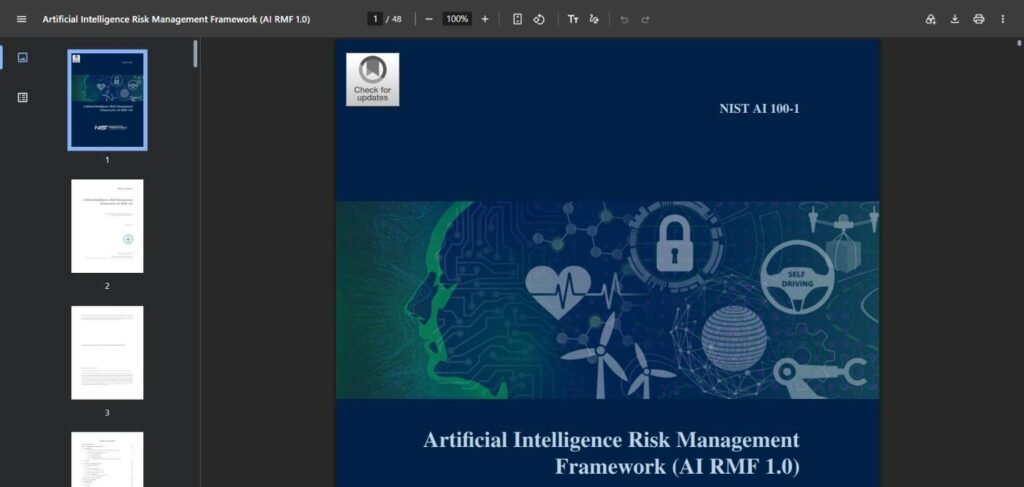
The NIST AI Risk Management Framework (AI RMF 1.0) is the US government’s primary voluntary framework for managing AI risk. NIST released it on January 26, 2023, describes it as meant for voluntary use and says it’s now being revised under the White House AI Action Plan.
The AI RMF is built around four core functions:
| Function | What it means in plain English | Where it shows up in the template |
|---|---|---|
| Govern | Culture, policies, roles and accountability; it runs across the other three | Owners, approvers, review dates |
| Map | Understand the context and identify risks | Part A, use case intake, and Part B, risk tier |
| Measure | Analyze, test and track the risks | Part C, risk register, and Part D, tests |
| Manage | Prioritize risks, respond, and monitor | Part E, decision and monitoring |
The framework also sets out seven characteristics of trustworthy AI, which double as a handy checklist for the risk register:
- Valid and reliable
- Safe
- Secure and resilient
- Accountable and transparent
- Explainable and interpretable
- Privacy-enhanced
- Fair, with harmful bias managed

The Generative AI Profile adds 12 risks
If the use case relies on a large language model, add NIST’s Generative AI Profile (NIST AI 600-1), released July 26, 2024. It identifies 12 risks that generative AI either creates or makes worse:
- CBRN information or capabilities
- Confabulation
- Dangerous, violent or hateful content
- Data privacy
- Environmental impacts
- Harmful bias or homogenization
- Human-AI configuration
- Information integrity
- Information security
- Intellectual property
- Obscene, degrading or abusive content
- Value chain and component integration
Most business use cases won’t run into all 12. We’d check confabulation, data privacy, information security, intellectual property and human-AI configuration first for typical business uses.
The AI risk assessment template
Copy the AI risk assessment template below into a document or form tool. Part B determines how much of Parts C and D you need: a Tier 1 use case can stop after a brief register, while a Tier 3 use case needs every section, with evidence attached.
AI RISK ASSESSMENT TEMPLATE (v1, aligned to NIST AI RMF 1.0)

PART A: USE CASE INTAKE (Map)
Use case name:
Business owner:
Technical owner:
Business purpose (one sentence):
AI type: predictive / generative / agentic (takes actions)
Built in-house or vendor? Vendor name and product:
Data the system uses (list; flag personal or sensitive data):
Outputs (what it produces or decides):
Who is affected (employees, customers, applicants, public):
Decisions it informs or makes:
Human review before action? yes / no / partial
Where it is used (states and countries):
Go-live date:

PART B: RISK TIER (answer yes or no)
B1. Does it make or materially support decisions about people's jobs, credit, housing, insurance, education, healthcare or legal rights?
B2. Does it process sensitive personal data?
B3. Do customers or the public see its outputs without human review?
B4. Can it take actions on its own (send, buy, change records, run code)?
B5. Is it used in a jurisdiction with AI-specific rules for this use (EU high-risk list, Colorado, NYC hiring tools)?
Tier: 0 yes = Tier 1 (low). 1-2 yes = Tier 2 (medium). 3+ yes, or yes to B1 = Tier 3 (high).

PART C: RISK REGISTER (Measure)
For each risk: Risk | Trustworthy AI characteristic | Likelihood 1-5 | Impact 1-5 | Score | Existing controls | Owner | Residual score

PART D: TESTS BEFORE LAUNCH (Measure)
Accuracy on representative data (method, result, date):
Bias or disparity testing across affected groups:
Security review, including prompt injection for generative AI:
Privacy review (data minimization, retention, vendor terms):
Human oversight design (who reviews, when, with what authority):

PART E: DECISION AND MONITORING (Manage)
Decision: approve / approve with conditions / reject
Conditions:
Approver and date:
Monitoring metrics and thresholds:
Incident triggers and who gets notified:
Next review date (Tier 3: 6 months; Tier 2: 12 months; Tier 1: on material change):
Retirement criteria:
How to fill in each part
Part A, intake. Write it so an outsider to the project can follow it. “Summarizes support tickets for agents; agents edit before sending” tells a reviewer much more than “LLM-powered support assistant.”
Part B, risk tier. The five questions are our own triage method, not a NIST AI RMF requirement. They route consequential decisions about people directly to Tier 3, since that’s where regulators in the EU, Colorado and elsewhere have concentrated.
Part C, risk register. Phrase each risk as a cause and an effect: “The model makes up a refund policy (confabulation), so a customer is promised money we don’t owe.” Tag it with the matching trustworthy AI characteristic or generative AI risk, then score it.
Part D, tests. Record the method and the outcome, not just “tested.” A bias test naming the groups compared, the metric and the threshold counts as evidence; a checkbox doesn’t.
Part E, decision. “Approve with conditions” is the most useful result. Common conditions are human review of every output for the first 90 days, a limit on decisions the system can make by itself or a retest after the next model update.
Scoring risks: likelihood times impact
Keep scoring simple enough that two reviewers would land within a point of each other. We use a 5 by 5 matrix:
| Score | Likelihood | Impact |
|---|---|---|
| 1 | Rare: hard to imagine in normal use | Minor: easy to fix, no one outside the team affected |
| 2 | Unlikely: could happen with unusual inputs | Limited: small number of people, quickly reversed |
| 3 | Possible: seen in testing or in similar systems | Moderate: customers or employees affected, some cost |
| 4 | Likely: expected to happen in normal use | Major: legal exposure, financial loss or lasting harm to people |
| 5 | Almost certain: already happening | Severe: rights violated at scale, regulatory action likely |
Multiply the two numbers. Scores of 15 or above need a control before launch and an owner who signs off on the remaining risk. Scores from 8 to 14 need a control or a written reason for accepting the risk. Anything under 8 can be accepted with monitoring. Treat these thresholds as a starting point; tune them to your company’s risk appetite and record the version you use in your AI policy.

When the law requires an AI risk assessment
For most US companies right now, an AI risk assessment is good practice, not a legal obligation. That’s shifting in particular places:
EU AI Act
The EU’s Digital Omnibus on AI, Regulation (EU) 2026/1744, entered into force on July 27, 2026, and pushed back the start of high-risk obligations. According to the AI Act Explorer, obligations for Annex III high-risk systems now apply from December 2, 2027, and for high-risk AI built into regulated products from August 2, 2028.
Under Article 27, certain deployers of high-risk systems have to complete a fundamental rights impact assessment before first use. That includes public bodies, private entities providing public services and deployers of systems used for creditworthiness checks or life and health insurance pricing. The assessment has to describe the processes where the system is used, how long and how often it runs, who’s affected, the specific risks of harm, human oversight measures and what happens if risks materialize. Parts A, C, D and E of the template line up with those elements.
Colorado
Colorado’s 2024 AI Act (SB 24-205) would have made deployers of high-risk AI run annual impact assessments. It never took effect in that form. Governor Jared Polis signed SB 26-189 on May 14, 2026, repealing and replacing it, according to law firm Eckert Seamans. The new law takes effect January 1, 2027, drops the annual impact assessment and concentrates on transparency: a pre-use notice, an explanation when automated decision-making technology materially contributes to an adverse decision and 3-year record retention.
That change doesn’t make the template any less useful in Colorado. You still need to know which use cases qualify, which notices they require and which records to keep, and Part A of the template captures exactly that.
Federal and other rules
The US has no general federal AI risk assessment law. Existing rules still reach AI outputs: anti-discrimination law covers hiring tools, and consumer protection law covers misleading claims and unfair practices. Regulators are already examining algorithmic decisions; our coverage of the FTC’s surveillance pricing orders offers one example.
How to run an AI risk assessment program in 6 steps
- Build an inventory. List every AI system in use, features inside software you already pay for included. You can’t assess what you haven’t found.
- Triage with Part B. Tier every use case. Plenty will fall into Tier 1, which keeps the program lightweight.
- Fully assess Tier 2 and Tier 3 use cases. Give each a business owner and a technical owner.
- Review and decide. A small group, often legal, security, privacy and the business owner, signs Part E for Tier 3 use cases.
- Monitor what you approved. Track the metrics listed in Part E and log incidents against the use case.
- Reassess when things change. A new model version, new data, a new user group or a new jurisdiction should trigger a fresh review, even ahead of the scheduled date.

Common AI risk assessment mistakes
- Assessing the tool instead of the use. The same chatbot is low risk for drafting internal notes and high risk for answering benefits questions, so assess each use case separately.
- Ignoring vendor AI. Features turned on inside your CRM or HR system are AI systems too.
- Testing just once. Models shift with vendor updates, so build a retest trigger into Part E.
- No named approver. An assessment without a signature is a draft, not a decision.
- Copying a 40-page framework. A template nobody completes protects nobody. Begin with the two-page version and add depth only for Tier 3.
Our Take / Expert Perspective
Our take: for most companies, the real question isn’t which framework to adopt. It’s whether anyone can say today which AI systems are running and who signed off on them. An AI risk assessment template answers that one use case at a time, which is why it’s worth having before any law demands it.
The legal landscape is moving two ways at once. The EU delayed its high-risk deadlines to December 2027, and Colorado swapped impact assessments for transparency duties. Meanwhile, customers and auditors are asking tougher questions. The AICPA’s proposed SOC 2 criteria, released for comment in October 2026, add AI points of focus like model monitoring and data poisoning. Forecast, not fact: within the next 12 months, documented AI risk assessments will come up in enterprise security reviews more often than in regulatory exams.
Our recommendation: begin with the inventory, tier everything with Part B this quarter and run full assessments only for Tier 3 use cases. A short, finished assessment for each high-risk system beats a flawless framework that covers none of them.
Frequently Asked Questions
What should an AI risk assessment template include?
At a minimum: a description of the use case and its owners, the data and people involved, a risk tier, a risk register with likelihood and impact scores, pre-launch test results and a signed decision with monitoring and a review date. Aligning those sections with the NIST AI RMF functions makes the template easier to defend.
Is the NIST AI RMF mandatory?
No. NIST describes the AI RMF as meant for voluntary use. Companies adopt it because it’s free, widely recognized and gives them a shared structure they can map to other frameworks and laws.
How often should you repeat an AI risk assessment?
Repeat it whenever something material changes, like a new model version, new data sources, new users or a new country. Otherwise, schedule reviews by tier; our template suggests every 6 months for Tier 3 and every 12 months for Tier 2.
Who should own AI risk assessments?
Each use case needs a business owner accountable for the outcome and a technical owner accountable for the system. A cross-functional group, usually legal, security, privacy and a business leader, should sign off on high-risk use cases.
Do US companies need an AI risk assessment by law?
Generally not yet. There’s no broad federal requirement, and Colorado’s replacement law, effective January 1, 2027, dropped its impact assessment duty. Companies deploying certain high-risk systems in the EU will need fundamental rights impact assessments once those obligations kick in during December 2027.
What is the difference between an AI risk assessment and an AI impact assessment?
The terms overlap. A risk assessment usually centers on what could go wrong and how to control it. An impact assessment, like the EU’s fundamental rights impact assessment, centers on the effects on people and their rights. The template above handles both.
This article is for general information only and is not legal advice. Laws differ by state, province and country; consult a qualified attorney for your situation.
Sources
- NIST: AI Risk Management Framework, checked November 7, 2026
- NIST: AI RMF 1.0 (NIST AI 100-1), checked November 7, 2026
- NIST: Generative AI Profile (NIST AI 600-1), checked November 7, 2026
- AI Act Explorer: Digital Omnibus on AI, Regulation (EU) 2026/1744, checked November 7, 2026
- AI Act Explorer: Article 27, Fundamental rights impact assessment, checked November 7, 2026
- Gibson Dunn: EU AI Act Omnibus agreement, checked November 7, 2026
- Eckert Seamans: Colorado repeals and replaces its landmark AI statute, checked November 7, 2026
- Journal of Accountancy: AICPA proposes improvements to SOC 2 trust services criteria, checked November 7, 2026
- aiandblog: AI vendor questionnaire and FTC surveillance pricing orders
- aiandblog: more AI Regulation articles and our Editorial Policy
Photos: Jackson Sophat, Christina @ wocintechchat.com, Evangeline Shaw and Steve A Johnson on Unsplash.






Leave a Reply