

Last updated: November 21, 2026
Reviewed by Tina Faulk, HR Compliance Specialist, on November 27, 2026
Reviewed by a certified public accountant (CPA) on November 21, 2026.
Form 941-X is how an employer fixes a mistake on a Form 941 it has already filed. It’s tempting to treat the three-year refund window as your deadline. For underpaid tax, it isn’t: the interest-free date is the due date of the return for the quarter in which you found the error. You file a separate Form 941-X for each quarter, and the box you check on line 1 or line 2 decides whether you pay, take a credit or get a refund.
Short answer: Form 941-X (Rev. April 2026) corrects errors on a previously filed Form 941. File one per quarter, choose either the adjustment process or the claim process, and file underpayment corrections by the due date of the return for the quarter you found the error to keep them interest-free. Refund claims generally expire 3 years after the Form 941 was filed.
Key takeaways
- Use a separate Form 941-X for each quarter, and don’t attach it to a regular Form 941.
- Underpayments use the adjustment process; overpayments can be a credit (adjustment) or a refund (claim).
- Errors found in January to March are due by April 30 to stay interest-free; April to June, July 31; July to September, October 31; October to December, January 31.
- A calendar-year Form 941 filed early is treated as filed April 15 of the next year, so 2023 overpayments generally run out on April 15, 2027.
- Form 941-X can be e-filed through the IRS Modernized e-File system.
Table of Contents
What Form 941-X corrects
According to the IRS Instructions for Form 941-X, Form 941-X fixes errors in amounts you reported on Form 941, including:
- Wages, tips and other compensation.
- Federal income tax withheld.
- Social Security and Medicare wages and tips, and Additional Medicare Tax withholding.
- The qualified small business payroll tax credit for increasing research activities.
- Certain COVID-era and COBRA premium assistance credits, within their own deadlines.
It doesn’t cover everything. Refunds of assessed interest or penalties go on Form 843. Errors on Forms 943, 944, 945 or CT-1 use those forms’ own correction returns; Form 944 filers use Form 944-X. Federal unemployment tax isn’t on Form 941 at all; it’s reported on Form 940.
Adjustment process vs. claim process
Part 1 of Form 941-X makes you pick one process per form, on line 1 or line 2. The choice matters more than anything else on the form:
| Adjustment process (line 1) | Claim process (line 2) | |
|---|---|---|
| Use it for | Underreported tax, or overreported tax you want as a credit | Overreported tax only, when you want a refund or abatement |
| What happens | You pay any balance when you file; an overpayment becomes a credit on Form 941 for the quarter you file | The IRS refunds or abates the overpayment |
| When it’s required | Any time you underreported tax | When the period of limitations ends within 90 days of filing |
| Interest | Interest-free if you file and pay on time | Not applicable to underpayments |
Found both underreported and overreported amounts in the same quarter? Report them together on a single Form 941-X using the adjustment process. If you want the overreported part refunded instead of credited, file two forms: one correcting only the underreported amounts, and a second claiming the overreported amounts.
Form 941-X deadlines
Underreported tax: the interest-free deadline
You can correct underreported tax interest-free if you file Form 941-X by the due date of the return for the quarter in which you discovered the error, and pay when you file:
| You discovered the error in | File Form 941-X by |
|---|---|
| January, February or March | April 30 |
| April, May or June | July 31 |
| July, August or September | October 31 |
| October, November or December | January 31 |
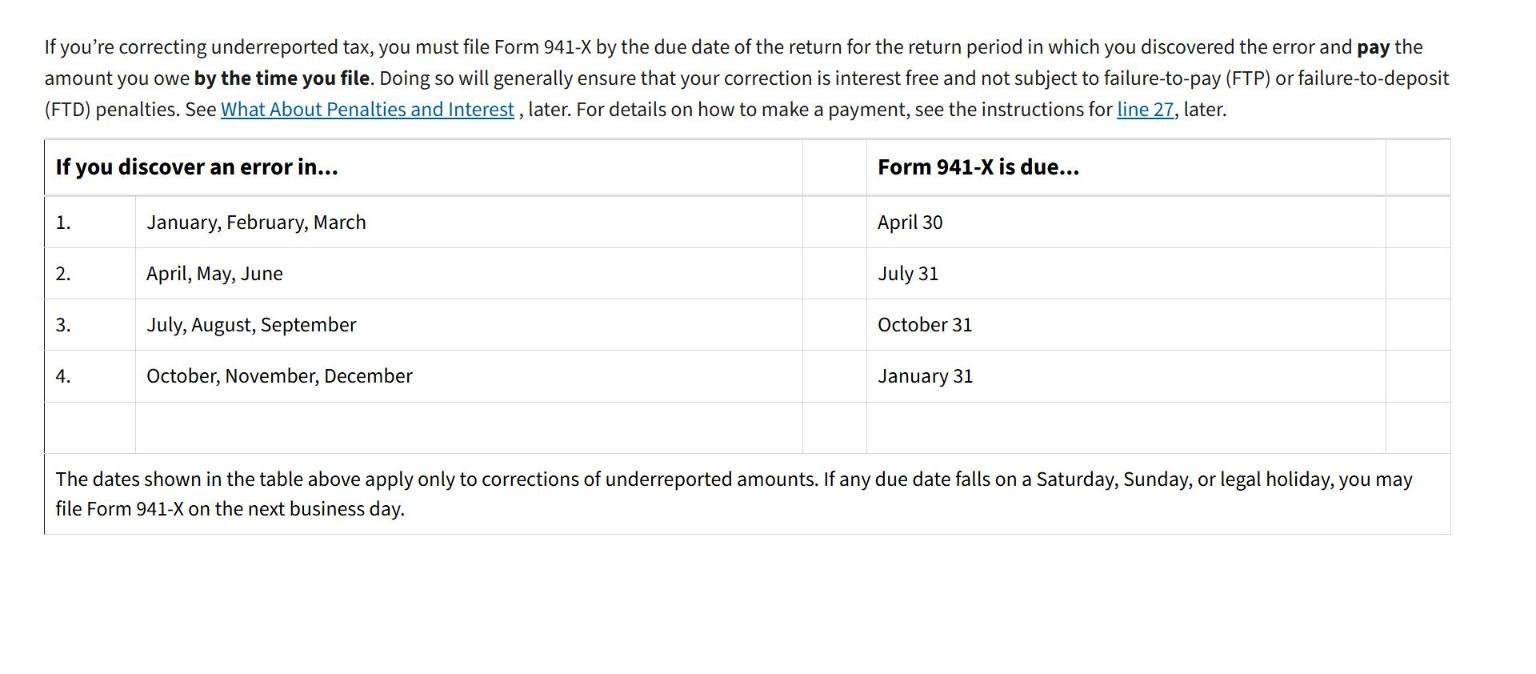
Interest-free treatment isn’t available if you knowingly underreported, the IRS has already sent a notice and demand for the tax, the issue came up in an IRS examination of a prior period, or you received a notice of determination under section 7436.
Overreported tax: the period of limitations
To correct overreported tax, you generally have until the later of 3 years from the date you filed the Form 941, or 2 years from the date you paid the tax. Underreported tax can be assessed for 3 years from filing.
There’s one quirk worth circling. Forms 941 for a calendar year that are filed before April 15 of the next year are treated as filed on April 15. So every 2023 quarterly return filed on time counts as filed April 15, 2024, and overpayment corrections for 2023 generally have to be filed by April 15, 2027, unless the 2-year-from-payment rule gives you longer. If you’re within 90 days of that date, you have to use the claim process.
Form 941-X instructions: how to file it, step by step
- Pin down the quarter and the error. Pull the original Form 941, payroll registers and any Forms W-2 that reflect the mistake. Our guide to how long to keep employee records covers which payroll files you should still have.
- Start one Form 941-X per quarter. Enter your EIN, the quarter and year being corrected, and the date you discovered the error.
- Part 1: choose line 1 or line 2. Adjustment for underpayments or credits, claim for refunds.
- Part 2: complete the certifications. If you overreported Social Security or Medicare tax, certify you’ve repaid or reimbursed employees, received their consent, or are adjusting only the employer share (lines 4 and 5).
- Part 3: enter the corrections. For each affected line, report the corrected total for all employees and the amount originally reported; the form works out the difference and the tax.
- Part 4: explain. Line 43 asks for a detailed explanation of each correction. Say what went wrong, which employees or pay dates it affected and how you fixed it.
- Sign, file and pay. If you owe, pay the line 27 balance when you file. You can e-file through Modernized e-File, or mail it to the address listed for your state.
- Fix the W-2s. When the correction changes reported wages, the instructions say you must also correct Form W-2 by filing Form W-2c.
Keep the employee statements and consents behind your certifications in your records. The instructions say not to send them to the IRS.
How Part 3 works: the four columns
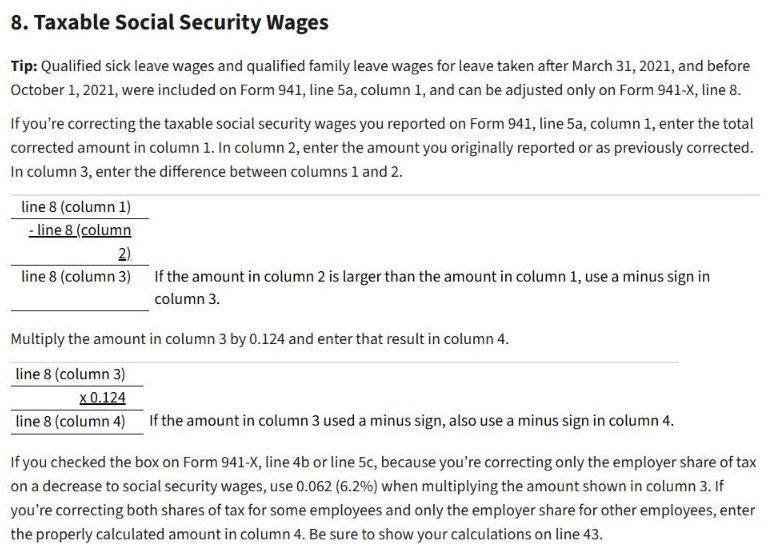
Every correction line in Part 3 uses the same four columns. Column 1 is the corrected total for all employees, not just the ones affected. Column 2 is what you originally reported, or the figure from an earlier correction. Column 3 is the difference, and column 4 turns that difference into tax:
| Line | What it corrects | Column 4 |
|---|---|---|
| 6 | Wages, tips and other compensation | No tax column; column 1 also feeds the annual totals on your Forms W-2 |
| 7 | Federal income tax withheld | Copy column 3, including any minus sign |
| 8 | Taxable Social Security wages | Column 3 x 0.124, or x 0.062 if you’re correcting only the employer share |
| 11 | Taxable Social Security tips | Column 3 x 0.124, or x 0.062 for the employer share only |
| 12 | Taxable Medicare wages and tips | Column 3 x 0.029, or x 0.0145 for the employer share only |
| 13 | Wages subject to Additional Medicare Tax withholding | Column 3 x 0.009 |
| 23 | Subtotal | Total of column 4 on lines 7 to 22 |
| 27 | Total | Line 23 plus lines 24 to 26c; a positive number is due when you file |
Two formatting rules trip people up. Negative amounts in columns 3 and 4 take a minus sign, not parentheses, unless your software requires them. And under the adjustment process, a negative total on line 27 isn’t refunded; the IRS Instructions for Form 941-X say it’s applied as a credit to your Form 941 or 944 for the period in which you file.
Part 2 certifications: repay, get consent, or fix the employer share
When you overreported Social Security or Medicare tax, part of that money came out of employees’ paychecks. The IRS won’t credit or refund the employee share unless you certify how you handled it:
- Line 4a (adjustment process): you repaid or reimbursed the employee share of current- and prior-year taxes and have written statements from the employees.
- Line 4b: the adjustment covers only the employer share, for employees you couldn’t find or who didn’t give you a statement.
- Line 4c: the overreported amount is tax you never withheld from employees.
- Lines 5a to 5d (claim process): the same choices for a refund claim, with line 5b covering employees who consented in writing to your claim for their share.
Statements and consents from former employees are slow to collect. If you can’t reach someone, you can still recover the employer share for that person and leave the employee share alone.
What a good line 43 explanation looks like
The IRS says Treasury regulations require you to explain in detail the grounds and facts behind each correction, and that a note like “administrative/payroll errors were discovered” isn’t enough and may delay processing. For each correction, the instructions ask for four things: the Form 941-X line numbers affected, the date you discovered the error, the difference and the cause. Here’s that level of detail, using the bonus example below:
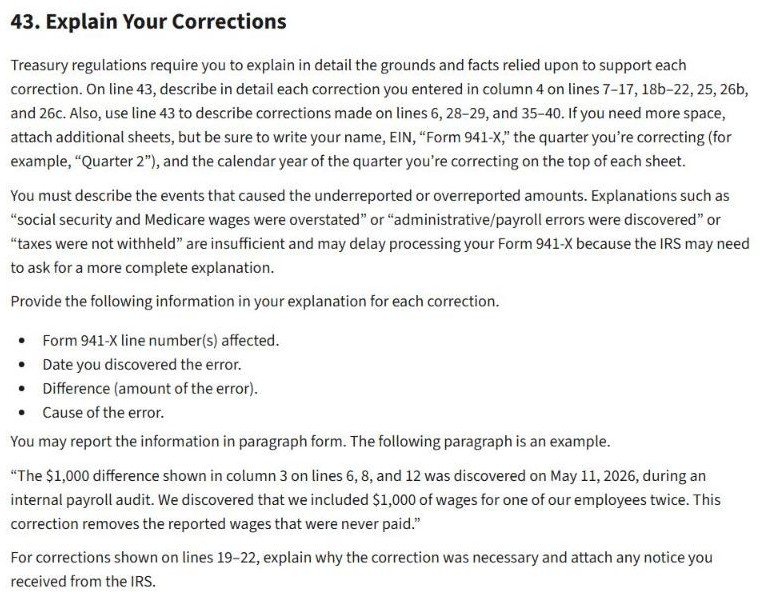
Lines 8 and 12: The $3,000 difference in column 3 is a bonus paid to one employee on
August 14, 2026 that was set up with the wrong earning code and left out of Social
Security and Medicare wages.
We found the error on November 9, 2026 during our quarterly payroll reconciliation.
The earning code is fixed, and the employee's 2026 Form W-2 will include the bonus.
That covers what was wrong, which pay date and employee it touched, when you found it and what you changed. Write one entry per corrected line, and keep the payroll reports that back it up.
Errors Form 941-X can’t fix
- Income tax actually withheld. You can’t file a refund claim for federal income tax or Additional Medicare Tax that was actually withheld from employees; that money belongs to them.
- Most prior-year income tax withholding errors. Only administrative errors, such as a transposed number or a math mistake, can be corrected for an earlier year.
- Old pandemic credits. The employee retention credit period of limitations for 2020 generally ended April 15, 2024, and for 2021, April 15, 2025. Under Public Law 119-21, credits for the third and fourth quarters of 2021 are barred unless claimed by January 31, 2024.
What changed in the April 2026 revision
The current Form 941-X carries three updates, per the IRS instructions checked November 12, 2026:
- Withholding on qualified tips and qualified overtime under Public Law 119-21, with limits on correcting prior-year withholding.
- Aggregate return filers have to identify themselves as a section 3504 agent, a certified professional employer organization or another third party.
- New limits and longer assessment periods for 2021 employee retention credit claims.
A worked example
Say a 12-person company finds in November 2026 that its payroll system left a $3,000 bonus paid in August 2026 out of Social Security and Medicare wages on its third-quarter Form 941. That’s underreported tax, so it’s an adjustment.
| Item | Calculation | Amount |
|---|---|---|
| Social Security tax (both halves) | $3,000 x 12.4% | $372.00 |
| Medicare tax (both halves) | $3,000 x 2.9% | $87.00 |
| Total underreported tax | $459.00 |
Because the error was discovered in November, the interest-free deadline is the due date of the fourth-quarter Form 941. January 31, 2027 is a Sunday, so that moves to Monday, February 1, 2027. Plan on filing the Form 941-X for the third quarter by then (Friday, January 29 leaves a cushion), check line 1 and pay the $459 when you file. This example is an illustration, not a real company.
On the form, line 8 shows corrected Social Security wages in column 1, the original figure in column 2, $3,000 in column 3 and $372.00 in column 4. Line 12 carries the same $3,000 difference and $87.00 of tax. If income tax withholding on the bonus was also wrong, line 7 would show that difference too. Lines 23 and 27 total $459.00, the amount due when you file.
5 common Form 941-X mistakes
- Attaching Form 941-X to the regular Form 941. File it separately; the narrow exception is certain worker-misclassification corrections on line 42.
- Correcting two quarters on one form. Each quarter needs its own Form 941-X.
- Missing the interest-free date. It’s tied to the quarter you found the error, not the quarter the error happened.
- Claiming a refund too late. Check the April 15 rule before assuming you have 3 years from the date you mailed the return.
- Forgetting the W-2c. A corrected Form 941 without corrected W-2s leaves the SSA and the IRS with numbers that don’t match.
If the error came from treating an employee as a contractor, read our guide to independent contractor vs. employee rules before you file, because the correction method differs.
Our Take / Expert Perspective
Our take: most Form 941-X filings are avoidable, and the cheapest ones are fast. The interest-free window rewards employers that reconcile payroll every quarter, because a mistake caught within the same quarter costs only the tax. One found two years later can cost interest, penalties and a W-2c run for every affected employee.
The 2026 calendar adds urgency in one spot. The April 15 rule means overpayments on 2023 returns, like Social Security tax collected past the wage base or benefits wrongly treated as taxable, generally expire on April 15, 2027. If you suspect you overpaid in 2023, that’s a five-month window, and anything inside 90 days of the deadline has to go through the slower claim process.
What to do now: before year-end, compare total wages on your four 2026 Forms 941 against your W-2 totals, and run the same check on 2023 while a refund is still possible. If something doesn’t match, file the Form 941-X now rather than in a busy February.
Well explained. Fix errors as soon as you find them. Filing Form 941-X by the due date for the quarter you found the error, and paying what you owe when you file, keeps an underpayment interest-free.
Reviewer’s note: Tina Faulk, HR Compliance Specialist
Frequently Asked Questions
What is Form 941-X used for?
It corrects errors on a Form 941 you already filed, such as wages, withheld income tax, Social Security and Medicare tax, or certain credits. You file one for each quarter you’re correcting.
Is there a deadline to file Form 941-X?
For underreported tax, file by the due date of the return for the quarter you discovered the error to avoid interest. For overreported tax, you generally have 3 years from the date the Form 941 was filed, or 2 years from when the tax was paid, whichever is later.
Can I e-file Form 941-X?
Yes. The IRS accepts Form 941-X through its Modernized e-File system, usually via payroll software or a tax professional. You can also mail it to the address for your state listed in the instructions.
Do I need to file Form W-2c with Form 941-X?
Usually. When a correction changes the wages you reported, the instructions say you must correct Form W-2 as well by filing Form W-2c, and line 3 asks you to certify that you filed or will file them.
What’s the difference between the adjustment and claim process?
The adjustment process fixes underpayments and turns overpayments into a credit on your current Form 941. The claim process is for overpayments only, when you want a refund or abatement.
Where do I mail Form 941-X?
It depends on the state of your legal residence or principal place of business. Employers in states such as New York, Florida and Illinois mail to Cincinnati, Ohio, while those in states such as California, Texas and Colorado mail to Ogden, Utah. Exempt organizations and government entities use the Ogden address wherever they are. Check the current list on the IRS website before you mail it.
This article is for general information only and is not tax, accounting or financial advice. Consult a licensed CPA or financial professional for your situation.
Sources
All sources (3)
- Internal Revenue Service: IRS Instructions for Form 941-X (Rev. April 2026), checked November 18, 2026
- Internal Revenue Service: Instructions for Form 944, checked November 18, 2026
- Internal Revenue Service: General Instructions for Forms W-2 and W-3, checked November 18, 2026
- aiandblog: more Tax articles and our Editorial Policy










Leave a Reply