

Last updated: November 21, 2026
Reviewed by Tina Faulk, HR Compliance Specialist, on November 27, 2026
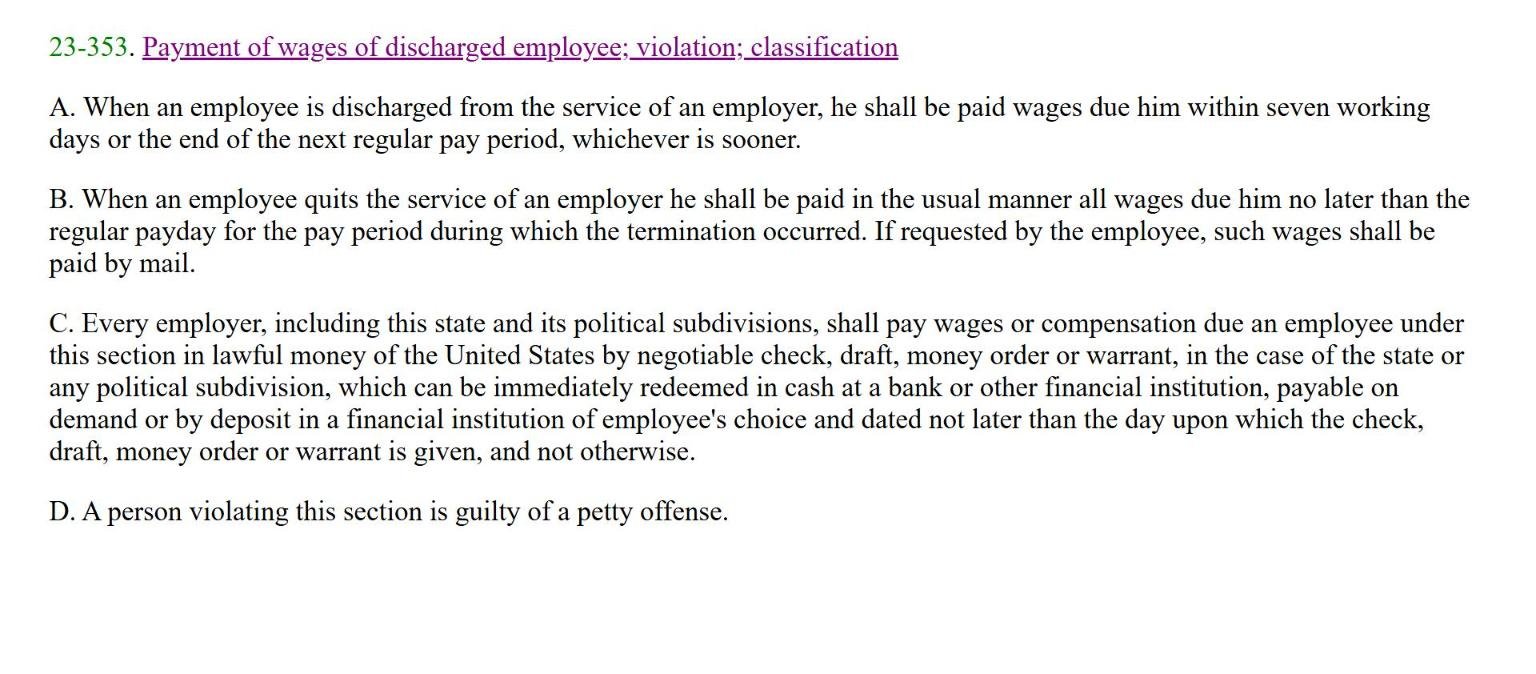
Arizona final paycheck law gives employers 7 working days after a firing, or less if the next pay period ends sooner, and treats a resignation like a normal payday. The deadlines are forgiving. The remedy isn’t: an employee who goes unpaid can sue for three times the wages owed. For other states, see our final paycheck laws by state table.
Short answer: Under A.R.S. 23-353, a fired employee must be paid within 7 working days or by the end of the next regular pay period, whichever comes first. An employee who quits is paid on the regular payday for that pay period. Unpaid wages can lead to a treble damages lawsuit or a state wage claim of up to $12,000.
Key takeaways
- Firing or layoff: pay within 7 working days or by the end of the next regular pay period, whichever is sooner.
- Resignation: pay on the regular payday for the pay period in which the employee left, by mail if they ask.
- Earned paid sick time doesn’t have to be paid out; vacation depends on your policy.
- Employees can sue for treble the unpaid wages under A.R.S. 23-355, though the court decides whether to award it.
- Wage claims with the Industrial Commission of Arizona are capped at $12,000 and must be filed within one year.
Table of Contents
Arizona final paycheck law at a glance
We checked each rule below against the Arizona Revised Statutes and the Industrial Commission of Arizona (ICA) on November 12, 2026.
| Situation | When final pay is due | Rule |
|---|---|---|
| Fired or laid off | Within 7 working days or the end of the next regular pay period, whichever is sooner | A.R.S. 23-353(A) |
| Employee quits | Regular payday for the pay period in which employment ended | A.R.S. 23-353(B) |
| Earned paid sick time | No payout required at separation | A.R.S. 23-372(F) |
| Accrued vacation | No statute requires it; depends on the employer’s policy | A.R.S. 23-350 |
| Late or unpaid wages | Employee can sue for treble damages | A.R.S. 23-355 |
| State wage claim | Up to $12,000, filed within one year | A.R.S. 23-356; ICA |
Federal law doesn’t set a deadline. The U.S. Department of Labor says federal law doesn’t require an immediate final paycheck, so Arizona’s rules apply.
Arizona final paycheck after a firing or layoff
A.R.S. 23-353(A) gives an employer that fires a worker until the earlier of two dates to pay the wages owed: seven working days later, or the end of the next regular pay period. Both halves of that sentence matter:
- Count working days, not calendar days. If an employee is let go on Monday, December 7, 2026, seven weekdays later is Wednesday, December 16, with no holidays in between.
- Check the pay calendar too. If your next regular pay period ends before that seventh working day, that earlier date is the deadline.
A layoff is a discharge for these purposes. When in doubt about which date comes first, pay at the earlier one; paying early never breaks the rule.
Arizona payday rules that set the final pay clock
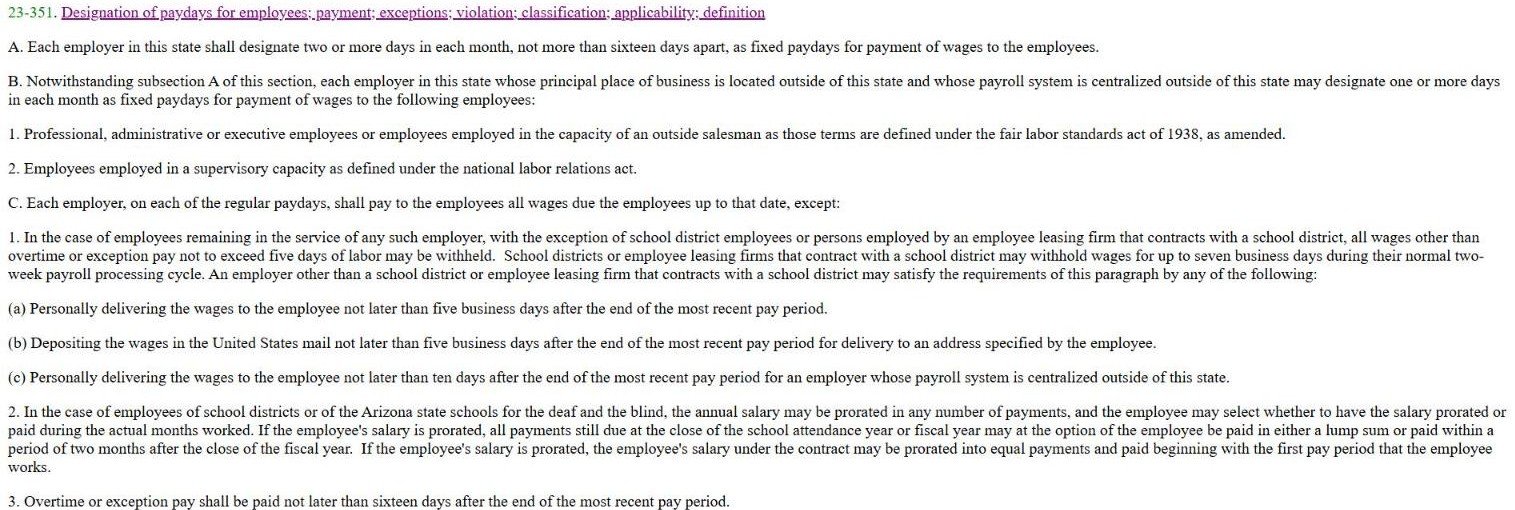
The “next regular pay period” in 23-353 depends on your pay schedule, and A.R.S. 23-351 sets the limits on that schedule:
- Two paydays a month, minimum. Employers designate two or more fixed paydays each month, no more than 16 days apart.
- A short lag is allowed. On each payday, pay all wages due up to that date, except that up to five days of labor can be held back. Delivering or mailing pay within five business days after the pay period ends satisfies that rule, or within ten days for an employer whose payroll is centralized outside Arizona.
- Overtime can trail. Overtime and exception pay can be paid up to 16 days after the end of the most recent pay period.
- Out-of-state payroll exception. Employers headquartered outside Arizona with centralized payroll may pay certain professional, administrative, executive, outside sales and supervisory employees once a month.
Breaking the payday statute is a petty offense of its own. For an Arizona final paycheck, the practical point is simple: the shorter your pay period, the sooner the end of the next one arrives, and the more often it beats the 7-working-day count.
Arizona final paycheck after a resignation
For employees who quit, 23-353(B) requires payment no later than the regular payday for the pay period in which the termination occurred. Payment follows your usual method, and the employee can ask to have it mailed.
That’s in line with Colorado and with Texas, which pays quitting employees on the next regularly scheduled payday, as our Texas final paycheck law guide explains. California is far stricter on resignations.
How an Arizona final paycheck can be paid
Arizona requires payment in lawful U.S. money. A check, draft or money order works if it can be cashed immediately at a bank or financial institution, and direct deposit into the employee’s chosen account is allowed. A violation of 23-353 is also a petty offense.
What counts as wages in an Arizona final paycheck
A.R.S. 23-350 counts as wages any nondiscretionary pay an employee has earned for work and reasonably expects to receive, however it’s calculated: by time, task, piece, commission or some other method. That definition decides what goes in the final paycheck:
- Earned commissions are wages. A commission that’s due under your plan belongs in the final pay.
- Discretionary pay falls outside. Our reading: a bonus written into an offer letter or plan as a formula is riskier to withhold than one left fully to management’s judgment, because the test is whether the employee reasonably expected it.
- Public employers are covered. The definition of employer includes the state, counties, cities, school districts and other political subdivisions.
Vacation and sick pay in an Arizona final paycheck
Arizona splits the two:
- Earned paid sick time. Arizona’s paid sick time law says nothing in it requires financial reimbursement for unused sick time when employment ends, under A.R.S. 23-372(F).
- Vacation. No Arizona statute requires a vacation payout. Under A.R.S. 23-350, wages are nondiscretionary compensation the employee has a reasonable expectation of receiving. Our reading: if your written policy promises a payout, a balance is likely owed as wages; if it clearly says unused vacation isn’t paid out, it’s likely not.
The ICA’s wage claim form lists vacation among the items an employee can claim, so a vague policy invites a claim. Spell out the rule in writing. Our guide to unlimited PTO covers how open-ended policies change the question.
Paid sick time at separation: caps, carryover and rehire
Arizona’s earned paid sick time law shapes what an employee walks away with, even though none of it is paid out:
| Rule | What the statute says | Source |
|---|---|---|
| Annual cap, 15 or more employees | Up to 40 hours a year may be earned and used; an employer can allow more | A.R.S. 23-372(A) |
| Annual cap, fewer than 15 employees | Up to 24 hours a year; an employer can allow more | A.R.S. 23-372(B) |
| Carryover | Hours not used roll into the next year, but the yearly caps still apply | A.R.S. 23-372(D)(4) |
| Payout at separation | Not required | A.R.S. 23-372(F) |
| Rehired within nine months | Unused hours earned before leaving come back | A.R.S. 23-372(D)(5) |
The rehire rule is the one offboarding checklists miss. Keep each departing employee’s sick time balance on file for at least nine months, so you can restore it if they come back.
Deductions from an Arizona final paycheck
Under A.R.S. 23-352, an employer can withhold wages only when:
- State or federal law requires or allows it.
- The employee gave written authorization in advance. If the employee revokes it in writing, the withholding stops, unless it’s settling a debt owed to the employer or a court orders otherwise.
- There’s a reasonable, good-faith dispute over the amount owed, including employer claims of debt, reimbursement or set-off.
Unreturned equipment isn’t on that list by itself. Get a written deduction authorization at hiring if you plan to recover property costs.
What happens if an Arizona final paycheck is late
| Path | What the employee can get | Limit |
|---|---|---|
| Lawsuit under A.R.S. 23-355 | Treble the amount of unpaid wages | Court action |
| Wage claim with the ICA Labor Department | Wages owed, such as unpaid bonuses or vacation pay, plus money taken through unauthorized deductions | Claims up to $12,000, filed within a year of when the wages accrued |
| Over $12,000 | The ICA sends these to the U.S. Department of Labor’s Wage and Hour Division or to a civil lawsuit |
The ICA cap rose from $5,000 to $12,000 under Senate Bill 1159, approved April 2, 2025. If you’re reading an older guide that says $5,000, it’s out of date.
The treble damages remedy is what makes Arizona expensive. A $2,000 final paycheck that goes unpaid can become a $6,000 claim, which is why the good-faith dispute exception matters: it protects a genuine disagreement over the amount, not a payroll backlog.
Are treble damages automatic in Arizona?
No. In D’Amico v. Structural I Co. (2012), the Arizona Court of Appeals held that treble damages under 23-355 aren’t mandatory and are left to the trial court’s discretion. Earlier cases cited in D’Amico shape how that discretion works:
- Good-faith disputes block treble damages. Courts have held the penalty shouldn’t be awarded when there’s a reasonable, good-faith dispute over the wages.
- Complex pay plans can create a genuine dispute. A real disagreement over a complicated compensation formula has supported a finding of good faith.
- No reason, real risk. When wages are withheld without a reason, courts have awarded treble damages.
Discretion isn’t a safe harbor. A court can still triple the award, and even when it doesn’t, you’ve paid to defend the case. The defensible position is a documented, specific reason for any amount you hold back, paid on time for everything else.
How an Arizona wage claim works
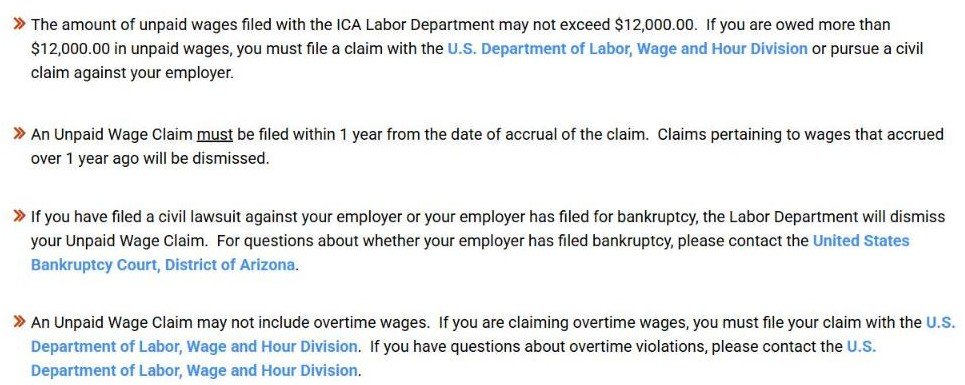
For an Arizona wage claim, the ICA’s unpaid wage claim form spells out what the state will and won’t handle:
- Covered: unpaid wages, bonuses, vacation, mileage, bounced paychecks and unauthorized deductions.
- Not covered: overtime, minimum wage complaints, earned paid sick time violations and retaliation claims, which go through other channels.
- Limits: up to $12,000, filed within one year of when the claim accrued.
- Dismissal triggers: the claim is dismissed if the employee has sued the employer or the employer has filed for bankruptcy.
Employees can file an Arizona wage claim through an e-sign form, by email, by fax or by mail to the Labor Department in Phoenix, and should include the employer’s legal name as it appears on a pay stub or tax form plus copies of evidence such as hours, pay rate and wages paid. For employers, expect a copy of the claim and the evidence, and note that the ICA says it can’t keep either confidential.
Arizona final paycheck checklist
- Record whether the separation is a discharge or a resignation.
- For a discharge, compare 7 working days with the end of the next regular pay period, and calendar the earlier date.
- For a resignation, schedule payment on the regular payday for the pay period in which the employee left.
- Apply your written vacation policy; don’t pay out earned paid sick time unless your policy says to.
- Withhold only what law, written authorization or a good-faith dispute allows.
- Pay in a form the employee can cash immediately, or by direct deposit, and mail it if they ask.
- If you dispute part of the amount, pay the undisputed part on time and write down the specific reason for the rest.
- Keep proof of the payment date and amount.
Our Take / Expert Perspective
Our take: under Arizona final paycheck law, the deadlines are reasonable, and the risk sits in the remedy. Seven working days is generous next to California’s same-day rule, explained in our California final paycheck law guide, but treble damages turn a small payroll miss into a claim worth fighting over.
The other pressure point is vacation. Arizona doesn’t require a payout, yet the wage definition rests on what the employee reasonably expected, and the ICA accepts vacation claims. Handbooks that say nothing about payout leave that question open, and an open question is how a $1,500 balance becomes a dispute.
The higher ICA cap helps both sides. More claims can now go through the state’s administrative process instead of court, which is faster and cheaper, and that’s also more claims employers will actually see. Forecast, not fact: a $12,000 cap covers most final paycheck disputes for hourly and mid-level salaried workers, so expect more of them to be filed.
What to do now: add one sentence to your handbook stating whether unused vacation is paid at separation, and set your offboarding checklist to pay discharged employees within 7 working days, every time.
Accurate on the 7-working-day rule after a firing. Check when the next regular pay period ends too, since the deadline is whichever comes sooner.
Reviewer’s note: Tina Faulk, HR Compliance Specialist
Frequently Asked Questions
How long does an employer have to give a final paycheck in Arizona if you quit or are fired?
For a discharge, within 7 working days or by the end of the next regular pay period, whichever is sooner. For a resignation, by the regular payday for the pay period in which the employee left.
Does Arizona require payout of unused vacation?
No statute requires it. Whether a balance is owed depends on your policy and whether the employee had a reasonable expectation of being paid it; earned paid sick time doesn’t have to be paid out.
What is the penalty for not paying a final paycheck in Arizona?
An employee can sue for treble the unpaid wages under A.R.S. 23-355, and the court decides whether to award the full amount. A violation of the final paycheck statute is also a petty offense.
How do I file a wage claim in Arizona?
Within one year, an employee can file an unpaid wage claim with the Labor Department of the Industrial Commission of Arizona. That office handles claims of up to $12,000; for larger amounts, it refers people to the U.S. Department of Labor or to a civil lawsuit.
Are treble damages automatic for a late final paycheck in Arizona?
No. The Arizona Court of Appeals held in 2012 that treble damages are up to the trial court, and courts have refused them when there’s a reasonable, good-faith dispute over the wages owed.
Can my employer hold my last paycheck until I return equipment?
Not on that basis alone. Arizona allows withholding only when the law allows it, when you authorized it in writing, or when there’s a reasonable good-faith dispute about the amount owed.
This article is for general information only and is not legal advice. Laws differ by state, province and country; consult a qualified attorney for your situation.
Sources
All sources (6)
- Arizona State Legislature: A.R.S. 23-353, A.R.S. 23-355, A.R.S. 23-352, A.R.S. 23-350 and A.R.S. 23-372, checked November 18, 2026
- Arizona State Legislature: A.R.S. 23-351 and A.R.S. 23-356, checked November 18, 2026
- Arizona Court of Appeals: D’Amico v. Structural I Co. (2012), via Justia, checked November 18, 2026
- Industrial Commission of Arizona: Unpaid Wage Claim Form, checked November 18, 2026
- Arizona State Legislature: Laws 2025, Chapter 38 (Senate Bill 1159), checked November 18, 2026
- U.S. Department of Labor: Last Paycheck, checked November 18, 2026
- aiandblog: more HR Compliance articles and our Editorial Policy







Leave a Reply